 Over at the Old Life Theological Society,
Darryl Hart questions Doug Wilson's label "R2K"
(radical two-kingdoms) when describing my view
and that of Westminster CA.
Check it out.
Over at the Old Life Theological Society, If you have been following Doug Wilson's posts on my book Dual Citizens, you will have noticed that the theme of dominion has come up quite a bit, especially among his commenters. The complaints usually go something like this: Genesis 1:28 talks about how Adam was to take dominion over creation, and yet Stellman's focus on the believer's identity as a pilgrim and exile fails to do justice to the dominion mandate given by God at creation."
You have made him a little lower than the angels and crowned him with glory and honor. You have given him dominion over the works of your hands; you have put all things under his feet... (vv. 5-6).
Now in putting everything in subjection to [man], [God] left nothing outside his control. At present, we do not yet see everything in subjection to him. But we see Him who for a little while was made lower than the angels, namely Jesus, crowned with glory and honor because of the suffering of death, so that by the grace of God he might taste death for everyone (vv. 8b-9).
Now it was not to angels that God subjected the world to come, of which we are speaking (v. 5).
 I'd like to take a moment to respond to a question that Doug Wilson has posed to me on his blog. He writes:
Stellman tags, as he ought to, the importing of worldly techniques of marketing, entertainment, and so forth into the broader contemporary world of evangelicalism. And I am right with him when he does this. But radical two kingdom theology has no problem with bringing worldly standards of science and academic history into the church, for example. Why is that?
When someone says that we need to take full account of what the old earth scientists say, or that we need to accept what professional historians say about the period of Second Temple Judaism, why does Stellman not reject this out of hand, on the simple ground that we are sojourners and pilgrims? If we don't need no stinkin' church marketers because our congregation is a mere band of wayfaring pilgrims, then does it not follow that we don't need no stinkin' geologists either?
 Chapter Two of Dual Citizens: Worship and Life Between the Already and the Not Yet is titled "The Irrelevance of Relevance: Grits, Salt, and the Assembling of the Saints." I begin the chapter by drawing a contrast between grits, the southern delicacy that has no taste of its own but instead takes on the flavor of what is added to it, and salt, the condiment that Jesus described as "good for nothing" if it loses the distinctness of its flavor. The purpose of this culinary observation is to show that the Christian church should be more like salt than like grits; in other words, instead of chameleonically changing our colors to adapt to the world around us, the church should seek to retain its distinctiveness and peculiarity in the culture.
Our sacred activity, such as hearing God’s Word and receiving the Lord’s Supper, therefore, is about as unique and countercultural as we can get, while our secular activity is just the opposite—it is thoroughly common. It is primarily on Sunday, therefore, rather than on Monday through Saturday, that believers display their peculiarity and distinctiveness from the world.
This means that the church’s main task, as simplistic as it may sound, is to be the church, to be, in the words of Stanley Hauerwas and William Willimon, “a new people, an alternative polis, a countercultural social structure.” They continue: “The church does not exist to ask what needs doing to keep the world running smoothly and then to motivate our people to go do it . . . The church has its own reason for being, hid within its own mandate and not found in the world. We are not chartered by the Emperor.” This does not mean that the church ceases to be influential, but that the church’s influence is of an altogether different—and often unwanted—variety. “[We] seek to influence the world by being the church, that is, by being something the world is not and never can be.”
 In case you're interested, the radio interview I did on New York's WNYG about Dual Citizens can be downloaded here.
 On the off-chance that any of you read both my blog and Doug Wilson's, you know by now that he is reviewing Dual Citizens. While I don't really have the time to interact with all of his commenters (nor the desire, to be honest), I did want to say a couple of things about his first post. The problem is that the blog requires an account in order to comment, and though I have submitted my information and am currently waiting for the pass code to be sent over email, I have yet to receive anything. So I will just say here what I would have said there. Here goes:
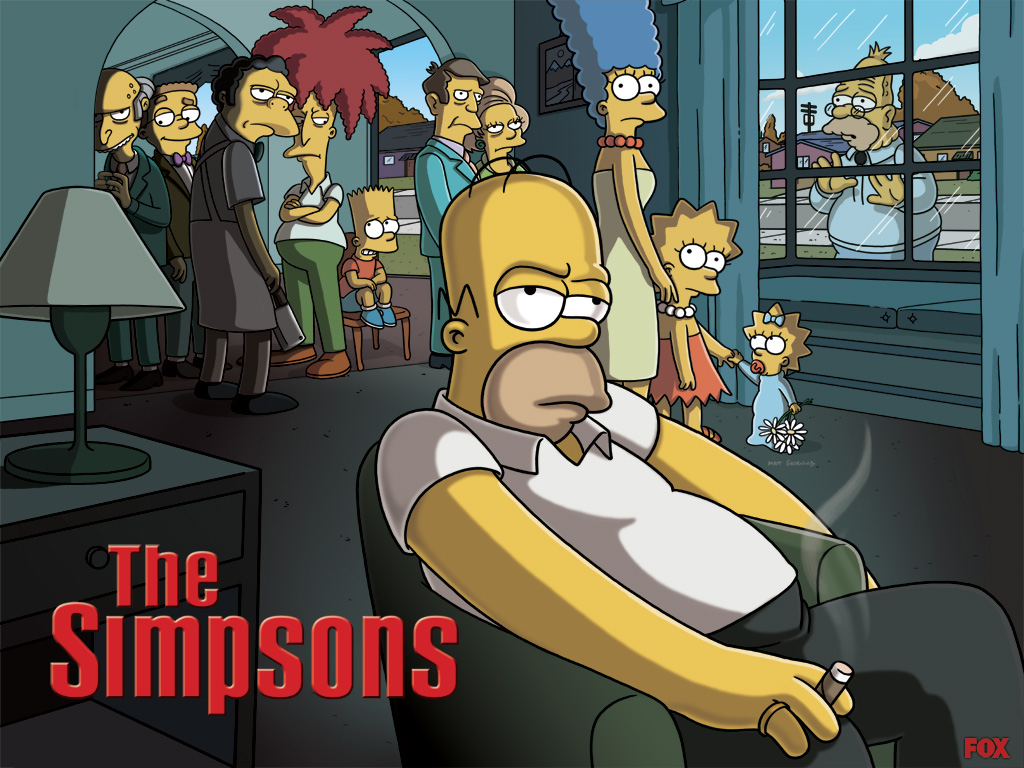 Last week I mentioned that I am reading David Dark's book Everyday Apocalypse, which surveys popular culture from Flannery O'Connor and the Coen brothers to Radiohead and The Matrix, seeking to recognize the ways in which the apocalyptic truths of the coming age creep into this one, even in ways unbeknownst to the artists themselves.
Unfortunately, the humility that is marked by a genuine readiness to know and acknowledge our own weaknesses and fears comes no more naturally to us than it does to the characters on The Simpsons. Yet without this humility of mind, no story, no art, and no apocalyptic can do its work on us. We walk through life unaffected, unmoved, and forever consigned to an invincible ignorance.
When viewed attentively, comedy like The Simpsons can awaken us to our disordered desires and motivations, breaking down our illusions of order, while holding back (temporarily) whatever false gods deceive us into regarding one another unkindly.
 The first section of Dual Citizens focuses on the corporate nature of the believer's life as a pilgrim caught in the overlap of the ages, with my attention being given primarily to the issue of the church's worship. Chapter 1 is called "Corporate Worship: Covenantal Assembly of a Peculiar People," and in it I state the chapter's aim thusly:
My aim in this chapter... is to call into question the American church’s desire to avoid the obscurity and lack of popular appeal with which Jesus Himself was seemingly plagued. In place of the flashy, high-octane worship experience, I will commend faithful attendance on the simple means of grace that Christ has instituted for His people’s growth, unremarkable though they may be.
 A quick point I'd like to bring to your attention:
 It occurred to me recently that as someone who has recently had a new book published, I'm not doing very much by way of promoting it (unless you count blogging about Dark's sacramental worldview and Newman's theory of doctrinal development, which I'm guessing you don't). So in the interest of reaching those of you who have yet to purchase Dual Citizens: Worship and Life Between the Already and the Not Yet, I will begin a brief walk-through of the book in the hopes that your interest will be piqued.
Let the reader always remember, however, that being a pilgrim means more than just being homeless. There is a final destination, an eternal city, a true theocracy that awaits all who have been baptized into Christ Jesus. In this heavenly abode, there will be no serpents to distrust or Canaanites to dispel, for "No longer will there be anything accursed, but the throne of God and of the Lamb will be in it, and his servants will worship him. They will see his face, and his name will be on their foreheads. And night will be no more. They will need no light of lamp or sun, for the Lord God will be their light, and they will reign forever and ever" (Rev. 22:3–5).
Do you long for this "building of God, a house not made with hands" (2 Cor. 5:1), compared to which the sufferings of this present time appear as mere trifles unworthy of mention? I hope that you do, for this is what it means to be a pilgrim.
 I just started reading David Dark’s book Everyday Apocalypse which, as far as I can tell, focuses on the various ways in which the dynamics of the future intrude into this present age. I say various ways because Dark has a much more sacramental view of the world than does your garden variety confessionalist (like me). For Dark, we experience spiritual realities not merely through the means of grace given to the visible church, but through the expressions of pop culture such as the music of Radiohead, TV shows like The Simpsons, and the stories of Flannery O’Connor.
The pictures and sounds and stories of apocalyptic expression are deliberately paradoxical in such a way that they tease the mind out of whatever old, self-justifying forms it has settled for.... Apocalyptic won’t flatter or privilege the powerful or congratulate us for our sincere intentions, but it will illuminate what is dark. It will passionately expose. It will make us see.
Apocalyptic was and is the only language adequate to describe this new beginning while maintaining its practice as one of constant exodus. It keeps religion strange and ready to question the given "reality" of the day. Without apocalyptic, no questioning occurs and the biblical voice is easily edited (or censored) to the point that it appears to support whatever sentimental sap or suburban self-improvement program it’s pasted upon.And on the farce of values-based entertainment:
We indulge a historical deafness when we think of the Jewish and Christian movements as the uncritical endorsers of whatever societal structures currently hold the population captive. It was Augustine, after all, who described earthly kingdoms as large-scale criminal syndicates.
Purposed domination [referring to Tolkien’s negative assessment of allegorical storytelling], we might say, is the method of propaganda. It leaves the audience with no room for "applicability," and the propagandist wouldn’t have it any other way. The tightly controlled "message," after all, was the point in the first place, not the dignity of the reader or the story (if we can even call it a story).... Given our current cultural climate, the media consumer does well to be wary of any product that has featured, foremost among its selling points, its so-called Christianness.... I’m personally convinced that such market-driven theology will be viewed, historically, with at least as much embarrassment as, say, the medieval sale of indulgences.Provocative stuff indeed—but is Dark right?
 In chapter 4 of his Essay on the Development of Christian Doctrine, John Henry Cardinal Newman takes up the issue of papal supremacy. Surprisingly, Newman argues that the papal office of Peter "would remain a mere letter, till the complication of ecclesiatical matters became the cause of ascertaining it." The universal jurisdiction of the first pope, in Newman's words, "slept." It was a "mysterious privilege, which was not understood, as an unfulfilled prophecy."
When the Church, then, was thrown upon her own resources, first local disturbances gave exercise to Bishops, and next ecumenical disturbances gave exercise to Popes; and whether communion with the Pope was necessary for Catholicity would not and could not be debated till a suspension of that communion had actually occurred. It is not a greater difficulty that St. Ignatius does not write to the Asian Greeks about Popes, than that St. Paul does not write to the Corinthians about Bishops. And it is a less difficulty that the Papal supremacy was not formally acknowledged in the second century, than that there was no formal acknowledgment on the part of the Church of the doctrine of the Holy Trinity till the fourth. No doctrine is defined till it is violated.
Far from being a universal body characterized by communion with the bishop of Rome, the early church was more decentralized, as Newman's citation of Barrow shows:
The state of the most primitive Church did not well admit such an universal sovereignty. For that did consist of small bodies incoherently situated, and scattered about in very distant places, and consequently unfit to be modelled into one political society, or to be governed by one head....
In fact, it was the exaltation of the church from the status of an illicit and persecuted religion to one of prominence and favor that precipitated the rise of the papacy:
If the Imperial Power checked the development of Councils, it availed also for keeping back the power of the Papacy. The Creed, the Canon, in like manner, both remained undefined. The Creed, the Canon, the Papacy, Ecumenical Councils, all began to form, as soon as the Empire relaxed its tyrannous oppression of the Church. And as it was natural that her monarchical power should display itself when the Empire became Christian, so was it natural also that further developments of that power should take place when that Empire fell.
This seems to coincide with Lampe's thesis in From Paul to Valentinus: Christians at Rome in the First Two Centuries that
The fractionation in Rome favored a collegial presbyterial system of governance and prevented for a long time, until the second half of the second century, the development of a monarchical episcopacy in the city.... Before the second half of the second century there was in Rome no monarchical episcopacy for the circles mutually bound in fellowship.
Some important questions arise (but are not begged) from Newman's position on the development of the papacy, not the least of which is: Is the view that the papacy developed consistent with Vatican I's statement that "We therefore teach and declare that, according to the testimony of the Gospel, the primacy of jurisdiction over the universal Church of God was immediately and directly promised and given to blessed Peter the Apostle by Christ the Lord" (a dogma that is called "a clear doctrine of Holy Scripture as it has been ever understood by the Catholic Church")?
Discuss....
 Just a few random things I'd like to bring to your attention....
 A member of my church just shared with me this story. It's about the journey of David Bazan, former Pedro the Lion frontman, from evangelical singer (with great crossover success among secular music fans) to agnostic. What struck me about this article was (1) the reactions of fans who recently saw him play the Crossroads Christian music festival after a five-year absence, and (2) Bazan's bitterness toward the evangelicalism of his youth and early adulthood.
 Anyone even remotely interested in historical theology will be familiar with John Henry Cardinal Newman’s Essay on the Development of Christian Doctrine, originally published in 1845. Newman’s overall thesis is that when it comes to just about any system of thought, the growth and development of its ideas are to be expected, and Christianity is no exception.
… the very scale on which they have been made, their high antiquity yet present promise, their gradual formation yet precision, their harmonious order, dispose the imagination most forcibly towards the belief that a teaching so consistent with itself, so well balanced, so young and so old, not obsolete after so many centuries, but vigorous and progressive still, is the very development contemplated in the Divine Scheme.
Now, it is undoubtedly true that each doctrine of the Christian faith has certain implications and tends toward certain conclusions. For someone like Newman, then, to seek to postulate an idea like papal infallibility he would certainly ground it in prior-held notions about divine revelation and the Church as pillar and ground of the truth. So although I may disagree with many of Newman’s conclusions, I still can recognize how he arrived at them.One furnishes evidence to another, and all to each of them; if this is proved, that becomes probable; if this and that are both probable, but for different reasons, each adds to the other its own probability. The Incarnation is the antecedent of the doctrine of Mediation, and the archetype both of the Sacramental principle and of the merits of Saints. From the doctrine of Mediation follow the Atonement, the Mass, the merits of Martyrs and Saints, their invocation and cultus. From the Sacramental principle come the Sacraments properly so called; the unity of the Church, and the Holy See as its type and centre; the authority of Councils; the sanctity of rites; the veneration of holy places, shrines, images, vessels, furniture, and vestments. Of the Sacraments, Baptism is developed into Confirmation on the one hand; into Penance, Purgatory, and Indulgences on the other; and the Eucharist into the Real Presence, adoration of the Host, Resurrection of the body, and the virtue of relics. Again, the doctrine of the Sacraments leads to the doctrine of Justification; Justification to that of Original Sin; Original Sin to the merit of Celibacy. Nor do these separate developments stand independent of each other, but by cross relations they are connected, and grow together while they grow from one….
You must accept the whole or reject the whole; attenuation does but enfeeble, and amputation mutilate. It is trifling to receive all but something which is as integral as any other portion; and, on the other hand, it is a solemn thing to accept any part, for, before you know where you are, you may be carried on by a stern logical necessity to accept the whole.
 In seeking to explain Paul's illustration of the son-as-heir in Galatians 4:1-7, Scott Hahn says that "Paul reintroduces the hard lessons of Galatians 3:19-25 in 4:2 by describing how Israel's sin increased the degree of Mosaic and angelic mediation," appealing to Paul's statement that the underage heir is under "guardians and trustees" until the time appointed by the father for his release frm such bondage. Hahn continues:
Israel's great failures at the golden calf and Beth-peor relegated it to the status of an immature minor son--differing little from that of a slave (4:1). As an immature minor son, Israel was placed under the (temporary) Levitical and Deuteronomic covenants that effected a reconfiguration of its filial relation to God along the lines of a treaty-type covenant. The relationship between God and Israel became characterized as that of a master and his slave (i.e., a suzerain and his vassal).
What Paul appears to be doing in using this "immature heir" image is making allowance for a situation where an heir, though long-since designated as such, endures for a time a period of suspension of all legal rights and only later receives the true legal capacity to inherit by having the status of sonship conferred....

But I withheld my hand and acted for the sake of my name, that it should not be profaned in the sight of the nations, in whose sight I had brought them out. Moreover, I swore to them in the wilderness that I would scatter them among thenations and disperse them through the countries, because they had not obeyed my rules, but had rejected my statutes and profaned my Sabbaths, and their eyes were set on their fathers’ idols. Moreover, I gave them statutes that were not good and rules by which they could not have life, and I defiled them through their very gifts in their offering up all their firstborn, that I might devastate them. I did it that they might know that I am the LORD (vv. 22-26).
For the law which the Lord spoke before the people had made the calf and served idols consists of the ten commandments and the judgments. But after they had served idols, He justly laid upon them bonds.... But our Savior came to set us loose from the bonds of the Second Legislation.
God himself personally spoke the Decalogue... that is why they remain valid for us.... But the precepts of slavery he laid separately upon the people through Moses.... When they turned aside to make the calf, they received further servile obligations, as Ezekiel says [citing 20:25].


