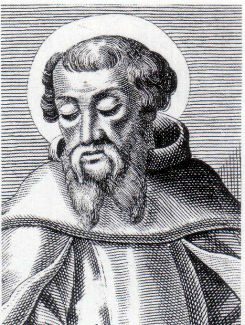
Thus, and for these reasons, by the vote of the whole people, not in the evil fashion which has since prevailed, nor by means of bloodshed and oppression, but in an apostolic and spiritual manner, he is led up to the throne of Saint Mark, to succeed him in piety, no less than in office; in the latter indeed at a great distance from him, in the former, which is the genuine right of succession, following him closely. For unity in doctrine deserves unity in office; and a rival teacher sets up a rival throne; the one is a successor in reality, the other but in name. For it is not the intruder, but he whose rights are intruded upon, who is the successor, not the lawbreaker, but the lawfully appointed, not the man of contrary opinions, but the man of the same faith; if this is not what we mean by successor, he succeeds in the same sense as disease to health, darkness to light, storm to calm, and frenzy to sound sense. NPNF2: Vol. VII, Oration XXI - On the Great Athanasius, bishop of Alexandria, §8.
Sunday, July 05, 2009
Abraham's True Sons, Alexandria's True Bishops
Wednesday, June 24, 2009
Apostles and Early Fathers: Who Were the Real Morons?
Wednesday, November 19, 2008
Determining the Degree of our Debt to the Dead
Indeed, argues Clark, it is indicative of a "Reformed Narcissism" to ignore or dismiss our debt to the past. Yet this debt to the dead notwithstanding, there is a "gulf fixed" between us and such luminaries as Anselm, Aquinas, Lombard, Bradwardine, Gregory of Rimini, Staupitz, and Wycliffe: The Protestant Reformation.
Though we embrace many of the same doctrines as our medieval forebears, we also embrace the conviction that sinners are justified only on the ground of the righteousness of Christ imputed to us and received through faith alone, a theological insight learned from Luther, Calvin, and Reformed orthodoxy, not from the fathers or the medieval theologians (emphasis added).I can hear a couple objections echoing from the Papist Peanut Gallery that I would like to raise and discuss. First, is Protestant soteriology really a "genuine theological novum" as McGrath is often quoted as saying and as Clark seems to concede? Secondly (and more profoundly), is the Protestant penchant for picking and choosing which bits of the fathers' teachings we embrace (accepting the Trinity but denying historical apostolicity, for example) not an example of the very Naricissim that we decry in evangelicalism?
In short, how ought we confessional Protestants to determine the degree of our debt to the dead?
Thursday, September 11, 2008
Apostolicam Ecclesiam: Tertullian vs. Turretin on the Church's Apostolicity
Wednesday, September 10, 2008
Catholicam Ecclesiam: Cyril vs. Turretin on the Church's Catholicity
First, Cyril of Jerusalem:
“And if ever you are sojourning in cities, inquire not simply where the Lord’s House is (for the other sects of the profane also attempt to call their own dens houses of the Lord), nor merely where the Church is, but where is the Catholic Church. For this is the peculiar name of this Holy Church, the mother of us all.”
And Francis Turretin:
“If to be called catholic is a mark of the church, this arises from God; but the Scripture is entirely silent about it. Or it arises from opponents; but they are not our judges. Or it arises from their own people; but what right have they to assume for a mark the name which they ascribe to themselves, since heretics are accustomed to set up in front of themselves specious names? … If the fathers formerly distinguished the orthodox from heretics by the name catholic, they did this… on account of the catholic and orthodox doctrine that they held…. Cyril teaches that ‘the church is called Catholic because it teaches fully and unfailingly all the doctrines which ought to be brought to men’s knowledge.’”
The issue here is not whether a church's catholicity is a matter of doctrine or not (for it surely is). The issue, rather, is whether it is by a church's doctrine alone that such a determination is to be made, or whether other factors, like pedigree and universality, are to be taken into account.
Well...?
Tuesday, September 09, 2008
Sanctam Ecclesiam: Clement vs. Calvin on the Church’s Holiness
"When the Church points to sanctity as one of her notes, it is manifest that what is meant is a sanctity of such a kind as excludes the supposition of any natural origin. The holiness which marks the Church should correspond to the holiness of its Founder, of the Spirit Who dwells within it, of the graces bestowed upon it. A quality such as this may well serve to distinguish the true Church from counterfeits. It is not without reason that the Church of Rome claims to be holy in this sense. Her holiness appears in the doctrine which she teaches, in the worship she offers to God, in the fruits which she brings forth."
OK, opine away....
Sunday, September 07, 2008
Unam Ecclesiam: Irenaeus vs. Turretin on the Church's Unity
Four points have been raised in the comments by Andrew McCallum concerning how we should read the early fathers. First, it is just as erroneous for the Catholic to insist that “If Protestants would just read the fathers they’d become Catholic” as it is for Protestants to insist that “If Catholics would just read the Bible they’d become Protestant.” The fathers must be read with an eye both to their philosophical and cultural milieu and their interpretive framework.
Secondly, we need to address the fact that, to the Protestant, it seems like the fathers are interpreted by Catholics anachronistically from the standpoint of contemporary Catholic dogma. In the light of the Catholic being bound by his Church’s interpretation of the fathers, how can reading them lead to anything but a fait accompli?
Thirdly, we need to discuss what exactly the fathers believed about their own authority. Did Clement or Polycarp believe they were writing with infallible authority? To the Protestant it appears that the Catholic Church’s insistence that the fathers, as interpreted by the Church, are infallible is a classic example of begging the question. Whether or not the fathers expected to be read as infallible is precisely the issue to be proven or disproven, not taken as an a priori.
Lastly, the Catholic must demonstrate that his position is in fact falsifiable. Is it possible that the Catholic claim to authority can turn out to be wrong? And if so, how would we know?
That said, please weigh in on these two representative statements about the church’s unity, keeping in mind these larger interpretive issues.
Friday, September 05, 2008
Clement and Augustine on Apostolic Succession
Friday, October 26, 2007
Scripture and the Church: The Dual-Source Theory of Infallible Authority
Mathison argues that in the first few centuries of church history one finds no hint of a two-source theory of inspired revelation. With Augustine and Basil, however, the idea that church tradition is co-equal with Scripture is first broached, and though it is debatable whether these men actually held to a dual-source theory, they would eventually be claimed by Rome as the initial proponents of what became official church dogma at Trent - the ex cathedra declarations of the Roman Catholic Church are, along with Scripture, infallible and authoritative.
If only....
I wish it were this easy. If Jesus had left behind an inspired and infallible individual, office, or institution that could just tell us exactly and perfectly what the Bible says concerning every possible issue, then we could all stop fighting, we could all attain visible unity, and we could all hold hands and sing "It's a Small World After All."
Maybe it's just me, but if the way most Catholics and evangelicals frame the debate were actually correct, and our only two options were Tradition 2 or hyper-individualism, I'd bypass Wheaton for Rome in a heartbeat.
The weaknesses of this position are easy enough to list, but what are its strengths?
Sunday, July 09, 2006
Early Christian Exiles
"For the Christians dwell in their own countries, but simply as sojourners. As citizens, they share in all things with others, and yet endure all things as if foreigners. Every foreign land is to them as their native country, and every land of their birth as a land of strangers. They are in the flesh, but they do not live after the flesh. They pass their days on earth, but they are citizens of heaven.
"They love all men, and are persecuted by all. They are unknown and condemned; they are put to death, and restored to life. They are poor, yet make many rich; they are in lack of all things, and yet abound in all; they are dishonoured, and yet in their very dishonour are glorified. They are evil spoken of, and yet are justified; they are reviled, and bless; they are insulted, and repay the insult with honour; they do good, yet are punished as evil-doers. When punished, they rejoice as if quickened into life; they are assailed by the Jews as foreign-ers, and are persecuted by the Greeks; yet those who hate them are unable to assign any reason for their hatred."
This glimpse into the pre-Constantinian church is a challenge to the triumphalistic attitudes of many today who are fond of (mis)quoting II Chronicles 7:14 to remind God of his "covenant promises" to prosper America.
If the Church were to slip even more deeply into cultural obscurity, if the people of God were made to pay a price for our faith, if believers were forced to relinquish our utopian visions of a this-worldly country "reclaimed for Christ" -- in a word, if we set our eyes upon the eternal City whose Builder and Maker is God, only then will we begin to understand the pilgrim existence that our brothers and sisters of old endured.
Thursday, July 06, 2006
Incest and Atheism, Cannibalism and Christianity
Such were the common descriptions of the early Christians by their nonbelieving contemporaries. Apparently their insistence upon marrying only brothers and sisters in the faith, their rejection of the Caesar cult of Rome, and their practice of eating the body and drinking the blood of their Leader effectively squelched whatever attempts the primitive church made to appear "relevant" to the world around them.
Add to this the fact that most of the early Christians were martyred, and any present-day delusions of ecclesiastical grandeur and cultural conquest quickly appear to smack more of good ol' American self-confidence than of realistic, vintage Christianity.
From our language to our calendars, from our past history to our future hope, there's just no way around it: Christians are weird.
How should we feel about this? Should we be ashamed, or should we embrace our weirdness?