Showing posts with label Sacramental Worldview. Show all posts

Sunday, September 20, 2009

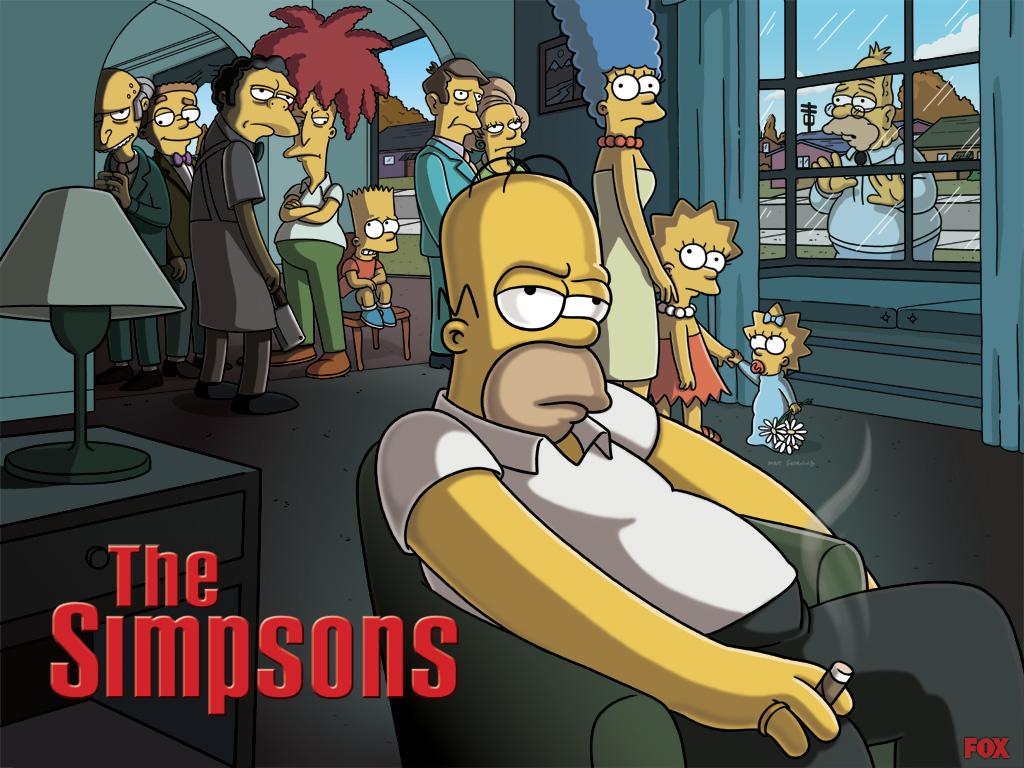
Are There Somber Calvinists in Springfield?

Last week I mentioned that I am reading David Dark's book Everyday Apocalypse, which surveys popular culture from Flannery O'Connor and the Coen brothers to Radiohead and The Matrix, seeking to recognize the ways in which the apocalyptic truths of the coming age creep into this one, even in ways unbeknownst to the artists themselves.

While Dark, so far anyway, refrains from calling all of life sacramental, he has no love for the sacred/secular distinction that two-kingdoms proponents insist upon. To be fair, though, he doesn't seem like he is all that aware of the doctrine of the two kingdoms, so who's to say he wouldn't appreciate it for its love of earth and it hatred of all things Gnostic?

In his chapter on The Simpsons he writes:

Unfortunately, the humility that is marked by a genuine readiness to know and acknowledge our own weaknesses and fears comes no more naturally to us than it does to the characters on The Simpsons. Yet without this humility of mind, no story, no art, and no apocalyptic can do its work on us. We walk through life unaffected, unmoved, and forever consigned to an invincible ignorance.

When viewed attentively, comedy like The Simpsons can awaken us to our disordered desires and motivations, breaking down our illusions of order, while holding back (temporarily) whatever false gods deceive us into regarding one another unkindly.
He then quotes Jean Bethke Elshtain: "We are not perched on top of the earth as sovereigns; rather, we are invited into companionship with the earth as the torn and paradoxical creatures that we are."

To put this all more simply, we shouldn't take ourselves so seriously. As long as we are expending all our energy seeking to maintain the facade we have created for ourselves to hide behind, we will be incapable of being made fun of. And once we reach the point of resentment when the mask is pulled back, we have become immune to all things apocalyptic.

I'm reminded of what the late Rich Mullins said about how he would rather live on the verge of radical sin than to maintain some Pharisaical fortress mentality that cannot admit weakness for fear of the bubble being burst.

Like it or not, this is the reputation we Calvinists have. Is it fairly attributed to us? And if not, is there anything we can do to dispel the myth?

Thursday, September 10, 2009

Apocalypse Now?

I just started reading David Dark’s book Everyday Apocalypse which, as far as I can tell, focuses on the various ways in which the dynamics of the future intrude into this present age. I say various ways because Dark has a much more sacramental view of the world than does your garden variety confessionalist (like me). For Dark, we experience spiritual realities not merely through the means of grace given to the visible church, but through the expressions of pop culture such as the music of Radiohead, TV shows like The Simpsons, and the stories of Flannery O’Connor.

A two-kingdoms guy he certainly is not, but still, he does seem to scratch where I itch.

Some excerpts on the nature of truly apocalyptic art:

The pictures and sounds and stories of apocalyptic expression are deliberately paradoxical in such a way that they tease the mind out of whatever old, self-justifying forms it has settled for.... Apocalyptic won’t flatter or privilege the powerful or congratulate us for our sincere intentions, but it will illuminate what is dark. It will passionately expose. It will make us see.
On the subversiveness of the apocalyptic:

Apocalyptic was and is the only language adequate to describe this new beginning while maintaining its practice as one of constant exodus. It keeps religion strange and ready to question the given "reality" of the day. Without apocalyptic, no questioning occurs and the biblical voice is easily edited (or censored) to the point that it appears to support whatever sentimental sap or suburban self-improvement program it’s pasted upon.

We indulge a historical deafness when we think of the Jewish and Christian movements as the uncritical endorsers of whatever societal structures currently hold the population captive. It was Augustine, after all, who described earthly kingdoms as large-scale criminal syndicates.
And on the farce of values-based entertainment:

Purposed domination [referring to Tolkien’s negative assessment of allegorical storytelling], we might say, is the method of propaganda. It leaves the audience with no room for "applicability," and the propagandist wouldn’t have it any other way. The tightly controlled "message," after all, was the point in the first place, not the dignity of the reader or the story (if we can even call it a story).... Given our current cultural climate, the media consumer does well to be wary of any product that has featured, foremost among its selling points, its so-called Christianness.... I’m personally convinced that such market-driven theology will be viewed, historically, with at least as much embarrassment as, say, the medieval sale of indulgences.
Provocative stuff indeed—but is Dark right?

Monday, July 13, 2009

Pierced by a Freeway

Speaking of sacramental worldviews, perhaps no one does a better job of beholding nature through the lens of spiritual reality that Bono himself. In the song "Heartland" from 1988's Rattle and Hum, he sings about the Mississippi River using the metaphor of a woman, and then goes on to sing:

She feels like water in my hand;
Freeway, like a river, cuts through this land
Into the side of love, like a burning spear.

Just like Rich Mullins refers to an open road as "a woman made from a rib cut from the sides of these mountiains, these great sleeping Adams," so Bono sees Route 66 as cutting through America like the spear that pierced the Savior's side, out of which a river of blood and water flowed.

I'll have what he's having....

Thursday, July 09, 2009

Lonely Mountains, Sleeping Adams, Dancing Angels, and the Color Green

I had a great conversation over cigars and stout with my good pal Armando on Wednesday, and we were discussing the way men like Chesterton, Bono, Rich Mullins, C.S. Lewis, and others wrote about God's involvement in the world (I have been told by my Catholic friends that these men have a "sacramental worldview," which I sort of understand, but not really). Anyway, they bring to the table a kind of richness and appreciation of God's immanence that cannot but stir one's heart, especially when you're just not used to that sort of thing.

I have written here before of Chesterton's view that apple blossoms produce apples not from the mere laws of nature but through magic, and that rivers flow downstream because they're enchanted, so I'll not repeat that stuff again. But consider these words of the late Rich Mullins from "The Color Green":

And the moon is a sliver of silver
Like a shaving that fell on the floor
Of a Carpenter's shop.
And every house must have its Builder;
And I awoke in the house of God.

Where the windows are mornings and evenings,
Sretched from the sun, across the sky,
North to south.
And on my way to early meeting
I heard the rocks crying out,
I heard the rocks crying out:

"Be praised for all your tenderness
By these works of Your hands!
Songs that rise, and rains that fall
To bless and bring to life your land!
Look down upon this winter wheat
And be glad that You have made
Blue for the sky, and the color green
That fills these fields with praise!"
Elsewhere Mullins fuses heavenly imagery with that of earth thusly:

And the work trucks come running
With their bellies full of coal,
And their big wheels humming
Down this road that lies open
Like the soul of the woman
Who hid the spies who were looking
For the land of the milk and the honey.

And this road, she is a woman;
She was made from a rib
Cut from the sides of these mounains,
O these great sleeping Adams who are
Lonely, even here in paradise;
Lonely for somebody to kiss them.
(If by God's grace I ever pen lines even remotely comparable to these, I will die a happy man.)

Sometimes I wonder what a man like Rich Mullins saw when he closed his eyes and meditated upon God, and the beauty and fieceness of his majesty. Whether he's singing about "angels dancing on Jacob's stairs" as "the moon moves past Nebraska, spilling laughter on those cold Dakota hills," or how God "takes by its corners this whole world and shakes us bored, and shakes us free," there was a depth (a simple depth actually, if you'll forgive the oxymoron) to his faith that I, for one, am trying to recover in my own life.

It is my conviction that, whether through a sacramental wordview or, even better, by means of a two-kingdoms theology whereby earth is legitimized, the greater our love is for this world, the greater will be our love for the God who made it.

Monday, June 08, 2009

On Misfits and Grandmothers

As I pointed out in an earlier post, many of the writers I have been reading over the past several years (Tolkien, Chesterton, Lewis) had such a unique outlook on the world, one characterized by a humility and wonder that is somewhat lacking in my own theological circles. One of you commented, suggest-ing that these men had a sacramental worldview. When I admitted that I have no idea what that means, another of you directed me to the short stories of Flannery O'Connor as an example of what a sacramental worldview looks like. So, off I went to purchase said volume.

I read a couple of O'Connor's lesser-known stories (one of which involved a boy dressing up as a gorilla for some reason I have yet to ascertain), but was then directed by a church member to read A Good Man Is Hard to Find, which I did yesterday (who, me unteachable?).

I admit, it is a disturbing story to say the least (though how it demonstrates a sacramental worldview I am unsure). The most interesting line is one of the very last, which is uttered by an escaped convict known as "The Misfit." After his cohorts murder a family of four, the only family member still alive is "the Grandmother," who has been engaging The Misfit in conversation, insisting that he is "not common," and indeed "good." She then reaches out to touch him, whereupon he recoils as if bitten by a snake, shoots her three times in the chest, and says:

"She would of been a good woman, if it had been somebody there to shoot her every minute of her life."
Hmmm....

Is the point that O'Connor's Misfit is making that we need to be faced with fear and threat before we will truly demonstrate decency, that real virtue is produced in the crucible of danger?

Is Miss Flannery's Catholic skirt showing?