Showing posts with label Christian Culture. Show all posts

Monday, November 30, 2009

There's No "I" in Worship

I made a statement in my morning sermon yesterday that struck some people as unsettling, but I plan to stick by it unless I can be shown to be wrong:

Worship, according to the New Testament, is an almost exclusively corporate, rather than individual, phenomenon.

Take for example what is arguably the locus classicus on the topic of worship: Jesus’ interaction with the Samaritan woman in John 4 (in which the word “worship” is used no less than ten times). If we try to substitute the contemporary understanding of worship for what our Lord and the woman are talking about, the dialogue makes little sense. Worship, in the parlance of our times, usually refers either to singing songs specifically, or more generally to whatever goosebumpy, “Hallmark Moments” our private devotions happen to yield. But what Jew or Samaritan in antiquity, if they were in their right minds, would have argued that one’s personal quiet times needed to take place on a mountaintop either in Jerusalem or Samaria? The very fact that the initial argument between Jesus and the Samaritan woman focused on the where of worship demonstrates that it was not private devotions that were being discussed since, as everyone knows, those can take place anywhere.

Even the well-known passage Romans 12:1, in which Paul speaks of “our spiritual worship” cannot be taken to denote individual private worship. The apostle urges the Romans to offer their bodies (plural) as a living sacrifice (singular), and he then launches into a discussion of the one body and its many members, thus indicating that the Romans’ spiritual worship was that which they offered in covenantal assembly.

And then when we add all the “let us draw near” passages of Hebrews, we arrive at a picture of worship that is corporate, collective, and covenantal.

This is not deny the Reformed categories of individual, family, and corporate worship. But in our day and age, characterized as it is by the atomization of society, it is the corporate nature of worship that needs to be drilled into the heads and hearts of God’s people.

That’s all I’m saying….

Thursday, September 10, 2009

Apocalypse Now?

I just started reading David Dark’s book Everyday Apocalypse which, as far as I can tell, focuses on the various ways in which the dynamics of the future intrude into this present age. I say various ways because Dark has a much more sacramental view of the world than does your garden variety confessionalist (like me). For Dark, we experience spiritual realities not merely through the means of grace given to the visible church, but through the expressions of pop culture such as the music of Radiohead, TV shows like The Simpsons, and the stories of Flannery O’Connor.

A two-kingdoms guy he certainly is not, but still, he does seem to scratch where I itch.

Some excerpts on the nature of truly apocalyptic art:

The pictures and sounds and stories of apocalyptic expression are deliberately paradoxical in such a way that they tease the mind out of whatever old, self-justifying forms it has settled for.... Apocalyptic won’t flatter or privilege the powerful or congratulate us for our sincere intentions, but it will illuminate what is dark. It will passionately expose. It will make us see.
On the subversiveness of the apocalyptic:

Apocalyptic was and is the only language adequate to describe this new beginning while maintaining its practice as one of constant exodus. It keeps religion strange and ready to question the given "reality" of the day. Without apocalyptic, no questioning occurs and the biblical voice is easily edited (or censored) to the point that it appears to support whatever sentimental sap or suburban self-improvement program it’s pasted upon.

We indulge a historical deafness when we think of the Jewish and Christian movements as the uncritical endorsers of whatever societal structures currently hold the population captive. It was Augustine, after all, who described earthly kingdoms as large-scale criminal syndicates.
And on the farce of values-based entertainment:

Purposed domination [referring to Tolkien’s negative assessment of allegorical storytelling], we might say, is the method of propaganda. It leaves the audience with no room for "applicability," and the propagandist wouldn’t have it any other way. The tightly controlled "message," after all, was the point in the first place, not the dignity of the reader or the story (if we can even call it a story).... Given our current cultural climate, the media consumer does well to be wary of any product that has featured, foremost among its selling points, its so-called Christianness.... I’m personally convinced that such market-driven theology will be viewed, historically, with at least as much embarrassment as, say, the medieval sale of indulgences.
Provocative stuff indeed—but is Dark right?

Tuesday, September 01, 2009

Breaking Up With Jesus

A member of my church just shared with me this story. It's about the journey of David Bazan, former Pedro the Lion frontman, from evangelical singer (with great crossover success among secular music fans) to agnostic. What struck me about this article was (1) the reactions of fans who recently saw him play the Crossroads Christian music festival after a five-year absence, and (2) Bazan's bitterness toward the evangelicalism of his youth and early adulthood.

I can't help but wonder if a healthy theology of the cross, chased with a couple shots of amillennialism, could have helped mitigate the tragedy? Or was there nothing any of us could have done?

Friday, July 24, 2009

Catholics: Heartier Partiers?

Speaking of the Protestant Reformation's crushing of the "creative activity" of the Middle Ages, author Tom Hodgkinson writes (with tongue in cheek):

The Puritan Revolution began to introduce boredom to the masses. Even religion and the path to salvation became boring. In the Middle Ages, religion had been full of blood and gore and death. Churches were centres of economic activity and partying as well as of worship. The Church was a patron of the arts and commissioned local craftsmen to make adornments for its properties. The sermons were attended largely for their entertainment value; they provided real theatre. In medieval Florence, people would queue all night to see a great preacher and then stream out of the church after the service, weeping copiously. All this drama and theatre was removed by the Puritans, who labelled the ways of the old Church "superstition" and "idolatry." In other words, all the pagan fun of the Catholic Church, which it had wisely kept, was taken away.
(I quote Hodgkinson here not because I necessarily agree with him, but because he has a knack for being really amusing, even as he offends just about everyone equally.)

This idea that Catholics are better partiers is perhaps what lay behind Sean P. Dailey's article titled "The Lost Art of Catholic Drinking," in which the author argues that the thing that distinguishes Catholic from Protestant drinking is not necessarily quantity, but control. Citing Chesterton's insistence that the way we thank God for wine is by not drinking too much of it, Dailey says that Catholics can steer the middle course between abstinence and excess that Protestants just can't seem to navigate.

(Oh, and another thing that distinguishes the two methods of imbibement is Hilaire Belloc's insistence that Catholics never drink any beverages that don't predate the Reformation [which supposedly limits their choices to beer and wine]. I suppose this would make The Wire's Jimmy McNulty's dismissing of Bushmills as "Protestant Whiskey" somewhat tautological (he prefers Jameson). Of course, legend does tell us that St. Patrick himself introduced the art of distilling to the Irish in the fifth century. But I digress.)

What's my point, you ask? Umm, I'm not sure I really have one, unless it's that with respect to the enjoyment of beverages, perhaps confessional Protestants are closer to Rome than they are to Saddleback after all. Not exactly a giant leap toward ecumenism or anything, but it's a start.

Wednesday, July 22, 2009

The Big Apple Versus The Growers of Big Apples

Always the provocateur, Darryl Hart has written an interesting piece for Front Porch Republic titled "If Cooking Slowly and Growing Organically are In, Why Is Rural Ministry Out?" In it, Hart highlights the irony that amid all our praise of Slow Food and organic food production, our attitude toward ministry is one area in which we are still unabashed city folk.

Signs are not encour-aging ... that the growing concern among evangelical Protestants about the environment is having any effect on their church’s estimation of the people who work on farms and live near them. A recent story in Christianity Today on Tim Keller, a popular Presbyterian pastor in New York City, suggests that for all the desires that evangelicals have to be cutting edge and socially aware, a ministry accessible to the rhythms of farming and local communities does not qualify as hip. The story fawns over Keller for his ability to carve out a multiple-congregation structure in the Big Apple, for a theology of the city that says cites are where redemption happens, and for the model of ministry he exhibits to a crop of younger pastors who aspire to make an impact.

According to the news story, “New York attracts the best and the most ambitious.” Keller senses this and ministers accordingly. He told the reporter, “Suppose you are the best violist in Tupelo, Mississippi. You go to Manhattan, and when you get out of the subway, you hear a beggar playing, and he’s better than you are.” One of Keller’s former colleagues puts Keller’s understanding of ministering in the city this way: “Paul had this sense of, I really should go talk to Caesar. He’s not above caring for Onesimus the slave, but somebody should go to talk to Caesar. When you go to New York, that’s what you’re doing. Somebody should talk to the editorial committee of The New York Times; somebody should talk to Barnard, to Columbia. Somebody should talk to Wall Street.”
(No offense intended to the violinists of Tupelo, I'm sure. I mean, you're from Mississippi, for crying out loud! Surely you didn't expect to best the Big Apple's beggars, didja? Know your place, is what I'm saying.)

Perhaps lurking behind this infatuation with The City (yes, I capitalized it on purpose), Hart suggests, is the desire to "elevate one's status by hobnobbing with the influential" coupled with a "born-again infatuation with celebrity." Then, when you factor in evangelicalism's absolute fear of the ordinary, you've got a perfect recipe (ahem) for the kind of elitism that sees the inexperience of young ministers as disqualifying them for urban church planting while not standing in the way of their ministering to simple farm folk (at least until they graduate from fly-over country to the corridors of power).

Evangelicals are disposed to understand grace and faith in extraordinary categories and so overlook stories of ordinary believers, routine piety, and even rural congregations as insignficant. Discontent with the average and routine aspects of natural life and of grace appears to breed a similar dissatisfaction with humble ministries in places of little interest to the editors of the Times.
I've said it before and I'll say it again: The appreciation for the ordinary that amillennialism produces is as difficult to reconcile with postmillennial transformationism as faith is with sight, and as the cross is with glory.

Saturday, May 30, 2009

"No One Told You It Was Gonna Be This Way...."

We've got a wide variety of readers here at DRD, so I'm hoping some of you can clear up a mystery for me.

Reformed people think they're on the same team with Lutherans, but Lutherans won't even offer the bread and cup to the Reformed. Anglicans often speak of themselves as non-Protestants more akin to Catholics, but Catholics don't understand themselves to be in communion with Anglicans. And it seems that Lutherans think of themselves as being much more Catholic than Calvinistic/Re-formed, while from the vantage point of Rome we're pretty much a gaggle of individualists.

What gives?

Tuesday, May 26, 2009

Elves in Geneva, Fairies in Heidelberg

In G.K. Chesterton's chapter "The Ethics of Elfland" in Orthodoxy, he writes:

All the terms used in the science books (such as law, necessity, order, tendency, and so on) are really unintellectual, because they assume an inner synthesis, which we do not possess. The only words that ever satisfied me as describing Nature are the terms used in the fairy-books: charm, spell, enchantment. They express the arbitrariness of the fact and its mystery. A tree grows fruit because it is a magic tree. Water runs downhill because it is bewitched.
We may smile at the quaintness of Chesterton's sentiments here (though he wouldn't, and neither would he call them "sentiments"), but the fact is that there is an element of wonder, humility, and childlikeness that characterizes Chesterton's writings, as well as that of others like him such as Lewis and Tolkien.

And none of them were Calvinists.

Now, Chesterton was fond of Geneva-bashing, insisting, for example, the the great hymn-writer William Cowper suffered his melancholic bouts of depression as a result of his belief in predest-ination. Of course, it is difficult to know exactly what Chesterton had in mind when he spoke of "Calvinistic determinists," and something tells me it wasn't John Calvin himself, but more likely his late nineteenth-century proponents.

But straw man arguments aside, one has to ask why it is that of all the Christian authors who tend to display the kind of refreshing wonder that Chesterton did, very few are of the Reformed or Presbyterian persuasion.

I, for one, wouldn't mind letting a little bit of Elfland into Geneva, assuming the former would deign to darken the latter's door.

Monday, November 17, 2008

The Pioneer Children of the Corn

**Disclaimer** In this post I am poking some fun at the Vision Forum, but I want to make clear that I in no way begrudge them their right to seek to restore what they consider to be a proper understanding of boyhood and girlhood. What I am questioning is their romanticizing of various periods of American history that were characterized by racism and xenophobia. Also, I am troubled by their linking of their stated principles with the Protestant Reformation. So if you like the Vision Forum and will be offended by its being challenged in a semi-jocular manner, then you may want to stop reading at this point....

I don't how how it started, but I occasionally get these catalogues in the mail from the Vision Forum which, as far as I can tell, is an organization whose aim is to harken the Christian family back to the good ol' days when Ma would milk Betsy so's we chillins could churn us up some fresh butter. Or better yet, we could just have our slave do it while we white folk can go down to the courthouse and carve the Ten Commandments into its hallowed walls.

I realize I'm being a tad melodram-atic, but only a tad. Some of the items for sale in the latest Vision Forum catalogue include civil war uniforms, Crusades-era knight costumes with swords and shields to "defend our sisters as protectors of womankind," and for the more contemporary warrior, various modern soldiery parephernalia that looks like the stuff issued to the new recruits at Blackwater U.S.A. right before they're shipped off to Baghdad to protect the interests of Halliburton. Did I say that out loud? I meant "America."

Is it me, or is this stuff seriously spooky?

Don't get me wrong, I love to rock a coonskin cap and hunt Injuns as much as the next red-blooded American boy, but equating the carefree and fun-loving days when we (white, male, land-owning) Americans were realizing our manifest destiny with the Protestant Reformation, well, that's a bit much.

Sunday, July 20, 2008

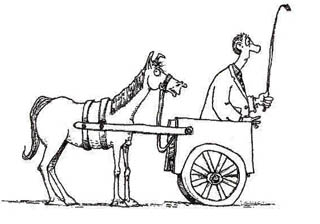
Of Style and Dogma, Carts and Horses

In Mark 7:1-23 we gain some subtle insight into the relationship between outward religious rituals (lex orandi) and the beliefs of those who practice them (lex credendi). After highlighting the extrabiblical nature of the Pharisees' demand that people scupulously wash themselves before eating bread (vv. 6-13), Jesus then gets to the heart of the matter:

And he called the people to him again and said to them, "Hear me, all of you, and understand: There is nothing outside a person that by going into him can defile him, but the things that come out of a person are what defile him" (vv. 14-16).
Why the abstract lesson on sin? Wasn't the issue supposed to be the amount of hygiene necessary to eat a sandwich?

Well if, as I have been arguing, a church's worship shapes its member's beliefs every bit as profoundly as its beliefs shape its worship, then Jesus' excursus on indwelling sin may not be as random as it initially appears.

You see, what certainly seems like a harmless religious ritual (ceremonially washing one's hands before eating) had clearly led to a deficient view of sin. In other words, the Pharisees' lex orandi (law of worship) had adversely affected their lex credendi (law of belief). Because they had for so many years been seeking to lessen their defilement by scrubbing their hands every few minutes, they had begun to think of defilement as primarily outward and circumstantial rather than inward and substantial.

Here's how this works in the church today: A church's leaders begin with the question, "What style of music should we have?" They decide that in order to reach the youth, they had better scrap the piano in favor of an acoustic guitar. They quickly realize that certain songs aren't easy to play on a guitar ("A Mighty Fortress"), while others are ("As the Deer"). Before long, the church's worship style (mellow acoustic music) defines its content (songs with a mellow acoustic feel). And then lo! and behold!, a movement is spawned that sees Jesus as that friendly guy at Woodstock with some real groovy spiritual insight.

But then, the Emergent Church has rescued us from the Jesus Movement, and I, for one, am thankful that none of these concerns can be applied to them....

Tuesday, July 15, 2008

Lex Orandi, Lex Credendi

Liturgical scholars often insist that a church's worship is a direct by-product of what they believe about God. If a particular congregation's leadership considers God to be a kind of magic genie whose job is to do our bidding, then their worship will most likely be narcissistic and consumer-driven. And conversely, if a church understands God to be the sovereign King of the universe, then an atmosphere of reverence and awe will prevail.

At least, so the theory goes.

Unfortunately, this is only half the story. As indicated by the historic slogan lex orandi, lex credendi (literally, "The rule of prayer influences the rule of belief"), the relationship between confession and worship, dogma and liturgy, cuts both ways. In other words, it's not simply the case that a church's worship is the result of her beliefs about God, but it is equally true that her beliefs about God are largely shaped by the way she worships.

History bears this out. Well before the church's Christology assumed its mature, Chalcedonian definition believers were already worshiping a God who subsisted in three divine Persons. Both Augustine and Prosper of Auquitatine appealed to the church's practice of infant baptism in order to refute the Pelagian heresy that children are born without original sin. They were saying, in effect, "If infants are innocent, then why have we been baptizing them all this time?" In Prosper's own words: "Legem credendi lex statuat supplicandi" ("Let the law of prayer establish the law of belief").

If it is true that worship shapes belief as significantly as belief shapes worship, then the ramifications are pretty serious for those churches—whether evangelical or Reformed—that insist on making style a leading factor in how they conduct divine worship. Whether their aim is to woo the unchurched or demonstrate their "relevance" to those coveted artsy-fartsy soul-patched bohemians, the ever-present danger is that Jesus will be transformed from Deus homo into some guyliner-wearing dude in an indy band hoping to land a record deal.

Luther was right, the church will sing its way into idolatry long before its dogmaticians join the party.

Tuesday, May 27, 2008

Aristocratic Missionalism

The second of Niebuhr's five options regarding the relationship of Christ to culture is dubbed "The Christ of Culture." This position, Niebuhr argues, is adopted by those who hail Jesus as the Messiah of their society, and has been represented by the early Gnostics, Abelard, John Locke, Immanuel Kant, Thomas Jefferson, and the various "culture-Protestants" who have dominated the religious scene since the eighteenth century.

Advocates of "The Christ of Culture" are to be congratulated, Niebuhr maintains, for making Jesus appear less alien than he does in the "Christ Against Culture" mindset.
"The cultural Christians tend to speak to the cultured among the despisers of religion.... They are missionaries to the aristocracy and the middle class, or to the groups rising to power in a civilization. "
The main difficulty with this view, argues Niebuhr, is that its watered-down flavor is so diluted that it fails to win the respect of true pagans or the truly pious. Carson remarks that:
"[Pagan writers] suspect that what is to them a compromised position will weaken the purity of their paganism, or of their liberalism, or of their Marxism—just as, from the other side, the orthodox suspect that these cultural Christians have sacrificed too much of what is essential to Christianity. "
From where I sit, I see a disturbingly fair amount of this "aristocratic missionalism" in my own circles. The main difference, though, is that the much-coveted prize is not so much the respect of politicians or scientists as it was in Niebuhr’s day, but the props of the bohemian, soul-patched Gen X-er (the well-inked Gen Y-er works, too, but he doesn’t tithe).

The way this plays out in the contemporary scene is in our obsession with "the arts" and "the city," and our palpable disinterest in anything that likes NASCAR, wears a blue collar, and rocks a John Deere cap unironically.

In biblical terms, these are the same people who would have bragged to Jesus about how impressively ornate their temple was, right before he pronounced that not one of its edgy, postmodern stones would be left upon another.

Tuesday, May 01, 2007

Whose Kingdom? Whose Glory?

John McWhorter, in his book Doing Our Own Thing: The Degradation of Language and Music, and Why We Should, Like, Care, argues that the day of oratory and rhetorical skill is all but over. Jesus’ disciples would probably have agreed after hearing his less-than-rousing speech following his "triumphant" entry into Jerusalem (on a donkey).

After years of insisting that "My hour has not yet come," our Lord finally declared, "The hour has come for the Son of man to be glorified" (John 12:23). At long last, the majesty would be restored to languishing Israel, and her preeminence among the nations would once again be apparent. The crowd was primed for revolt, and a mere call to arms from their Messiah surely would have resulted in a great military exploit to overthrow Rome and put their King in his rightful place.

What they got, however, was a cryptic illustration about a seed needing to die in order to grow, and then a bunch of morbid stuff about losing their lives and carrying crosses (vv. 24-26). "What could this possibly have to do with the kingdom?" the scribes, Pharisees, and proto-Dispensationalists must have been asking.

And we’re still asking. The American church wants glory, relevance, and her "best life now." The cross may have been fine for Jesus to die on, but not us (we have our inalienable rights, you know).

So here's my question: Is it a "theology of glory" to expect the American church to surrender its "theology of glory"?

Saturday, April 28, 2007

Every Underdog Will Have Its Day

I have been preaching a series of sermons at Exile Presbyterian Church entitled "Thy Kingdom Come" for the last four months or so, and surprisingly (at least to me), one of the most important of these sermons was the one about Noah and the ark.

The kingdom of God had come to be identified with one man and his family, with the rest of the earth being filled with violence and wickedness. When the cause of God was that dire, and the kingdom that threatened, Noah's hope was placed not in the transformation of "the world that then existed," but in the new creation that would emerge in the postdilluvian world (II Pet. 3:6). In fact, since Peter holds Noah and his generation up as the pattern for us and ours (II Pet. 3:1ff), and since Jesus explicitly points to "the days of Noah" as indicative of the end (Matt. 24:37), it seems rather obvious what this means for our faith:

Christianity will always be an underdog religion. In fact, it works better that way.

But the problem with this hypothesis should be obvious: We Americans are not used to being in the minority, and when it comes to being underdogs, we're just plain bad at it. Hence the American church's desire to craft a faith that is relevant and beneficial to the culture around us (some people actually say, out loud, that if a church is doing its job, the community should thank them for their presence).

Is all of this sentiment the result of actual exegesis, or is it merely an example of our confusing the "power" and "wealth" of the earthly kingdom with that of the heavenly? Or to put it differently, if few bothered to thank Jesus for stopping by, can we expect better without shirking the cross in the process?

Sunday, May 07, 2006

Form and Content, Medium and Message

Marshall McLuhan has famously stated that "the medium is the message." This means that it is not only the content of what we say that speaks to people, but the form which our message takes screams every bit as loudly.

As social critic Ken Myers has written, "The assumption that all forms are neutral is not itself a neutral assumption." In other words, the idea that as long as the message of the Bible is preached, it makes little difference what types of media are used to convey that message, is a uniquely post-Enlightenment position with which hardly anyone in the first 1500 years of Church history would have agreed.

I could provide an obvious example involving, say, "Fairest Lord Jesus" sung to the tune of "I Stab People" by the Insane Clown Posse, but for the sake of bringing the point a little closer to home, take the issue of informal dress (of which most informal churches are quick to assure us when we visit their websites). It is undeniable that there is a connection between the anti-authoritarian assumptions of post-sixties Americans and the resistance of many of today's evangelicals to dress as nicely for church as they do for work. In the "wardrobe wars," it seems, God can't hold a candle to Mammon.

A better example could be provided from Paul's argument to the Corinthians that their desire for the Christian message to be presented with such power and eloquence that it would seem impressive in the eyes of men is utterly inconsistent with the nature of that message. If the gospel is all about the weakness and foolishness of the cross, then to present it in glitzy packaging is rather inconsistent. Like trying to hold water in a sieve or communicate the Pythagorean Theorem using smoke signals, the content simply can't be conveyed using that form.

Is it possible that, in our insistence upon the supposed neutrality of the media which carry our message, we have allowed our cultural convictions to shape our conventions, thus rendering our churches expressions of our cultural disorder, rather than remedies for it?

Monday, May 01, 2006

Pop Culture, Folk Culture

What do the advocates of "contextualization" mean exactly by that term?

Yeah, yeah, I know: We're supposed to communicate in terms that the culture can actually understand. But everyone agrees with that (at least in theory). Beyond the obvious, though, what should churches do in order to be contextual?

It is here that a crucial distinction comes into play: pop vs. folk culture.

Many seem to presuppose that pop culture sets the terms of the discussion, and then the Christian church must conform. So, since Boomers in our culture want a relaxed worship experience in which they can hear Beach Boys style music surrounded by people in leis and hula skirts, we should give them that. After all, as long as the message is good, the form it takes doesn't matter, right? Welcome to Margaritaville Community Church!

But pop culture is a pretty recent concept (until the invention of analog tape and the subsequent ability to mass-market and mass-produce it, pop culture didn't have a leg to stand on).

Christianity, however, has always been a folk culture. We are a "peculiar people" with a calendar, language, and history that are unique and distinct from the world's (with some overlap, of course). So rather than asking, "How many X-Boxes will our children's ministry need to have a large, successful church?" we should be asking, "What, according to the Bible's folk culture, should our children's ministry look like?"

When we ask the right question, we find (to our contemporary culture's horror) that it is biblical for kids to worship together with their parents from as early an age possible, and that dividing the body of Christ by age or musical tastes is an incredibly American thing to do.

But isn't insisting that families forget their own personal tastes and worship together "irrelevant" in today's society?

Maybe. But when a society's popular culture is out of accord with the Bible's folk culture, it is the former, and not the latter, that is the truly irrelevant one.

Sunday, April 09, 2006

More Bad Slogans

I'll exercise some self-control and skip over "God Is My Co-Pilot"; it's just so laughable that it hardly deserves comment....

But one cliche that is particularly bad -- though rarely recognized as such -- recently came to my mind when I was preparing to teach on the seventh chapter of Hebrews:

"Christians aren't perfect, just forgiven."

Now try to stick with me here, as this argument is rather eschatological in nature. The whole problem with the Levitical priesthood, according to this chapter, is that it could not bring about perfection in its worshipers. In other words, Old Covenant saints gained a measure of forgiveness by means of the Levitical law, but that law was "useless" in bestowing the perfection that its subjects needed. This is why another priest was needed who would minister according to another order than that of Aaron.

By contrast, the Melchizedekian priesthood of our great high priest, Jesus Christ, not only offers us forgiveness, but more importantly, perfection. Sure, we haven't actually received this perfection in full measure yet, but regardless, we are completely qualified to enter the Holiest by the blood of the Perfect One, Jesus Christ, who is both priest and sacrifice.

So the bumper sticker should read thus:

"Old Testament Saints Weren't Perfect, Just Forgiven."

But in its current form, this popular slogan betrays a drastically under-realized eschatology.

Sunday, March 12, 2006

The Cross, Glory, and 80's "Christian" Rock

If you had the privilege of being a Christian in the 1980's, and if you found most of that era's Christian rock deplorable (with the possible exception of the Altar Boys), then my guess is that there were two "secular" bands that you desperately tried to convince yourself were actually Christian in order to appease your conscience.

Those bands were U2 and The Alarm.

As an avid fan of both, I remember it being easier to make the case for The Alarm's Christianity than for U2's. After all, they were so blatant, confident, and outspoken about their faith. They sang things like, "When the nails are biting into your hands, and the cross is heavy on your heart, now's the time to really make a stand," or in their ode to the devil they sang, "You are the Deceiver, you are not welcome in my life, and I will break your hold."

U2 on the other hand? Well, they were somewhat less convincing: "You broke the bonds and You loosed the chains, carried the cross and all my shame... but yes, I'm still running. For I still haven't found what I'm looking for." Not exactly the confidence I was hoping for. Or consider this line: "Yea, though I walk through the valley of the shadow, yet I will fear no evil. I have cursed Thy rod and staff, they no longer comfort me. Love, rescue me."

And remember, this was before the 90's when Bono left his Father's kingdom "by the back door, and threw away the key."

But looking back now from a more mature and educated perspective, my diagnosis has flip-flopped. Having come to understand Luther's distinction between the "theology of glory" and the "theology of the cross," it would appear that the spiritual doubts expressed by Bono were never doubts about God's existence or his ability to save, but doubts about his own ability to hang on to God's hand: "I try to stand up, but I can't find my feet. I try to speak up, but only in You I'm complete." Bono has never thought very highly of his own Christianity, but he certainly thinks highly of the Christ in whom he has professed faith for the last 25 years.

In short, I think the music of The Alarm and U2 furnish us with a perfect illustration of the difference between the theologies of glory and the cross, respectively.

And what's more, since the theology of glory is more consistent with postmillennial eschatology while the theology of the cross is more consistent with amillennialism, it is only fitting that a Two Kingdoms advocate such as I would still be a die-hard U2 fan after all these years.

The Alarm's still great, but my own sinfulness requires that I be reminded every few days that "Grace... travels outside of Karma."

And thank God....

Friday, March 10, 2006

The Plight of the Christian Artist

I have a good friend who is a strong believer and an award-winning artist. We recently had an interesting conversation which I'd like to recount to you:

Me: "How's life in the art world?"
Him: "Man, it is so hard to be a Christian in the art world!"
Me: "Why, what's hard about it?"
Him: "Well for one thing, these people's politics are very left wing, almost socialist."
Me: "What does that have to do with being a Christian in the art world?"
Him: "Well, my views are at the other end of the political spectrum from theirs, which makes life difficult."
Me: "What if you were a European Christian artist, and your politics were more in line with your colleagues', would it still be as difficult?"
Him: "No, that would make things much easier!"
Me: "OK, then are you sure your point is that it's difficult to be a Christian in the art world, or that it's difficult to be a Republican in the art world?"

As the conversation continued, we both came to the conclusion that Christianity and conservative politics are often (wittingly or unwittingly) equated, with the Church being portayed -- by us and by the media -- as the GOP on its knees.

I ask, then: Is it a good thing that we convey this image? Why or why not?

Wednesday, March 08, 2006

"... A Dark, Godless, Liberal Place...."

Thus the Northwest is described by many people who hail from other parts of these United States.

What I find curious, however, is the (seemingly-related) string of adjectives in this common description:

1. Dark: True, it's pretty gloomy here, both spiritually and meteorologically.

2. Godless: Well, if you take into account the fact that church attendance here is the lowest in the nation, with 25% of people claiming no religious affiliation whatsoever, I can see the merit in this description.

3. Liberal: No doubt about it; Washington, along with most coastal States, is blue and left-of-center.

But it's interesting to note that, in the thinking of those who describe the Evergreen State in this way, these three characteristics naturally go together. In other words, to be "liberal" is to be "Godless," and to be "Godless" is to be "liberal."

Doesn't this line of reasoning beg the question by presupposing, first, that there is a distinctively Christian political theory, and secondly, that this political theory is suspicious of government aid to the poor and disenfranchised, gun control, and strong concern for the environment?

Hmmm... and I thought the Bible was supposed to be a chronicle of the fall, redemption, and consummation of the cosmos, not a political science textbook.

But then, I could be wrong....