Showing posts with label James. Show all posts

Monday, April 20, 2009

Is Romans 2 Good or Bad News?

As I pointed out in my post last Wednesday, the standard Catholic position with respect to Paul and James on the relationship of works to justification states that, while man can never bring God into his debt or earn any reward from him, he nonetheless may (and must) perform Spirit-wrought good works in order to be saved. Romans 2:6-13 is often quoted in favor of this view:

He will render to each one according to his works: to those who by patience in well-doing seek for glory and honor and immortality, he will give eternal life; but for those who are self-seeking and do not obey the truth, but obey unrighteousness, there will be wrath and fury. There will be tribulation and distress for every human being who does evil, the Jew first and also the Greek, but glory and honor and peace for everyone who does good, the Jew first and also the Greek. For God shows no partiality.

For all who have sinned without the law will also perish without the law, and all who have sinned under the law will be judged by the law. For it is not the hearers of the law who are righteous before God, but the doers of the law who will be justified.
Now the traditional Protestant response is that Paul is explaining to his Jewish readers that if they insist on relating to God on the basis of works, then they'll have to go the distance. "Don’t just listen to the law," Paul sarcastically urges, "but go ahead and do it. All of it." Paul then proceeds to demonstrate both the Jews' and Gentiles' failure to perfectly obey the law, showing that God's solution is a "righteousness apart from the law" that has been revealed in Christ.

The Catholic will not relent at this point, however, but will argue that Paul is not pitting perfect law-keeping against faith, but rather, is contrasting the perfect kind of obedience that cannot justify with a less-than-perfect kind that can.

Their argument follows these points: (1) If Paul is speaking in Romans 2 of a covenant-of-works type of righteousness that is unattainable, then he would not have immediately referred his Jewish readers to "Gentiles who by nature do what the law requires" (v. 14). Unless such Gentiles exist, his argument has no force; (2) The whole context of Paul's chiding of his kinsmen is "repentance" and "continuance in well-doing" (vv. 4, 7), which makes no sense under the original Edenic covenant; (3) Every other New Testament reference to final judgment states that it will take place "according to works," and none of them are said to be hypothetical by Protestant exegetes, so why single out this one? (4) Paul describes the entire doing-the-law-to-be-justified and judgment-according-to-works processes as things that happen "according to my gospel" (v. 16), meaning that his message in Romans 2 is not meant to be taken as bad news, but as good news.

Two questions arise. First, how weak or strong are these points? And second, how consistent or inconsistent are they with the confessional Reformed position?

Wednesday, April 15, 2009

Rome's Reconciliation of Paul and James

I think I’m beginning to get a handle on the Catholic approach to reconciling Paul and James. Unless I’ve totally misunderstood their position, I think it goes something like this:

There are two kinds of faith, and two kinds of works. (1) Dead Faith is a bare intellectual assent akin to that of devils; (2) Living Faith is the genuine kind of faith that produces heartfelt obed-ience; (3) Dead Works are works done without living faith; and (4) Living Works (not the best way of putting it, but I’m trying to keep this simple and consistent) are those acts of obedience that spring from living faith.

How does this apply to the apparent contradiction between Paul and James, with the former saying that Abraham was justified apart from works and the latter saying that the patriarch was justified not by faith alone, but by faith and works?

Well, the Catholic would say that Paul is not concerned with answering the question "What kind of faith justifies?", and likewise, James is not addressing the question "What kind of works do not justify?" In fact, it’s the other way around. Paul’s concern is to dispel the idea that the works done by the Judaizers (and by extension, by faithless Gentiles as well) can garner any favor with God whatsoever. James's concern, on the other hand, is to dismantle the notion that a mere cognitive assent of the mind can justify anyone. But, Rome maintains, what both writers agree on is the idea that a living faith justifies.

So as you can see, both Protestants and Catholics insist that certain words are used equivocally by Paul and James, we just disagree on which words those are. The Catholic maintains that they are using "justification" identically but are using "faith" and "works" differently, while the Protestant says that the interpretive key is the different definitions of "justification" that are in play (Paul's has to do with legal acquittal before God, and James's with demonstrative vindication before men).

To the Scriptures, then.

Avoiding the silly accusations that fault Catholics for not being more Protestant and Protestants for not seeing things like Catholics, which position makes the most sense out of the data? And can either approach be adopted by either side?

Monday, April 13, 2009

When Grace Loses Its Graciousness

Forgive me for the harping, but I just can't figure out the Catholic position with respect to justification in general, and Abraham's in particular.

Paul takes up this point in Romans 4. He begins not by stating that Abraham was not justified by the boastful kind of works, but rather that the reason Abraham did not boast was because he did not work at all, but believed on him who justifies the ungodly.

For if Abraham was justified by works, he has something to boast about, but not be-fore God. For what does the Scripture say? "Abraham believed God, and it was counted to him as righteousness." Now to the one who works, his wages are not counted as a gift but as his due. And to the one who does not work but believes in him who justifies the ungodly, his faith is counted as righteousness (vv. 2-5).
Clearly Abraham is not justified by works according to Paul, meaning that whatever James is talking about when he says that the patriarch was justified by works, it must be something different than what Paul is referring to.

Moreover, the apostle makes it clear elsewhere that the fact that salvation is by grace demands that it be by faith, for if works are mingled into the justification equation, the principle of grace has been undermined: "But if it is by grace, it is no longer on the basis of works; otherwise grace would no longer be grace" (Rom. 11:6; cf. 4:14-16).

And lest the reply be offered that it is only Jewish ceremonial "works of the law" that cannot justify, both Paul and Peter state that these ethnic boundary markers, which all good Jews meticulously kept, only serve to bind their adherents with an unbearable yoke and curse them along with all who are in Adam. Why would laws that the Judaizers obeyed serve to curse and not justify, unless the point being made is that Israel is but a microcosm of all people who trust in works of any kind to gain God's gracious acquittal?

It seems to me that the Reformed formula of guilt/grace/gratitude does a much better job of guarding the graciousness of the gospel on the one hand, while still retaining a place for holiness and obedience on the other.

Sunday, August 31, 2008

Paul, James, and the Word-Concept Fallacy

It is often suggested that James's statements in his epistle (2:14-26) necessitate a re-assessment of the doctrine of justificatio sola fide. If James explicitly says that Abraham was not justified by faith alone, we are asked, how can we not take this into account when formulating our doctrine of justification?

There is an underlying assumption at work here, which is that the existence of a word in a passage necessarily means that a related concept is also present. This error, called the “Word-Concept Fallacy,” insists that if the term “justify” or “justification” is used in a certain text, the biblical doctrine of justification be expanded to account for this usage.

Concerning what he calls the “unwarranted neglect of disting-uishing peculiarities of a corpus,” D.A. Carson writes:
Because Paul uses δικαιόω to mean “to justify,” and often uses δικαιοσύνη to mean “justification,” many scholars have applied this meaning to the term when it is used by other writers. Not a few, for instance, take “justification” to be the meaning of δικαιοσύνη in Matthew 5:20; but Benno Przybylski has convincingly shown that in Matthew δικαιοσύνη always means an individual’s conduct of righteous life, not forensic righteousness being imputed to him.... The fallacy involved in this case is the false assumption that one New Testament writer’s predominant usage of any word is roughly that of all other New Testament writers; very often that is not the case.
Turning to James, we observe that “The meaning of such terms as ‘faith,’ ‘works,’ and ‘justify,’” writes James White, “cannot be ascertained outside the context in which James uses them.” He continues:

Polemicists who need to find in this passage a foundation for some kind of synergistic works-salvation system insist that James’s use of the identical term for “justified” (δικαιόω) and the identical phrase for “by works” (ἐξ ἔργων) proves beyond question that we must read James’s use of these terms in the same context that Paul uses them in Romans and Galatians. But we have already seen that James is arguing against a use of the word “faith” (a deedless, dead, empty, useless faith that exists only in the realm of words and not action) that is not paralleled in the Pauline passages that speak of how one is justified.
It is illegitimate and fallacious, therefore, to simply appeal to “justification language” found in various biblical contexts in order to demand that we broaden our doctrine of justification to incorporate that language. This is why, White points out, the NIV is correct in rendering ἐδικαιώθη as “considered righteous” in James 2:25. This flows not from some “precommitment to a theological perspective, but from the context itself.”

Luke Timothy Johnson writes:

The precise meaning in each case must be determined by context, not some general theological concept. Given the previous statement demanding the demonstration of faith, the translation here as “shown to be righteous” seems appropriate.... It is in this light that the present translation renders the Greek as “shown to be righteous,” (2:21, 24), for the entire line of argument here has involved demonstration: “show me your faith apart from deeds, and by my deeds I will show you my faith (2:18).”
The fact that the event to which James appeals to demonstrate Abraham's justification by works (the sacrifice of Isaac in Gen. 22) transpires a few decades later than the event to which Paul appeals to highlight Abraham's justification by faith (Abraham's initial response to God in Gen. 15) further illustrates that these two authors have different phenomena in mind. Paul is using “justification” to refer to the patriarch's initial acceptance by God, while James's term denotes the demonstration of this prior reality before men. Hence the latter's challenge:
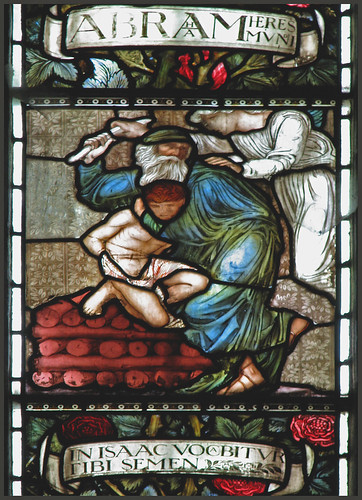
But someone will say, “You have faith and I have works.” Show me your faith apart from your works, and I will show you my faith by my works. Do you want to be shown, you foolish person, that faith apart from works is useless? Was not Abraham our father justified by works when he offered up his son Isaac on the altar? You see that faith was active along with his works, and faith was completed by his works; and the Scripture was fulfilled that says, “Abraham believed God, and it was counted to him as righteousness”—and he was called a friend of God. You see that a person is justified by works and not by faith alone (vv. 18, 20-24, emphasis added).
The issue here is clearly Abraham's being vindicated and his righteousness being demonstrated to us, not to the God who already declared that it was so.

OK, fire away....

Monday, August 25, 2008

Isaac to the Altar, Jimmy to the Stove

The second of the "Slogans of Protest" that Catholics re-ject is Sola Fide, the Protestant teaching that the believer is justified by faith alone apart from works. The way the Reformed tradition has expressed this doctrine con-fessionally is as follows:

Those whom God effectually calleth, he also freely justifieth: not by infusing righteousness into them, but by pardoning their sins, and by accounting and accepting their persons as righteous; not for any thing wrought in them, or done by them, but for Christ's sake alone... by [God's] imputing the obedience and satisfaction of Christ unto them, they receiving and resting on him and his righteousness by faith; which faith they have not of themselves, it is the gift of God (Westminster Confession of Faith XI.1).

To this the Catholic responds by pointing out that the only place in the Bible where the phrase "faith alone" is used is in James 2:24, which reads, "You see that a person is justified by works and not by faith alone." He will further highlight the fact that the issue in James is not, as the Protestant claims, Abraham's justification before men, for the context makes it plain that the question is whether faith alone can "save" (v. 14).

Plus, Abraham's supposed "justification coram hominibus" must have fallen pretty flat since, besides God, there weren't any other people hanging around Mt. Moriah to "ooh" and "aah" at his "demonstration that he had been previously justified" (which, by the way, dikaioutai doesn't even mean).

Can Paul and James be reconciled, or must we "throw Jimmy into the stove"?