Showing posts with label Protestantism. Show all posts

Friday, July 24, 2009

Catholics: Heartier Partiers?

Speaking of the Protestant Reformation's crushing of the "creative activity" of the Middle Ages, author Tom Hodgkinson writes (with tongue in cheek):

The Puritan Revolution began to introduce boredom to the masses. Even religion and the path to salvation became boring. In the Middle Ages, religion had been full of blood and gore and death. Churches were centres of economic activity and partying as well as of worship. The Church was a patron of the arts and commissioned local craftsmen to make adornments for its properties. The sermons were attended largely for their entertainment value; they provided real theatre. In medieval Florence, people would queue all night to see a great preacher and then stream out of the church after the service, weeping copiously. All this drama and theatre was removed by the Puritans, who labelled the ways of the old Church "superstition" and "idolatry." In other words, all the pagan fun of the Catholic Church, which it had wisely kept, was taken away.
(I quote Hodgkinson here not because I necessarily agree with him, but because he has a knack for being really amusing, even as he offends just about everyone equally.)

This idea that Catholics are better partiers is perhaps what lay behind Sean P. Dailey's article titled "The Lost Art of Catholic Drinking," in which the author argues that the thing that distinguishes Catholic from Protestant drinking is not necessarily quantity, but control. Citing Chesterton's insistence that the way we thank God for wine is by not drinking too much of it, Dailey says that Catholics can steer the middle course between abstinence and excess that Protestants just can't seem to navigate.

(Oh, and another thing that distinguishes the two methods of imbibement is Hilaire Belloc's insistence that Catholics never drink any beverages that don't predate the Reformation [which supposedly limits their choices to beer and wine]. I suppose this would make The Wire's Jimmy McNulty's dismissing of Bushmills as "Protestant Whiskey" somewhat tautological (he prefers Jameson). Of course, legend does tell us that St. Patrick himself introduced the art of distilling to the Irish in the fifth century. But I digress.)

What's my point, you ask? Umm, I'm not sure I really have one, unless it's that with respect to the enjoyment of beverages, perhaps confessional Protestants are closer to Rome than they are to Saddleback after all. Not exactly a giant leap toward ecumenism or anything, but it's a start.

Wednesday, July 15, 2009

I'm Protestant, Therefore I Shop?

In his post entitled “Ecclesial Consumerism vs. Ecclesial Unity,” Covenant-Seminary-graduate-turned-Catholic Bryan Cross writes:
One is an ecclesial consumerist if one's decision regarding which "church"
to attend is based on anything other than this question: Which institution is
the one founded by the incarnate Christ?
While I appreciate Cross’s attack upon ecclesial consumerism as well as the humble and irenic manner by which he argues his position, I must question, from the perspective of my own experience, the simplistic and reductionistic nature of this statement.

For my own part, one of the things I appreciate about Reformed ecclesiology in general (as well as my own church’s worship in particular, if I may toot my own horn) is the very fact that that we refuse to give people what they want, and instead insist on giving them what they need, even if this results in a lesser degree of “success” as defined by American evangelical criteria. In other words, there are certain things that I, individually speaking, would want in a church, such as an elaborate children’s program, professional-sounding music, and messages that tickle my (fallen) sensibilities as well as funny bone.

You know, like Mark Driscoll does.

But despite the pressure to grow in terms of both nickels and noses, faithful Reformed churches have deliberately and decidedly determined not to give ecclesial consumerists what they want. Do we claim to be the church that Jesus founded? Not exactly. But have we therefore fallen prey to the consumerism that characterizes churches like Saddleback or Mars Hill?

Not by a long shot.

Wednesday, June 24, 2009

Apostles and Early Fathers: Who Were the Real Morons?

Since Mark Shea's book By What Authority? founds its way into the conversation, I thought I'd clear up what I believe his point to have been, as well as put forth a question to him (or to anyone who feels like trying to answer it).

Shea draws his readers' attention to the way that evangelicals respond to the work of the Jesus Seminar, saying that evangelicalism is certainly correct in highlighting the absurdity of the idea that Jesus, whose knowledge and insight could penetrate into the very souls of men, was nonetheless so shortsighted that he couldn't seem to choose any disciples who would be able to correctly remember a single thing he said. In other words, how likely is it that, nine minutes after our Lord's death, his disciples would both immediately forget everything he really said and did, and invent a bunch of stuff he never said or did?

(This reminds me of the wisdom of Holden Caulfield from The Catcher in the Rye, who insisted that "Jesus needed his disciples like he needed a hole in the head." When challenged with the claim that if you reject the disciples you reject Jesus, Caulfield explained that Jesus picked his dicsiples at random since he didn't have the time to screen them properly, being busy and all.)

Now Shea's argument becomes challenging when he turns to Protestantism's response to Rome. The Protestant, Shea insists, commits the very same fallacy that the proponent of the Jesus Seminar does, only we push it back a generation. So we (rightly) deny the likelihood that the original twelve apostles completely messed up Jesus' teachings, but we also (wrongly) insist that the first generation of post-apostolic fathers misunderstood the apostles' teachings. We roll our eyes at the claim that John invented the idea that the Logos was God, while we nonetheless maintain that Ignatius delibererately inflated the authority of the bishop, or that Irenaeus concocted the theory of apostolic succession as a means to ensure orthodoxy. Thus we dismiss early church teachings on prayers for the dead, the sacrificial nature of the Mass, or veneration of Mary by insisting that the church fathers simply went astray pretty soon after the original twelve died.

The question to my Catholic readers is this: Does not Paul himself marvel at how quickly the churches of Galatia perverted the gospel they received from apostolic messengers? Is it indeed a given that the teachings of the early fathers were apostolic simply because they were in close chronological proximity to the apostles?

Thursday, June 18, 2009

Binding and Loosing in Orlando

I'm sitting here in Orlando at the PCA's General Assembly, and the food line is a mile long, so to kill time I figured I'd relay a question I was posing to some fellas last night over smokes and seven-and-sevens:

"Has anything been bound in heaven this week?"

(Insert blank stare and the sound of crickets here.)

The reason for my question is that Jesus says in Matthew 16, "You are Peter, and on this rock I will build my church, and the gates of hell will not prevail against it. And I give to you the keys of the kingdom of heaven, and whatever you bind on earth will be bound in heaven, and whatever you loose on earth will be loosed in heaven." What our Lord is promising here is that the church he will build will have the power to speak in heaven's name on earth, with all authority.

So the question I posed was, "Have we actually concluded anything in Christ's Name that we are confident is now bound in heaven and ratified with heavenly authority?" And my follow up question, if the answer given was "Yes," is, "OK then, should we go through the Yellow Pages once we're home and call all the other churches in our community and inform them of Jesus' decisions that were made at the PCA's GA?"

Again, crickets and stares....

I am certainly not trying to undermine or call into question the importance of the work that we are doing as PCA commissioners. But I guess I'm simply lamenting the fact that the church that Jesus seemed to describe in the Gospels, when compared with our current situation in Protestantism, is not exactly easily recognizable. Instead of declaring with heaven's own authority God's will for all Christians we are setting up the rules that govern our own little corner of the kingdom.

Do I like my corner? Sure. But I can't help but wish there were more unity and true catholicity within Reformed Protestantism. Here endeth the rant.

Saturday, May 30, 2009

"No One Told You It Was Gonna Be This Way...."

We've got a wide variety of readers here at DRD, so I'm hoping some of you can clear up a mystery for me.

Reformed people think they're on the same team with Lutherans, but Lutherans won't even offer the bread and cup to the Reformed. Anglicans often speak of themselves as non-Protestants more akin to Catholics, but Catholics don't understand themselves to be in communion with Anglicans. And it seems that Lutherans think of themselves as being much more Catholic than Calvinistic/Re-formed, while from the vantage point of Rome we're pretty much a gaggle of individualists.

What gives?

Monday, April 20, 2009

Is Romans 2 Good or Bad News?

As I pointed out in my post last Wednesday, the standard Catholic position with respect to Paul and James on the relationship of works to justification states that, while man can never bring God into his debt or earn any reward from him, he nonetheless may (and must) perform Spirit-wrought good works in order to be saved. Romans 2:6-13 is often quoted in favor of this view:

He will render to each one according to his works: to those who by patience in well-doing seek for glory and honor and immortality, he will give eternal life; but for those who are self-seeking and do not obey the truth, but obey unrighteousness, there will be wrath and fury. There will be tribulation and distress for every human being who does evil, the Jew first and also the Greek, but glory and honor and peace for everyone who does good, the Jew first and also the Greek. For God shows no partiality.

For all who have sinned without the law will also perish without the law, and all who have sinned under the law will be judged by the law. For it is not the hearers of the law who are righteous before God, but the doers of the law who will be justified.
Now the traditional Protestant response is that Paul is explaining to his Jewish readers that if they insist on relating to God on the basis of works, then they'll have to go the distance. "Don’t just listen to the law," Paul sarcastically urges, "but go ahead and do it. All of it." Paul then proceeds to demonstrate both the Jews' and Gentiles' failure to perfectly obey the law, showing that God's solution is a "righteousness apart from the law" that has been revealed in Christ.

The Catholic will not relent at this point, however, but will argue that Paul is not pitting perfect law-keeping against faith, but rather, is contrasting the perfect kind of obedience that cannot justify with a less-than-perfect kind that can.

Their argument follows these points: (1) If Paul is speaking in Romans 2 of a covenant-of-works type of righteousness that is unattainable, then he would not have immediately referred his Jewish readers to "Gentiles who by nature do what the law requires" (v. 14). Unless such Gentiles exist, his argument has no force; (2) The whole context of Paul's chiding of his kinsmen is "repentance" and "continuance in well-doing" (vv. 4, 7), which makes no sense under the original Edenic covenant; (3) Every other New Testament reference to final judgment states that it will take place "according to works," and none of them are said to be hypothetical by Protestant exegetes, so why single out this one? (4) Paul describes the entire doing-the-law-to-be-justified and judgment-according-to-works processes as things that happen "according to my gospel" (v. 16), meaning that his message in Romans 2 is not meant to be taken as bad news, but as good news.

Two questions arise. First, how weak or strong are these points? And second, how consistent or inconsistent are they with the confessional Reformed position?

Wednesday, April 15, 2009

Rome's Reconciliation of Paul and James

I think I’m beginning to get a handle on the Catholic approach to reconciling Paul and James. Unless I’ve totally misunderstood their position, I think it goes something like this:

There are two kinds of faith, and two kinds of works. (1) Dead Faith is a bare intellectual assent akin to that of devils; (2) Living Faith is the genuine kind of faith that produces heartfelt obed-ience; (3) Dead Works are works done without living faith; and (4) Living Works (not the best way of putting it, but I’m trying to keep this simple and consistent) are those acts of obedience that spring from living faith.

How does this apply to the apparent contradiction between Paul and James, with the former saying that Abraham was justified apart from works and the latter saying that the patriarch was justified not by faith alone, but by faith and works?

Well, the Catholic would say that Paul is not concerned with answering the question "What kind of faith justifies?", and likewise, James is not addressing the question "What kind of works do not justify?" In fact, it’s the other way around. Paul’s concern is to dispel the idea that the works done by the Judaizers (and by extension, by faithless Gentiles as well) can garner any favor with God whatsoever. James's concern, on the other hand, is to dismantle the notion that a mere cognitive assent of the mind can justify anyone. But, Rome maintains, what both writers agree on is the idea that a living faith justifies.

So as you can see, both Protestants and Catholics insist that certain words are used equivocally by Paul and James, we just disagree on which words those are. The Catholic maintains that they are using "justification" identically but are using "faith" and "works" differently, while the Protestant says that the interpretive key is the different definitions of "justification" that are in play (Paul's has to do with legal acquittal before God, and James's with demonstrative vindication before men).

To the Scriptures, then.

Avoiding the silly accusations that fault Catholics for not being more Protestant and Protestants for not seeing things like Catholics, which position makes the most sense out of the data? And can either approach be adopted by either side?

Wednesday, April 08, 2009

Isn't It Ironic?

I like irony, and when I detect it I like to point it out. And I'm not talking about rain on your wedding day or ten thousand spoons when all you need is a knife.

I have been chuckling to myself recently about how that Catholics deny the Protestant idea of the perspicuity of Scripture (that the Bible is clear enough on its basic teachings that even children can understand its message), but at the same time, Rome's doctrines represent the conclusions that any child would reach by just reading the Scripture for what it says. And contrariwise, we Protestants insist that the Bible is perfectly clear and understandable while employing our most impressive systematic and exegetical acumen to highlight just how complicated the seemingly-plain language of Scripture really is.

For example, if my four-year-old daughter were to read the words, "This is My body," she would probably conclude that the bread is Jesus' body in the most basic and literal sense of the word, and I would have to try my hardest to explain that what Jesus really meant was that the bread is his body truly, but spiritually and not physically since insistence upon the ubiquity of Jesus' human nature betrays an erroneous, indeed Eutychean, understanding of the communicatio idiomatum.

Or, if she read the instruction of Ananias to Saul to "be baptized and wash away your sins," she would most likely assume that baptism washes away sins, leaving me to point out that the administration of the signum and the reception of the res significata are not necessarily simultaneous, and that it's not the waters of baptism that really wash away sins anyway, but the blood of Christ (of which baptism is a sign and seal).

And heaven help me if I ever let her read the book of James, for then she'll probably get the idea that Abraham was not justified by faith alone, but by faith and works (which, in turn, will force me to patiently point out that Paul and James use the words pistis and dikaioo in quite different ways, even though they sound the same in Greek and English).

Does all this hassle tempt me to abandon my complex theology? Of course not. But it does make me wonder if Geneva should trade the notion of perspicuity to Rome for something that they claim, but would look better sitting exclusively on our mantle.

How about sola gratia?

Thursday, March 12, 2009

Let Them Eat Cake!

I like cake. But the thing is, I like to eat it, too.

Because of this tendency, I often shy away from arguments against Catholicism that take as their launching point the various abuses and aberrations of the church throughout the centuries, as if the Protestant's only problem with Rome is the occasionally opulent pope or abused altar boy. In other words, a robust Reformed argument against Rome would focus not only on what it became, but also on how it began.

If all we focus on are the incidentals, then is not this a tacit admission not only that the solution to Rome is not Protestantism but reformed Catholicism, but also that our entire ecclesiology is a convention arising post hoc, a reaction to biblical Christianity gone awry instead of a return biblical Christianity itself? Don't miss the import of what I'm saying: if we focus solely upon Rome's abuses, we are surrendering not only all exegesis, but also conceding that Jesus did in fact intend to found a visible church characterized by apostolic succession and Petrine primacy, but once that church messed things up, we came along with a bunch of new ideas about invisible churches and Sola Scriptura.

To put it bluntly, Protestants need to argue for Protestantism, not just against Catholicism, and we need to do it from Scripture, as if (gasp!) Jesus actually intended something akin to Reformed ecclesiology all along. Why would we be comfortable with anything less? I mean, what are we, Protestants or simply non-Catholics?

So let's not shoot ourselves in the foot by just settling for cake. Let's go the next step and demand to eat it, too.

Wednesday, March 04, 2009

Men at Work: Cool Band, Bad Theology

Continuing our look at Louis Bouyer’s The Spirit and Forms of Protestantism, we now turn specifically to the “negative principles” that, the author argues, constituted the Church’s real problems with the Reformation and precipitated her rejection of it.

Bouyer insists that sola gratia, sola fide (salvation by grace alone through faith alone) is perfectly within the pale of Catholic orthodoxy, and it is only when the Reformers waxed polemical that they got all negative and carried away.

The affirmation of sola fide is not content with excluding works in the Jewish sense or works done before faith is received or works done by the believer apart from the agency of faith in grace or even apart from this as the unique means giving man power to do good works. The Catholic faith could not do otherwise than take all these exclusions as its own and ratify them. [But] Luther, and Protestantism after him… declared that all possible and imaginable works are harmful, that faith itself has not to produce them for salvation, cannot, should not, do so.
Bouyer goes on to wonder at the fact that Protestants “attack the scholastic idea of faith ‘informed’ by charity, contrasted with faith without charity as living faith to dead.”

Setting aside for the moment Bouyer’s characterization of Protestantism as arguing that faith not only need not but indeed should not produce good works for salvation (a statement that is false on its face), I would like to offer a brief exegetical rebuttal to Bouyer’s claim that the Protestant Reformers went overboard on their negative statements about works.

According to Bouyer, there are four senses in which the Catholic may agree that works do not contribute to man’s acceptance by God. First, he admits Catholics agree with Protestants that “works in the Jewish sense” are inadmissible. I assume he means what some theologians call “Jewish boundary markers,” those works of the law such as circumcision and dietary restrictions that divided Jews from Gentiles. Second, Bouyer lists “works done before faith is received,” by which he most likely means the good deeds done by the unregenerate pagan before he is converted. Third are “works done by the believer apart from the agency of faith in grace.” I guess what Bouyer is referring to here are the Christian’s attempts to please God in the arm of the flesh. And the last kind of works that the Catholic would agree are useless for pleasing God is works “apart from this [Option 3] as the unique means giving man power to do good works.” I have no idea what Bouyer is talking about here.

So here’s my question: Which type of works was Peter referring to when he insisted at the Jerusalem council that Gentiles need not be circumcised since such practice would “place upon them a burden that neither we nor our fathers could bear?”

The option that seems most obvious at first is #1 (works in the Jewish sense), since the whole debate in Acts 15 was over Jewish boundary markers. But not so fast. If the Judaizers of Peter’s and Paul’s day were so meticulous about adhering to circumcision and dietary laws—even going above and beyond by fasting twice a week (Luke 18:12)—then how can Peter call these works an unbearable burden? They kept them, didn’t they? So what was the problem?

Paul says something similar in Gal. 3:10ff, arguing that the Galatians should not submit to circumcision for the specific reason that “all who rely on works of the law are under a curse.” Now this curse is obviously not solely due to failing to keep the Jewish ceremonies since, as we have seen, the Jews kept them scrupulously (I mean, how circumcised can a man be?). And the “works” Paul is referring to cannot be works done apart from faith or before receiving grace since he is holding up his own kinsman as his foil, arguing that even faithful, circumcised, ham-shunning Jews are under God’s curse.

The only answer that seems to make any sense of these passages is that circumcision binds a man to the entire law (Gal. 5:3) and that failure on just one point is tantamount to failure on all (Epistle of Straw 2:10). In fact, Paul says as much in the verse under consideration, quoting Lev. 18:5 to the effect that the Israelites were bound to perform “all things written in the Book of the Law.” That's the kind of works that curse: not the Jewish kind, the ceremonial kind, the prideful kind, or the faithless kind. All kinds.

The conclusion of all this, therefore, is that even faithful Christians, if they bring works of any kind into the justification equation (even ceremonial boundary markers), thereby bind themselves to a law whose only function this side of the fall is to curse, accuse and condemn.

Better, in my view, to affirm what Trent anathematizes, namely, that whatever good works we perform are but results of grace received and in no way contribute to God’s acceptance of us.

If I’m wrong, please show me how.

Monday, March 02, 2009

Which of the Seven Dwarfs Best Sums Up Protestantism?

Lutheran-turned-Catholic Louis Bouyer argues in his The Spirit and Forms of Protestantism that the expulsion of the Protestant Reformers from the Catholic Church was in no way a response to the "positive principles" of the Reformation such as Sola Gratia and the emphasis on divine sovereignty (principles which, according to Bouyer, had "the power to rejuvenate and restore traditional Christianity"). Instead, the Reformers were tossed out for "something else," namely, the unnecessary negative principles that were also insisted upon but were, Bouyer maintains, "so far from following from the principles already examined or from being necessarily implied by them or even useful or expedient."

The question that must be pondered, according to Bouyer, is not "If the positive principles of the Reformation are perfectly consistent with Catholic tradition, then why did the Church reject them?" but rather, "What was present in the Reformation that forced the Church to reject it despite its clearly orthodox positive principles?"

Before we look at the specific examples Bouyer cites, I'd like to examine his general claim. Is there a "mysterious fatality" resident within Protestantism that inevitably moves its adherents to attach a "negative significance" to its positive principles?

It's a good question.

Just answering the challenge in general terms, it seems necessary to insist that if A is true, then non-A must be equally false. That being said, however, is it absolutely necessary to say that if, say, the Bible is uniquely authoritative then the Church has no real authority beyond that which I attribute to it? Or is it inevitable that if salvation is a sovereign work of divine grace alone, and that works play no role in disposing God towards the sinner, that therefore all works are eliminated from the salvation equation altogether?

I guess what Bouyer is asking is, "Why do Protestants have to be so grumpy all the time?"

Wednesday, February 25, 2009

Could Luther and Leo Have Ironed Things Out Over a Few Pints?

In his book The Spirit and Forms of Protest-antism, French Lutheran-minister-turned-Catholic Louis Bouyer argues that Protestantism, positively considered, is completely consistent with Catholic tradition both ancient and modern. He writes concerning sola gratia:

... this assertion, taken in its essence as we have sought to define it, is a genuine-ly Christian one and fully in accord, of course, with Catholic tradition properly understood.... Luther's basic intuition, on which Protestantism continuously draws for its abiding vitality, so far from being difficult to reconcile with Catholic tradition or inconsistent with the teaching of the apostles, was a return to the clearest elements of their teaching and is in the most direct line of that tradition.
Bouyer even goes as far as to say:

Protestantism, reduced to what Protestants regard as its essence, was under no necessity to embody itself in schism and heresy. On the contrary, by the very logic of its nature, it should have initiated in the Church itself a powerful movement of regeneration.... Unfortunately, that is not what happened, though the blame, in any case, does not lie exclusively with the basic principle of the Reformation.
Bouyer goes on to argue that Protestantism's central principles such as divine sovereignty, the unique authority of Scripture, and salvation by grace alone are not fallacious in what they affirm, only in what they deny (which things, he argues, are unnecessary and incidental to the heart of the Reformation).

This line of argument seems to be along the same lines as the sentiments of the late Richard John Neuhaus, who insisted that when he abandoned Wittenberg for Rome he relinquished nothing of what he formerly believed, but instead just picked up a bunch of extra stuff.

I'm interested to hear your thoughts on this, because I find it incredibly interesting (not to mention baffling and suspicious) that former Lutheran clergymen like Bouyer and Neuhaus would say such things. My initial reaction is to dismiss such sentiments as indicative of their never really having understood their own tradition, but I am also aware of how much of an ass that makes me look.

So what gives? Did Luther and the pope just need a heart-to-heart over a few ales in order to smooth things over?

Wednesday, February 04, 2009

Orthodoxy (Generous and Otherwise)

I’ve been thinking lately about how to relate the idiosyncratic beliefs and emphases of a particular Christian tradition to the Christian faith as a whole, and it seems to me that there are a few approaches we may take, at least.

First, we can choose the course that minimizes the specific idiosyncrasies in order to emphasize commonality. Accordingly, if a particular doctrine gets in the way of ecumenicity, it should be either deemphasized or jettisoned altogether. Protestant liberalism seems to prefer this approach.

A second option would be to do the very opposite, willingly sacrificing broad catholicity in order to maintain faithful adherence to the tenets of some Christian tradition or another. When I think of this approach, the Orthodox Presbyterian Church comes immediately to mind. Say what you will about its relevance or lack thereof in the culture, the OPC has the stones to say, "Look, we don’t give a frak about how small we are, we’re maintaining fidelity to our confessions, whatever the cost." Agree or not, you gotta give props to the OPC for their audacious lack of interest in success as defined by their transformationist peers. And for their bow ties.

A third option would be to attempt some hybrid of these two, which is where the PCA seems to fall. Should we ordain women as deacons? Well, that would certainly gain us some street cred in "the city" (you know, the place God really cares about). But then, whatever tolerance we display on the diaconate is canceled out if we oust all the Federal Visionists because they cross their "i"s and dot their "t"s instead of the other way around.

What this all boils down to is the relationship of Orthodoxy and orthodoxies. The former, I would maintain, consists of all the stuff you have to believe to be a Christian. The latter includes the stuff over and above the former, all the peculiar beliefs that make Pentecostals Pentecostal (like the Second Blessing), Calvary Chapel people Calvary Chapel people (like the Rapture), and Presbyterians Presbyterian (like the doctrine of Imputation).

The Protestant belief in the invisible church usually precludes us from equating our various orthodoxies with Orthodoxy with a big O, meaning that we treat the former more as house-rules and not as the actual apostolic paradosis and deposit of faith. There is one church, of course, that sees no distinction between its every dogma and Orthodoxy itself, but they’ve been around long enough to brag a bit, even if they get carried away at times.

But when it comes to the PCA, I hardly think it would be appropriate for me to make such lofty claims, especially about a denomination that was born the same year I was.

Monday, February 02, 2009

Is Being Right a Sufficient Tactic Against Heresy?

First off, I am sicker than I ever remember being, so if the following makes little sense or sounds half-baked, just back off and cut me some slack or I’ll cough the bubonic plague on you.

My Catholic readers make a big fuss over the fact that, according to them, there is no "principled difference" between Protestant theology and heresy. What they mean is that when a Protestant debates a Mormon, the conversation may go something like this:

Protestant: "You’re wrong about Jesus, you know. He was God."
Mormon: "Nuh-uh."
Protestant: "Yeah-huh!"
Mormon: "Prove that I’m wrong."
Protestant: "OK, look at these verses."
Mormon: "Fine, but first I want you to look at these verses."
Protestant: "Nice ten-speed" (slams door).

The Catholic (claims the Catholic) is not doomed to forever spin in a circular prooftext battle, for he alone can appeal to the historic succession of bishops stretching back to the apostles. His position, in other words, rests both on appeal to Scripture but also upon a version of apostolicity that is actually verifiable rather than invisible.

So here's my question: How does Paul the apostle tell his readers to deal with heresy that would eventually arise?

Let's consider a couple texts. In Acts 20, Paul bids farewell to the Ephesians, telling them that savage wolves would invade the flock from within and without. He then says, "Therefore I commend you to God and to the Word of his grace."

To his protégé, Timothy, Paul says that his heretical opponents must be dealt with gently and peaceably, without quarrelsomeness, if perhaps God might grant them repentance and the ability to know the truth and be spared the devil's snare.

In both cases, doctrinal error is to be combated with doctrinal truth, and in neither case is there any sentiment that says, "Riiight.... Can we have a look-see at your list of bishops? Oooh, don’t got one, do ya? Thanks for playing, the consolation prize is available in the losers' lounge."

I’m not denying the role that such succession may have played in the early church, but I am wondering if something that began as an circumstance of history has become a litmus test that excludes others who may actually be right.

I mean, once the locus of our worship ascended to heaven, the significance of historical succession seems to have ceased. Jesus is not a priest after the order of Aaron, but it doesn't matter. Gentiles can't trace their heritage back to Abraham, but so what, they were spiritual Israelites. So why can't apostolicity be spiritual as well, rooted in truth rather than genealogy?

Tuesday, January 27, 2009

The Definitive Case Against Definitive Justification?

In his reflections on his White Horse Inn interview conducted by Michael Horton, Catholic apologist Robert Sungenis complains that he offered up a perfect test case for the Catholic doctrine of justification, and Horton kept ignoring it. He says:

On the matter of David’s justification that St. Paul mentions in Romans 4:5-8, I mentioned the fact (as I do in my book) that it is obvious from Paul’s treatment of the account that David lost his justification by committing adultery and murder (2 Samuel 11-12) and that these sins are the very reason that Paul can then use David as an example of a person who, after he committed these heinous mortal sins, can now receive justification when he repents of those sins. If there is any passage of Scripture that supports the Catholic understanding of Justification, this is it. But to my dismay, Horton made no comment about the obvious conundrum the account of David’s justification creates for his own “one-time forensic event” and “eternal security” beliefs to which he holds so dearly in his Reformed theology, even though I referred to David’s account THREE times in the interview. Rather, each time I mentioned David he quickly turned to another topic of discussion and pretended as if the example of David didn’t even make a dent in his view.
As I understand it, here is Sungenis’s argument in a nutshell:

Major Premise: Paul cites David as an example of his doctrine of justification, quoting from Psalm 32 (“Blessed is the man whose lawless deeds are forgiven, etc.”).

Minor Premise: The event to which David is referring is his adultery with Bathsheba and murder of her husband Uriah.

Conclusion: Since David was described as “a man after God’s own heart” prior to this sinful episode, Paul’s calling David’s receiving of forgiveness “justification” demonstrates that, for the apostle, justification Is not a one-time event that occurs at the beginning of the Christian life, but rather is a process that is repeated with each new occurrence of mortal sin and receiving of forgiveness.

What do you think of Sungenis’s case? Is it strong? Weak? And why?

Monday, January 26, 2009

Christian Speech: Common or Commandeering?

In our continuing debate over the nature of justification, the conversation seems to be going like this:

Protestant: “You Catholics are misusing the term ‘justify’ (dikaioo), claiming that it means everything from ‘receive into God’s family’ (which the Bible calls ‘adoption’) to ‘make one a partaker of the divine life’ (which the Bible calls ‘regeneration’), when the actual word itself has a much more limited meaning, namely, to ‘acquit’ or ‘vindicate.’”

Catholic: “Well, even if the Greek term has a more limited meaning that the one we assign to the doctrine named after it, it doesn’t matter. Justification is an in-house doctrine, a teaching of the church that is uniquely ours, and therefore we oughtn’t ask Jewish or pagan lexicographers how to speak our own tribal, peculiar language.”

An interesting response, I admit. William Willimon would be proud.

I think it is necessary to clarify the Protestant position here. We are not saying that we should prefer the technical definition of the best lexica over that of Paul and the subsequent church fathers. Rather, we are saying that Paul used the term in accord with how it was commonly understood in the vernacular of his own day. In other words, he didn’t commandeer a common legal term and transform its meaning without bothering to let anyone in on the joke.

Though the dikaio- word group has a pretty broad semantic range, Paul uses the term “to justify” primarily to denote the act of God rendering to a person his legal due in response to the moral actions he has (or has not) performed. There are two kinds of justification in Paul, one ordinary and the other extraordinary. According to the former, God simply rewards a man according to his works (see Rom. 2:13). Extraordinary justification, on the other hand, occurs when the Father does what he often claims is impossible for him to do, namely, when he “clears the guilty” and “justifies the wicked.”

The reason he can do this is because he has provided for himself an airtight theodicy—he has punished his Son in the sinner’s stead and has imputed to the sinner Christ’s own righteousness as a free gift, thus remaining “just, and the justifier of the one who believes” the gospel (Rom. 3:23-26).

But semantics can be tedious, after all. What I’m really interested in finding out is whether or not the Catholic can accept what is said above, regardless of what they call it.

Well?

Monday, January 19, 2009

On Pleasantville and the Visible Church

As our discussion seems to have morphed into one about the visible vs. invisible church, I think a valid question that arises (but is not begged) is, “What, exactly, is a ‘church’?”

I would argue that a “church” is a self-governing ecclesiastical body that administers the Word and sacraments, meaning that a pastor-led congregational assembly is a church, Calvary Chapel as a whole is a church, and the PCA is a church (I’m putting aside for the moment the issue of whether these churches are any good).

And according to this definition, the Catholic Church is also a visible church.

The tricky part, however, is determining whether Protestants believe in a visible church at all, or simply in visible churches. If I visit a Missouri Synod Lutheran church I will be denied the bread and cup, despite the fact that I’m a Presbyterian minister. If one of my kids joins a Calvary Chapel (shudder) in high school, he or she will be offered a re-baptism, one that “really counts.”

So much for the sacraments having anything to do with unity in our circles....

So for better or worse, we Protestants must function as though “church” = “autonomous local body” or “denomination.” Perhaps some space could be made for a group like NAPARC (to which most conservative Reformed and Presbyterian denominations belong), but that is only a loose affiliation with no real jurisdiction or control over what, say, the PCA or OPC do.

Once we have sufficiently convinced ourselves that the visible church is small enough only to contain those who are under the authority of our particular denomination or body, then we can allow passages like Matthew 16:19 to play a significant role in our ecclesiastical practice. When someone becomes unrepentantly delinquent in doctrine or morals, we exercise our proper jurisdiction and remove such a one from our assembly.

But while all of this painful, sober, and faithful discipline happens we have this nagging thought in the back of our minds that the excommunicated person can just run out and join one of many other churches in the area, and that the chances that those churches will take seriously our disciplinary sentence are slim to nil. So he’s not really “delivered over to Satan,” but delivered over to Lakeside Community Church.

My point is two-fold. First, Protestantism doesn’t really believe in a visible church but in visible churches, and secondly, it is only in the context of any one of these distinct churches that spiritual authority and discipline make any sense. But like the residents of Pleasantville, once the members of an isolated church figure out that Main Street is not a big circle but a line that could dangerously lead to other ecclesiastical options, the game could very well be over.

This is a problem that needs to be fixed. But how?

Wednesday, January 14, 2009

Cogito, Ergo Sum [Protestant]?

On his blog Pontifications, Fr. Kimel puts forth a kind of Van Tilian, presuppostional defense of the papacy, building his case on the argument of Cardinal Manning, whom Kimel quotes at length:

The doctrines of the Church in all ages are primitive. It was the charge of the Reformers that the Catholic doctrines were not primitive, and their pretension was to revert to antiquity. But the appeal to antiquity is both a treason and a heresy. It is a treason because it rejects the Divine voice of the Church at this hour, and a heresy because it denies that voice to be Divine. How can we know what antiquity was except through the Church? No individual, no number of individuals can go back through eighteen hundred years to reach the doctrines of antiquity. We may say with the woman of Samaria, “Sir, the well is deep, and thou hast nothing to draw with.” No individual mind now has contact with the revelation of Pentecost, except through the Church. Historical evidence and biblical criticism are human after all, and amount at most to no more than opinion, probability, human judgment, human tradition.

In the same way that a Reformed presuppositionalist would argue that it is a subtle display of rationalism to demand evidence for God's existence or the veracity of Scripture, so Kimel, echoing Manning, is insisting that it is also rationalism to insist that the Catholic Church's claims about its papal authority be historically proven.

The reason why such evidence is demanded, Kimel admits, is that the pope is the very icon of scandal and offense in the eyes of many.

I grant Manning’s point, yet still it seems appropriate to ask for evidences to support the Church’s teaching on the papacy. The Pope is, after all, is the rock upon which so many stumble. Even Paul VI conceded that “the pope—and we know this well—is without doubt the most serious obstacle on the ecumenical road.” The pope hypostatsizes the skandalon that is the Catholic Church.
I must admit, this argument is clever (if not a bit too convenient as well), for it puts Protestants in the unenviable position of having to sift through the historical data on the church and weigh it in the balances, all the while disassociating it from the testimony of the very church it is seeking to understand. Better, Catholics would argue, to simply believe the Church on its own authority than to subject it to the bar of human reason and inquiry.

In a word, apply all the stuff Van Til said about Scripture to the Catholic Church, and voila!, all our problems will be solved.

What do you think? Clever or convenient?

Friday, January 02, 2009

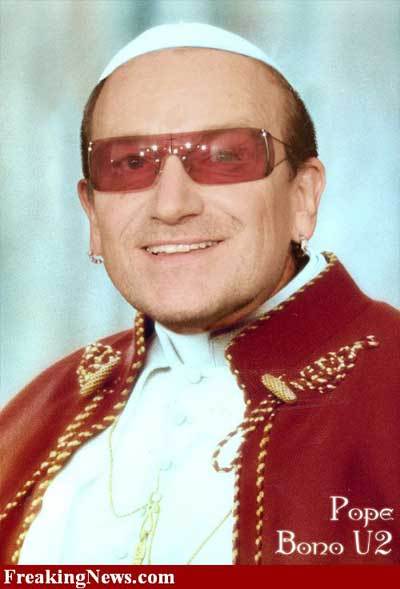
Bono, Luther, and the Seeds of Modernity

I’ve been on a bit of a ‘90s U2 kick of late (possibly due to the scheduled release of No Line on the Horizon in March, which has been compared to Achtung Baby), and so I’m (re)reading Bill Flanagan’s U2 at the End of the World. The author has been a close friend of the band’s since the early ‘80s and was given permission to follow them around during their ZooTv tour (’92-’93) and basically be privy to every show, every party, every conversation, and every recording session. Not a bad job this Flanagan fellow has.

Anyway, I read this passage the other night that I found interesting:

Bono is quick to admit that many of his ideas are instinctive, not intellectual—he does not have the time to be rigorous in researching or testing them. One of the theories that gets him into great arguments is that he believes that modernism started with Luther, with the Reformation, with the dismantling of the iconography of the culture and insistence on simplicity and function…. Bono is convinced that all this stripping down and directness goes back to the Protestant impulse, back to Luther, and that the modernists made the great mistake of taking on the antireligion of the existentialists and lost that thread. (It’s one of the wonders of Bono’s considerable intellect that he can construct a unified field theory of all his interests—even when they have nothing to do with each other.)
Now I know that my Catholic readers will jump on this and say, “See? Even Bono realizes that the seeds of modern man’s supposed autonomy are to be found in the Reformation with its individualistic doctrine of Sola Scriptura.” And it may very well be the case that when you mix together Sola Scriptura, anti-authoritarianism, and Descartes, you may not exactly like what you get as a result. Still, I can’t help but wonder how we are to avoid some degree of individualism, whether our home is Geneva, Saddleback, or Rome. We are all evaluating some body of data, whether it is Scripture or the early church fathers (or both), and coming to some conclusion or another about what they have to tell us.

So maybe evangelicals should stop dismissing Presbyterians for our refusal to let the Bible speak for itself; and maybe Presbyterians should soften our self-congratulatory tone when slapping ourselves on the back because of how well we avoid the individualism of the Bible-only, Anabaptist evangelicals out there; and maybe Catholics should stop looking down their noses at all of us and admit that they employ the same private judgment to determine that the Magisterium replaces private judgment as we do when we determine that the Bible speaks clearly enough on its core teachings that even children can understand its basic message.

Wednesday, December 17, 2008

The Visibility of Vinyl (Or, Put the Needle on the Record)

As many of you know I’m a bit of a music junkie, and I have been noticing a rather interesting trend as I read interviews with various artists about the state of music today. As unpredictable as it would have been a few years ago, there is a growing dissatisfaction among musicians toward digital music in general, and MP3s in particular. White Stripes frontman Jack White, when asked about the biggest challenges facing contemporary artists, said in a recent interview, “[The biggest challenge] is the fight against intangible music, the fight against invisible music.” He continues:

I hope that [in the next several years] there will be some balance between intangible music, invisible music and something that you can hold in your hand. A positive thing right now is that vinyl is staying alive, and record players are starting to be sold at stores again…. We can’t afford to lose the feeling of cracking open a new record and looking at large artwork and having something you can hold in your hands.
So many dots just begging to be connected….

Despite our Gnostic objections to the contrary, Adam Sandler’s character in The Wedding Singer was absolutely correct when he said, “We are living in a material world, and I am a material girl. Or boy.” Madonna was right and Sting was wrong, we’re not “ghosts in the machine” or “spirits in a material world,” but we are embodied, situated, corporeal humans who sometimes feel the need to “hold something in our hands,” whether it’s a new LP or a piece of bread and a cup of wine.

I cannot help but wonder if the sacramental instinct on the part of the confessional Protestant is not somewhat frustrated by our unfortunate inability to trace our visible churches back to the time of the apostles by means of an historical succession of bishops whose authority was conferred through something physical like the laying on of hands. I know, I know: neither Rome nor Constantinople—the two churches that do make this kind of claim—can match Geneva’s systematic and exegetical brilliance. But in the same way that we cannot but lament the near-disappearance of the 12" record due to the invisible MP3, so we must fight to protect the visible church from being eclipsed by the invisible one.

Vinyl skips, gets scratched, and cannot be downloaded, and likewise, the visible church is at times rather cumbersome and inconvenient. But so was that body that the second Person of the Godhead assumed, right? But we gotta believe it was worth the hassle.