Monday, August 18, 2008

The Church: What She Is, and How She Acts

By the middle of the second cent-ury, each local Christian church was led by a single bishop whose ministry was considered to carry apostolic authority. On his way to martyrdom in Rome in 110, Ignatius, bishop of Antioch, wrote to the church in Tralles:

"... when you obey the bishop as if he were Christ Jesus, you are (as I see it) living not in a merely human fashion, but in Jesus Christ's way.... It is essential, therefore, to act in no way without the bishop, just as you are doing."
And to the church in Smyrna he wrote:
"You should all follow the bishops as Jesus Christ did the Father.... Where the bishop is present, there let the congregation gather, just as where Jesus Christ is, there is the Catholic Church.... Whatever [the bishop] approves pleases God as well."
Whether they were correct in their assessment or not, it appears that the early post-apostolic Christians thought that their bishops carried the same authority that the original apostles held: If they forgave sins, those sins were forgiven; if a thing was bound on earth, it was bound in heaven.

Now for this to "work," of course, it had to be determined whether a so-called bishop was in fact duly ordained through an unbroken succession reaching back to the apostles themselves. Unlike in movements such as Calvary Chapel in our own day, in which ordination is largely a logistical exercise in paperwork (for kicks, I still have my Calvary ordination card in my wallet, complete with Chuck Smith's signature), ordination in the early church was a serious matter. The reason for this was bound up in their belief in the church's apostolicity and catholicity. When a bishop or group of bishops spoke in an official capacity, their word was considered infallible, for "he who hears you hears me," Jesus had promised.

What drives the Catholic view of authority, as well as the Protestant one, is their respective understandings of what the church actually is. Is it an invisible entity with various local expressions, or did Jesus actually found a visible, institutionally-united church that could be pointed to with a "Lo! It is here," or "Behold, it is there"?

How we answer this question will determine how we answer a score of others, as I hope to demonstrate in my next couple posts.

Sunday, August 17, 2008

Paul, Timothy, and the Nature of Post-Apostolic Authority

The first step in understanding the Catholic view of authority focuses on Peter and his unique leadership role among Jesus' disciples, as we saw in Friday's post. But what comes next?

In John 20:21-23 we read that Jesus said to his disciples, "Even as the Father sent me, so I send you." He then breathed on them and said, "Receive the Holy Spirit. If you forgive the sins of anyone, they are forgiven. If you withhold forgiveness from anyone, it is withheld." As in all four gospels, Jesus here sends the apostles forth with his commission and the authority to carry it out.

As time went on the possibility became ever more likely that the apostles would die before Christ returned in glory, meaning that permanent offices would need to be established in the churches. We see both in Acts and the epistles, therefore, the emergence of bishops and deacons who would serve the church after the apostles passed from the scene.

The principle of passing on the God-given deposit from inspired apostles to others is demonsrated is such passages as: "Now I praise you, brethren, that you... keep the traditions just as I delivered them to you" (I Cor. 11:2); "Therefore, brethren, stand fast and hold the traditions which you were taught, whether by word or our epistle" (II Thess. 2:15); "Withdraw from every brother who walks disorderly and not according to the tradition which he received from us" (II Thess. 3:6); "By the Holy Spirit who dwells within us, guard the good deposit entrusted to you" (II Tim. 1:14); "What you have heard from me in the presence of many witnesses entrust to faithful men who will be able to teach others also" (II Tim. 2:2).

It was the bishops specifically who were ordained by the laying on of hands to the office of ministry of the Word: "Fan into flame the gift of God, which is in you through the laying on of my hands" (II Tim. 1:6); "Do not neglect the gift you have, which was given you by prophecy when the council of elders laid their hands on you" (I Tim. 4:14); "For a bishop, as God's steward, must be above reproach.... He must hold firm to the trustworthy word as taught, so that he may be able to give instruction in sound doctrine and also to rebuke those who contradict it" (Tit. 1:7, 9).

As I noted in Friday's post about the New Testament's evidence concerning the preeminence of Peter, so here, there is nothing particularly objectionable about any of this. The point at which the disagreement between the Catholic and Protestant does begin to take shape, however, is when we ask the question, "What was the nature of that authority that the first generation of post-apostolic bishops carried?"

We know that the apostles' authority was conveyed both in word and in writing, by preaching and epistle. We also know that non-apostolic elders were involved in the Jerusalem Council, the conclusions of which were binding upon all believers (Acts 15:2, 28). Must we then conclude that men like Timothy and his successors carried genuine apostolic authority? Or can we insist that with the death of the apostles and cessation of the revelatory gifts, all extra-biblical authority took on a different, derivative character?

And regardless of which view we take, can we prove it?

Fiona Rose


A couple pics of the new addition. Thanks for your prayers.
***
PS - New post coming later tonight....

Friday, August 15, 2008

The Church's (Petrine?) Apostolicity

Over at Principium Unitatis, Bryan Cross is proposing an interesting avenue for fostering unity among Catholics and Protestants. Since, he acknowledges, the tendency of both sides is to question-beg (to assume what we should be trying to prove), the only realistic option is to go back far enough in history until we come to a time when we were both on the same team. "To the fathers!" he cries.

Let's go back a bit further.

What does the Nicene Creed mean when it affirms that the church is "one, holy, catholic, and apostolic?" Catholics maintain that apostolicity refers to the church's being built on the foundation of the apostles, and further, that it exercises the authority that Christ gave them.

To "trace the matter," we begin with Jesus' training of the twelve and giving them authority to teach, preach, heal, and administer the sacraments. Though this authority was given to them all, it was focused more specifically on the apostle Peter. Some arguments that Catholics put forth to demonstrate Peter's primacy are: (1) Peter often speaks for the twelve in the Gospels, especially in climactic moments (Mark 8:29; Matt. 18:21; Luke 12:41; John 6:67ff); (2) Peter is often central in many dramatic Gospel accounts (Matt. 14:28-32; Luke 5:1ff; Mark 10:28; Matt. 17:24ff); (3) Peter is always named first in the Synoptic lists of disciples (Mark 3:16-19; Matt. 10:1-4; Luke 6:12-16; Acts 1:13). Sometimes the disciples are referred to as "Peter and his companions" (Mark 1:36; Luke 9:32; Mark 16:7); (4) John waited for Peter at the tomb of Jesus and allowed him to enter first (John 20:3-8); (5) Jesus singled out Peter as the shepherd of his people (John 21:15-17); (6) Paul mentions Peter first among those who saw the resurrected Christ (I Cor. 15:5). Furthermore, the book of Acts reinforces Peter's primacy among the other apostles.

Jesus had much to say about Peter's unique role as well. It was Peter that Jesus said Satan desired to sift as wheat, "but I have prayed for you," Jesus assures him. "When you have turned again, strengthen your brethren" (Luke 22:31-32). In John's Gospel, It is Peter who is told specifically to nurture and feed Jesus' sheep (21:15-19). And of course, there is Christ's famous statement that Peter is to be called rock, "for on this rock I will build my church" (Matt. 16:18-19, both occurrances of "rock" are identical [kepha] in the Aramaic which Jesus spoke).

As Protestants, there is nothing we really need to fear by acknowledging this evidence as weighty. But as we "trace the matter" further and discuss whether Peter had a successor who had a successor, then the (ahem) you-know-what starts to hit the you-know-what, so hang on to your seats....

Thursday, August 14, 2008

"No Justification Without Representation!"

I have a question for my Catholic Readers (with some preamble to set it up):

As I understand your position, the only hope for unity and genuine ecumenical progress is for us Protestants to return to Rome. The reason for this is that, according to you, the Reformation began with rebellion against lawful ecclesiastical power, and regardless of how long our subsequent history or how well-ordered our subsequent polity may be, there is no statute of limitations on apostasy. To put the matter simply, as long as the prodigal remains outside his father's house he is just that, a prodigal. Even if his pig-sty experience evolves into a great empire in which he becomes a mogul in the pork industry (even "the Sausage King of Chicago"), his success began with unlawful division, and this being the case, no amount of years can transform what is illegitimate into something legitimate.

My question, then, is this: What do you make of the United States of America? If the case can be made that the beginnings of this country were rooted in rebellion against lawful power (i.e., the Crown, an authority that, while not ecclesiastical but civil, is nonetheless divinely instituted), then it would seem to follow that, regardless of how many years transpire or how powerful we as a nation become, our only hope of gaining legitimacy would be by submitting ourselves once again to the United Kingdom against which we rebelled (over issues, I might add, much less important than those that compelled Luther and Calvin to break from Rome).

Since I honestly have no idea how tis question will be answered, I offer it merely in humble curiosity and not as some "knock-down, drag-out" zinger.

So what gives, Catholics? Are the rules different for civil power than they are for ecclesiastical, and if so, why? And if not, is not our Protestant nation even less legitimate than our Protestant churches?

Tuesday, August 12, 2008

Would a Nicene Creed With Any Other Copyright Date Smell As Orthodox?

The "God-Fearin' Fiddler" has asked a series of provocative questions over at his blog, Army of Martyrs. The topic is the development of doctrine, and the Council of Nicaea's doctrine of the Trinity is being used as paradigmatic of the phenomenon as a whole.

The first point The Fiddler makes concerns the doctrine of the Trinity itself, and why we believe it. We do not believe it, he argues, because it is clearly taught in Scripture or because the post-apostolic fathers held to it uniformly (for it isn't, and they didn't). We believe it because the church lent to it her living and authoritative voice.

The Fiddler goes on to ask whether we would still believe in the Trinity if the Council of Nicaea had not been called until a few hundred years after it actually was convened. What about a thousand years later?

Building on point #2, the question arises: If the church can legitimately and authoritatively formulate the doctrine of the Trinity in 325, why can't it, with equal legitimacy and authority, formulate the doctrine of the Immaculate Conception in 1854? If there is an historical point after which all conciliar decrees become non-binding, when is it, and who determines it?

The Fiddler quotes N.T. Wright to the effect that if the doctrine of the Trinity hadn't developed organically, the church would have had to invent it in order to combat the Arian heresy. If that is the case, who's to say that the same rationale couldn't have been in play in order for the church to combat the errors of Protestantism at Trent?

Lastly, we are told that we do not have the right nor the luxury of picking and choosing with which ecumenical councils, and with which decrees of those councils, we choose to agree and submit ourselves. We either respect tradition or we do not, meaning that if some of the ecumenical councils are authoritative then they all are, and if one of them isn't, then none of them are.

Now the Reformed response to all this is to insist that we adhere and submit to the ecumenical councils insofar as their decrees are in accord with Scripture (the latter of which is ultimately authoritative, while the former are only penultimately so). But whose interpretation of Scripture? And if we believe them because they're biblical, then why not just read the Bible and save ourselves the hassle?

In short, must Nicaea bow down before me?

We're Good To Go....

OK, you can continue fighting now.

Hang In There....

As you can see, we've made some changes here at DRD. The comments function will be operative shortly.

Thanks for your patience....

Sunday, August 10, 2008

On Barnacles, Time Travel, and Ancient Christian Worship

Roman Catholic philosopher Peter Kreeft recalls a conversation he had with his professor while a freshman at Calvin College during his last days as a Protestant. The professor explained that the Christian church is like Noah's ark floating through the water, and that over the course of centuries it had accumulated a huge number of barnacles attaching themselves to its hull. "All the reformers did," the professor explained, "was scrape the barnacles off and restore the ship to its original simplicity." In other words, all the elements of Catholic worship were medieval pagan accretions and completely foreign to biblical, New Testament Christianity.

Kreeft raised his hand and asked, "So you're telling us that if we could travel back in time with a Catholic and visit a service in an early church, that it will resemble a Protestant church rather than a Catholic one?" "Exactly," the professor replied.

Kreeft became excited about this claim because, not being a theologian himself, it still allowed him to put each tradition to the test of history. He writes:

"I thought this made the Catholic claim empirically testable, and I wanted to test it.... I discovered in the early Church such Catholic elements as the centrality of the Eucharist, the Real Presence, prayers to saints, devotion to Mary, an insistence on visible unity, and apostolic succession. Furthermore, the Church Fathers just 'smelled' more Catholic than Protestant, especially St. Augustine, my personal favorite and a hero to most Protestants too. It seemed very obvious that if Augustine, or Jerome, or Ignatius of Antioch, or Anthony of the Desert, or Justin Martyr, or Clement of Alexandria, or Athanasius were alive today they would be Catholics, not Protestants."
The way we Protestants respond to this kind of thing is to insist that the decline in Christian ecclesiology happened almost immediately upon the dawn of the post-apostolic period (you know, everyone attending John's funeral on Patmos suddenly decided to hail Mary and re-crucify Jesus).

Does this version of history hold up? How do we explain the seemingly early appearance of such doctrines as apostolic succession and the veneration of Mary?

Friday, August 08, 2008

What Hath Jerusalem To Do With Nicaea?

I almost never post on Friday nights, but our ongoing discussion about the merits (no pun intended) of Sola Scriptura is showing no signs of dying down.

In the spirit of fairness, I would like to play the devil's advocate (well, more accurately the "bishop's advocate") and ask a question of my fellow-Protestant readers.

In the days of the infant church, theological controversies were settled in the context of the ecclesiastical council. The most obvious example is found in Acts 15, where the leaders of the Jerusalem and Antioch churches gathered together to decide what to do with all the uncircumcised, pigs-in-a-blanket-eating Gentiles pouring into Christ's church. The conclusion that was reached was then written in epistolary form and sent to the churches throughout the region. And, of course, it was to be taken as God's Word and therefore obeyed.

Now in the intervening years between the closing of the canon of Scripture and the ability of laypeople to procure their own personal copies of those canonical Scriptures, how were theological controversies solved? Does not history demonstrate that they were solved in the same way that the Jewish/Gentile controversy was solved in Acts 15, i.e., by conciliar decrees?

For a Protestant to counter the Catholic argument, then, must he (1) show that all post-apostolic, extra-canonical conciliar statements were to be considered suggestive rather than legislative (as in, qualitatively different from the conclusions of the Jerusalem Council); or (2) show that the conclusions of the Jerusalem Council were mere suggestions to be considered and ratified by individual church sessions; or (3) show that once the Scriptures were in the hands of the people, church councils were no longer necessary?

And if none of the above are incumbent upon the Protestant to demonstrate, then how else do we account for the rules of the game changing once the last apostle died?

Wednesday, August 06, 2008

Whoa! I Know Theology!

As I mentioned in a comment under a previous post, life is way easier in Rome or Wheaton than it is here in Geneva. While we con-fessional Reformed folk have to spend our energy searching the Scriptures, the Catholic can simply believe whatever he is told without having to engage in a bunch of critical thinking, while the evangelical stopped thinking critically a long time ago (he's too busy living his best life now).

There is, however, one really momentous decision that a Catholic is permitted to make on his own, namely, whether or not he wants to be permitted to make any more momentous decisions on his own. You see, once he swallows the red pill of apostolic succession, the Catholic has, for all intents and purposes, answered every question he will ever be asked, and has (implicitly) understood every verse of the Bible that has ever been written.

(You know, like Neo learning Kung-Fu by means of an instantaneous upload to his brain.)

Now I don't want to be dismissive of my new Catholic readers and their views, especially since if their major premise is in fact true, then I'll be the first to trade in my Geneva gown for one of those cool pointy hats. Make no mistake about what I'm saying: if the Roman Catholic Church is the church instituted by Jesus, whose authority was handed down to infallible apostles who then handed it down to infallible bishops to the present day, then we Protestants are pretty much $¢®εwεd.

So how do we answer this question?

According to the Reformed doctrine of Sola Scriptura (Tradition 1), the Bible is the church's book and must be interpreted communally according to the hermeneutical boundaries of the regula fidei (that much, at least, is established). But in order for this claim to have any force we must answer the question of the hour, "Which church? Where is it?"

If any one church claims that it is the only true communion because it is most faithful to the Bible (Protestants) or to the tradition of the fathers (Catholics), then subjectivism ensues, for the question arises, "To whose interpertation of the Bible or the fathers are you the most faithful?" The answer will always be the same, "Our own."

To escape this vicious circularity, we must insist that Christ's one invisible church is scattered throughout various branches, some more and some less healthy than others. It is to this church, both universal and local, that the Holy Spirit bears witness to the Word of Christ. And it is in this church that Christ's Word is interpreted according to the apostolic rule of faith.

Tuesday, August 05, 2008

The Importance and Authority of the Creed

Keith Mathison argues that the doctrine of Sola Scriptura, as understood by the Reformed tradition, bears little re-semblance to the "Solo Scriptura" of evangelicalism. Far from advocating "no creed but the Bible," believers in Reformation churches insist that the Bible is the church's book, and must be interpreted by the church within the hermeneutical bounds of the regula fidei, the apostolic rule of faith that existed before the canon of Scripture was completed.

What place, then, is there for creeds and confessions?

Aside from their inevitability (all Christians believe something, whether written down or simply made up and stored in their "heart of hearts"), creeds are necessary to give light and expression to the teachings of Scripture. The doctrine of the Trinity, for example, gains creedal status in the Apostles' and Nicene creeds. "Why not just believe the doctrine because it is biblical?" we are often asked, "Why the need to make it creedal?" The answer is that without the hard work of those who wrote these creeds it is unlikely that every individual believer would arrive at the difficult yet biblical doctrine that God exists in three divine Persons, Father, Son, and Holy Spirit.

"But," the Catholic will object, "you just gave away the farm! By citing Nicaea you have effectively betrayed Sola Scriptura." To this the Reformed believer will respond by pointing out that the authority that our creeds and confessions carry is real, albeit secondary, penultimate, and derivative. In other words, the ultimate reason we hold to this or that creed is because it comports with the church's reading of Scripture as it is interpreted within the apostolic regula fidei, and not simply because it is a creed written by a lawfully-called church council.

This gives rise to a question for all my new Catholic friends: Why do you believe the conclusions of the Council of Trent? "Well," you might say, "because the conclusions reached at Trent were a conciliar statement of the one true Church." But even if I grant this for the sake of argument, I still want to know why you as an individual Catholic believe its decrees. Did you just get the memo and believe whatever it said before you read it, or did you seek to become personally convinced by history and Scripture that Trent was correct? Is this way of thinking "too Protestant"?

If a Catholic holds Trent's conclusions to be important because they represent the teaching of their church, but if a further layer of importance is added when he becomes convinced of those conclusions himself, then what I want to know is: Are you really that different from us, methodologically speaking?

Sunday, August 03, 2008

Is the Bible's Table of Contents Inspired?

One of the most oft-cited problems for proponents of Sola Scriptura is that of the formulation of the canon. "If nothing outside the Bible has authority," we are asked, "then how do you determine which books comprise that Bible? The table of contents is not itself inspired, but required an authoritative council with infallible knowledge to make this determination."

In response I will reiterate a few of the points made by Keith Mathison in his book The Shape of Sola Scriptura. First, infallibility and inerrancy are not the same thing, nor does the latter necessitate the former. I make inerrant (factually true) statements all the time without being infallible (unable to be wrong). In fact, Catholics and Protestants will agree that the Jewish Scriptures were inerrant despite the obvious fallibility of the covenant people who wrote and revered them (Rom. 3:1-2). The point here is that the Old Testament canon was preserved by the Jews to whom it was delivered without the need for infallibility, either of its leaders or of a council to formally adopt it.

Turning to the actual historical recognition of the canon, Mathison points out that although there were local synods in Hippo (393) and in Carthage (397 and 419) that addressed the issue, Rome did not express its opinion on the subject for another thousand years (at the Council of Florence in 1439 - 1443), and it did not authoritatively define the canon until Trent in 1546. The Catholic objection to Sola Scriptura on the basis of the canon, then, falls flat, for the Western Church existed for 1500 years before doing what Protestants are supposedly incapable of doing, i.e., recognizing an authoritative canon.

How, then, do we who hold to Sola Scriptura discover that Scriptural authority without an infallible body to direct us?

In his article entitled "The Canon of the New Testament," Roger Nicole has argued that the way we recognize the canon is by "the witness of the Holy Spirit given corporately to God's people and made manifest by a nearly unanimous acceptance of the NT canon in Christian churches." The sheep of God hear the Shepherd's voice, Jesus says (even without conciliar decrees to make it official, as Rome must admit).

What role does the church play in all this? Adherents of Sola Scriptura (properly understood) would say that the church, though fallible, has made an inerrant judgment concerning the New Testament canon. This is not tantamount to mere subjectivism, Mathison argues, for "it is an appeal to the corporate witness of the Spirit to the whole communion of saints. The Holy Spirit is the final authority, not the church through which he bears witness and to which he bears witness."

Thursday, July 31, 2008

Continue Commenting Here....

It looks like Haloscan is a bit sluggish in processing all the comments on the last thread, so let's move the party here.

Thanks.

Tuesday, July 29, 2008

Protestant Unity: Oxymoronic, or Just Plain Moronic?

All this talk about inter- and intra-denominational unity can be viewed by some as utterly disingenuous. To Roman Catholics, for example, the very notion of "Protestant unity" is moronic at worst, and oxymoronic at best.

I've been thinking lately about the arguments of Covenant Seminary graduate (!) Bryan Cross, whose spiritual pilgrimage has taken him from Presbyterianism to Anglicanism, and then finally to Roman Catholicism. His recent posts argue that all Protestant versions of Sola Scriptura are necessarily individualistic. Even the so-called Reformed position of "Tradition 1," which (contra evangelicalism's view of Solo Scriptura) insists that the Bible is the church's book and therefore must be interpreted collectively rather than individually, is, according to Cross, individualistic.

Here's how Cross's argument works: Even the confessional Reformed believer who submits his personal beliefs to the authority of the Westminster Standards is ultimately guilty of individualism, albeit of a masked variety. The reason for this is that before he bowed in submission to the Confession and Catechisms he determined within himself, as a result of his personal Bible study, that those documents best comported with his own individual understanding of Scripture.

In other words, one's "submission" to the church is somewhat suspect when he first spends a year searching for the church that already agrees with him. Such submission, Cross argues, is tantamount to shooting an arrow at the wall and then drawing the target around the point where the arrow happened to land. Simply put, it's kind of hard to miss the mark that way. To interpret the simile, the Protestant understanding of Sola Scriptura makes it virtually impossible for the individual believer's theological views to actually be challenged by the church and found wanting.

There are only two real options, Cross argues: individualism or apostolic succession. All claims of Sola Scriptura necessary devolve into the former, and all true respect for ecclesiastical authority necessary demands the latter.

How would you answer this charge?

Sunday, July 27, 2008

What Would You Trade for Unity?

Our discussions concerning liturgical similarity (or the lack of it) among and within Reformed denominations must necessarily give way to the discussion of unity in general. When Jesus spoke of unity in his high-priestly prayer, was it institutional and visible unity that he had in mind, or was it unity of a more spiritual, mystical kind? And what is it that grounds our unity with other believers?

The other day I found my half-finished copy of D.G. Hart's history of American Presbyterianism (Seeking a Better Country) under the passenger seat of my car. As I continued reading where I left off ten months ago -- with the pan-Presbyterian and pan-Protestant "unity" of the post-civil war churches -- I couldn't help but notice an interesting contrast between ecclesiastical and political unity (hey, two-kingdoms observations are my bread and butter, remember?).

As Darryl points out in his book, the unity that arose among post-war Protestants was one that circumvented theology and replaced it with ethics. If two doctrinally-diverse churches shared some common position with respect to the culture war (like, say, "Drinking is wrong" or "Catholics are evil"), then their respective theological differences were happily trumped by a common social vision.

By contrast, a couple books I've recently read that explore the supposed distinction between the Republican and Democratic parties (The Uprising by David Sirota and The Great Derangement by Matt Taibbi) highlight the very opposite phenomenon in the kingdom of culture. Since the Clinton-era '90s at least there has been a lessening of the gap between the left and the right when it comes to economic- and foreign policy (both parties are pro-NAFTA, pro-globalization, and pro-war). The only thing that really distinguishes the right-leaners from the left-leaners is the culture war: Interventionist foreign policy? Check. Free markets? Check. But what about gay marriage?

To summarize, then, right-wing culture warriors will set aside their economic security and beat their plowshares into swords in order to clean up the neighborhoods and fix the gays. But if that sounds like acting against one's own interests, what do we say about those who, under the guise of "kingdom work," set aside not Mammon but heaven for those same goals?

Friday, July 25, 2008

Memento Mori

Memento Mori. “Remember Death.” That’s the title of the sermon I am supposed to preach this Sunday. Only I don’t feel like preaching it, nor do I feel like remembering death.
An old friend of mine died earlier today in a car accident in CA (if you were driving on the 91 Freeway between Riverside and the 55 at midday you know what I’m talking about). His name was Chris Laurie; I knew his parents, they lived down the road from us. I used to drive him to school. We’d go surfing afterwards at 54th Street in Newport. In fact, the last thing he did with his Facebook page was add me as a friend.

Last I checked, his father Greg’s blog had around 3,000 comments offering comfort, so I’ll just add mine here in the off-chance he and Cathe and Jonathan will actually see it. I grieve for your loss, and I am angry and confused and am taking this harder than I would have expected given the fact that I haven’t seen Chris in years.

This world is fallen and cruel, and death is a relentless enemy who stakes his earthly claim on us all, often sooner than expected. But the resurrection gets the last word, and this allows us to grieve and lament not as those who have no hope beyond the cursed confines of this present age.
Grace and comfort to the Lauries.

Sunday, July 20, 2008

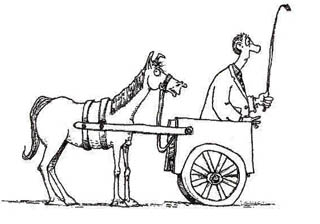
Of Style and Dogma, Carts and Horses

In Mark 7:1-23 we gain some subtle insight into the relationship between outward religious rituals (lex orandi) and the beliefs of those who practice them (lex credendi). After highlighting the extrabiblical nature of the Pharisees' demand that people scupulously wash themselves before eating bread (vv. 6-13), Jesus then gets to the heart of the matter:

And he called the people to him again and said to them, "Hear me, all of you, and understand: There is nothing outside a person that by going into him can defile him, but the things that come out of a person are what defile him" (vv. 14-16).
Why the abstract lesson on sin? Wasn't the issue supposed to be the amount of hygiene necessary to eat a sandwich?

Well if, as I have been arguing, a church's worship shapes its member's beliefs every bit as profoundly as its beliefs shape its worship, then Jesus' excursus on indwelling sin may not be as random as it initially appears.

You see, what certainly seems like a harmless religious ritual (ceremonially washing one's hands before eating) had clearly led to a deficient view of sin. In other words, the Pharisees' lex orandi (law of worship) had adversely affected their lex credendi (law of belief). Because they had for so many years been seeking to lessen their defilement by scrubbing their hands every few minutes, they had begun to think of defilement as primarily outward and circumstantial rather than inward and substantial.

Here's how this works in the church today: A church's leaders begin with the question, "What style of music should we have?" They decide that in order to reach the youth, they had better scrap the piano in favor of an acoustic guitar. They quickly realize that certain songs aren't easy to play on a guitar ("A Mighty Fortress"), while others are ("As the Deer"). Before long, the church's worship style (mellow acoustic music) defines its content (songs with a mellow acoustic feel). And then lo! and behold!, a movement is spawned that sees Jesus as that friendly guy at Woodstock with some real groovy spiritual insight.

But then, the Emergent Church has rescued us from the Jesus Movement, and I, for one, am thankful that none of these concerns can be applied to them....

Tuesday, July 15, 2008

Lex Orandi, Lex Credendi

Liturgical scholars often insist that a church's worship is a direct by-product of what they believe about God. If a particular congregation's leadership considers God to be a kind of magic genie whose job is to do our bidding, then their worship will most likely be narcissistic and consumer-driven. And conversely, if a church understands God to be the sovereign King of the universe, then an atmosphere of reverence and awe will prevail.

At least, so the theory goes.

Unfortunately, this is only half the story. As indicated by the historic slogan lex orandi, lex credendi (literally, "The rule of prayer influences the rule of belief"), the relationship between confession and worship, dogma and liturgy, cuts both ways. In other words, it's not simply the case that a church's worship is the result of her beliefs about God, but it is equally true that her beliefs about God are largely shaped by the way she worships.

History bears this out. Well before the church's Christology assumed its mature, Chalcedonian definition believers were already worshiping a God who subsisted in three divine Persons. Both Augustine and Prosper of Auquitatine appealed to the church's practice of infant baptism in order to refute the Pelagian heresy that children are born without original sin. They were saying, in effect, "If infants are innocent, then why have we been baptizing them all this time?" In Prosper's own words: "Legem credendi lex statuat supplicandi" ("Let the law of prayer establish the law of belief").

If it is true that worship shapes belief as significantly as belief shapes worship, then the ramifications are pretty serious for those churches—whether evangelical or Reformed—that insist on making style a leading factor in how they conduct divine worship. Whether their aim is to woo the unchurched or demonstrate their "relevance" to those coveted artsy-fartsy soul-patched bohemians, the ever-present danger is that Jesus will be transformed from Deus homo into some guyliner-wearing dude in an indy band hoping to land a record deal.

Luther was right, the church will sing its way into idolatry long before its dogmaticians join the party.

Sunday, July 13, 2008

Ties That Bind, Ties That Divide

One of my mates in the OPC recently accused us in the PCA of being "functional congregation-alists." He was responding to something I said about the diversity of our presbytery in areas like worship, theology, and overall philosophy of ministry. As it is elsewhere, it's pretty much live-and-let-live here in the Pacific Northwest.

He certainly has a point.

A denomination as broad as the PCA is bound to get messy and confusing, especially with respect to where we draw our various lines in the sand. On issues of worship, for example, one may identify himself with one set of allies, while he may disagree with those men over issues concerning biblical theology and Pauline eschatology. Conversely, those who share a similar view of the importance of eschatology may differ over whether justification or union with Christ is more central to Christian doctrine and life. And don't get me started on the bedfellows of a confessionalist who believes in women deacons.

I suppose what I'm wondering is whether the diversity and broadness of a denomination like the PCA is an asset or a liability. And if the latter, which issues represent ties that bind, and which are ties that divide?

Thursday, July 03, 2008

A Little Help?

OK, so I'm feeling a tad under-inspired. If anyone has some ideas for topics to discuss, let's hear 'em, because the well's a bit dry at the moment.

Cheers.

Sunday, June 29, 2008

Where to Begin?

As I argued in the comments under the "Bishops, Elders, and Deacons" post, one's position with respect to the number and nature of church offices is informed--if not determined--by where one begins his investigation of the biblical data.

If we start with I Timothy 5:17, a verse that speaks of "elders who rule" and "elders who labor in the Word and doctrine" ("elder" = presbyteros), it would not be surprising that we would conclude that the elder is an ordinary officer in the NT church, and that there are two kinds of elders: the ruling kind and the teaching kind. Then we simply add deacons, stir, let cool, and voila! we have a three-office ecclesiology (or at least 2 1/2).

But it is not altogether obvious to me that this is the most prudent approach. I Timothy 5:17 is a single verse whose context doesn't really have anything to do with the specifics of church office. In fact, it is not certain whether Paul is talking about church offices at all (when you look at the entire chapter, particularly its discussion of fathers, young men, brothers, old women, mothers, young women, sisters, and widows, it is at least possible he is using presbyteroi to refer literally to old men, not the office of elder).

If we seek to understand the nature and number of church offices, therefore, we should begin by looking to I Timothy 3:1-7 and 8-13. When we begin there, we see that Paul lists bishops and deacons with no mention of elders at all (cf. Phil. 1:1). When the clear passages illuminate the less-than-clear ones, it becomes possible, if not likely, that I Timothy 5:17's "elders who labor in the Word" are bishops (or ministers), and its "elders who rule" are deacons (or servant rulers).

So do me a favor and try this experiment: Read Paul's description and qualifications for the deacon, doing your best to forget everything you know about how that officer functions in the modern Reformed church. What we see is that the deacon must be dignified, he must hold to the deep things of the faith, and he must rule his house well.

Kinda sounds like what we expect from a "ruling elder," doesn't it?

Saturday, June 28, 2008

Happy Birthday, Nelson

I don't know about you, but this clip makes me pretty excited about U2's new album due out later this year (it was performed via satellite for Nelson Mandela's birthday). Bono's hitting those high notes like it ain't no thang.

Enjoy.

Wednesday, June 25, 2008

On Bishops, Elders, and Deacons


The series of questions I asked in my last post was meant to soften you all up for the proposal that I, as devil's advocate, will now attempt to make concerning officers in the church. Let the record show that I am merely wrestling with these things and have by no means landed on terra firma yet. Still, I will argue as though I'm convinced of this position, if for no other reason than to see if the view can bear your scrutiny.

My (hypothetical) thesis is as follows: There are two ordinary and perpetual offices in the New Testament church, bishops and deacons. The bishop (or overseer, Greek episkopos) is the minister of the Word, and the deacon (Greek diakonos) is a servant-ruler, an office that combines what we today separate, i.e., the "ruling elder" and the "deacon." And the Greek word presbyteros ("elder") can refer to either bishops or deacons.

Calm down, I haven't even made my case yet....

Paul writes his Philippian epistle "to the church in Philippi, with the bishops and deacons" (1:1). The omission of "ruling elders" can be explained (1) By saying that this church unfortunately didn't have any, (2) By saying that they were included under the category of bishops, or (3) By saying that no such distinct office existed in the churches Paul planted, but the "ruling" and "serving" was done by the deacons.

Option #1 is pure speculation. Option #2 is unlikely given Paul's description of the responsibility of the bishop in Titus 1:9 and Acts 20:28, one that sounds a lot like a trained minister and not a layman. Option #3, however, is most consistent with Paul's instruction to Timothy concerning how to order the church. In I Tim. 3:1-7 and 3:8-13 he lists the qualifications for (drumroll please)... bishops and deacons. "Ruling elders" are, once again, omited.

But when we flip ahead to I Tim. 5:17 we come to what many see as the only real Scriptural support for the contemporary notion of "ruling elders." But given that Paul specifically lists "bishops and deacons" as the church officers in Philippi, and given the apostle's qualifications for bishops and deacons specifically a couple chapters earlier, it makes a lot of sense to let Scripture interpret Scripture by saying that in this verse, the "elder who labors in the Word" is the bishop, and the "elder who rules" is the deacon.

Finally, when we observe (1) That the qualifications in Acts 6:3-7 for members of "the diaconate" include things like being "filled with wisdom and the Holy Spirit" and the ability to, essentially, determine who is a church member and who is not, and (2) That the requirements for deacons listed in I Timothy 3:8-13 include "ruling" their own households well, it seems possible (and even probable) that the "deacon" in the churches Paul planted was responsible to do what we today assign to the diaconate and the session.

In a word, the bishop ministers the Word and sacraments, while the deacons both rule and serve.

Tuesday, June 24, 2008

And Now For Something Completely Different

I realize we're supposed to be talking about D.A. Carson on Christ and culture, but I wouldn't be the über-hip, edgy, ever-relevant PCA guy that I am unless I took up the topic du jour and spent some time talking about officers in the church.

Now, I have a bunch of stuff I'd like to dig into regarding elders and deacons, but since I am going to be at Disneyland all day Wednesday with my family (and thence away from the computer), for now I will kick the discussion off by asking some questions I've been wrestling with.

1. What is the relationship between episkopoi/presbyteroi/ diakonoi, and ministers/elders/deacons?

2. If the episkopos (bishop or overseer) is a minister of the Word as many argue, then why does Paul address his Philippian letter "to the church in Philippi, with the bishops and deacons"? Why does he omit the "ruling elders"?

3. Why does Paul only list qualifications for episkopoi and diakonoi in I Tim. 3, again leaving out the elders?

4. Who are "the [presbyteroi] who rule" and "the [presbyteroi] who labor in the Word and doctrine" in I Tim. 5:17?

5. Were the seven men ordained in Acts 6 "deacons" as we commonly define them today?

6. What was Phoebe (Rom. 16:1)?
The proposal I've been thinking through is, shall we say, rather dissimilar to anything I've heard advocated in Reformed circles (until a private discussion at the PCA's General Assembly a couple weeks ago, that is). I'll put it out there for discussion and critique, hopefully, tomorrow night.

Until then, answer away....

Sunday, June 22, 2008

Speaking Prophetically to the Church

As much as I hate to disagree with my brother Lane Keister, I just can't help myself on this one.

In his recent post entitled How to Avoid a Recession, Lane argues that the way the government must respond to our current economic downturn is by cutting spending and cutting taxes. Now, when libertarian-type arguments begin to take this form, what is almost always meant by "cutting spending" is "cutting spending on programs that the poor benefit from." Characteristically Lane, like many Reformed limited-government advocates, lists such programs as public schooling, Social Security, and welfare as among those areas in which Big Brother has no business sticking his nose.

Maybe Lane's right (but I, for one, don't think this question is solved by an appeal to Romans 13). Still, if he were consistent he would have to include the military-industrial complex as an example of massive government spending of U.S. taxpayer dollars (around $626,000,000,000 in 2007).

But that aside, what irked me about Lane's post and subsequent comments was the idea that the church is to "speak prophetically" to the culture about its sin:

"It is very disappointing to me to see that the church is not seeking to be prophetic in its critique of the government. Should the church ignore sin when the church sees sin? I think not."
Now, what I almost never hear in these kinds of calls to speak prophetically to the state is any defense of what exactly the church, speaking as such, has the authority to tell the government to do or stop doing.

If we're to tell the state to stop overspending, does that include the hundreds of billions spent on the war? If we're to tell the state to enforce the Decalogue's moral demands, does that include covetousness and greed? If we're to tell the state to be tough on crime, does that include the kinds of crime wealthy white people commit?

Rather than speaking prophetically to the culture on earthly matters as a minister of the Word (a task I hardly feel competent to do), I would rather just do what my presbytery actually ordained me to do: to speak prophetically to my church, giving them the law, the gospel, the bread, and the wine.

You know what they say about the Jack of All Trades....

Wednesday, June 18, 2008

What Hath Cairo To Do With Beaverton?

As I mentioned in my last post, D.A. Carson's main criticism of the "pessimism" of D.G. Hart's and Frederica Matthewes-Green's respective positions on the role of the church in culture is that they "fail to see the temporally good things we can do to improve and even transform social structures." Carson then cites abolishing slavery, curing disease, and reducing sex traffic as concrete ways (among "countless others") that "God's redeemed people" can fulfill our "responsibility to do good to the city."

Judging by the number of comments in the last thread, I'd say this has hit a nerve. Let's delve deeper and in greater detail, shall we?

For now, let's start with Carson's first example of how Christians can impact society: abolishing slavery. As has been pointed out already, "slavery" is hardly a univocal concept. The Egyptian subjugation of the Hebrews was evidently bad (though it got the divine thumbs-up later on when the Hebrews were the ones holding the whips). The Roman Empire's version of slavery, however, was apparently not evil enough to elicit a condemnation from Jesus, Peter, or Paul. American slavery was clearly an abomination, not only in this writer's opinion but in that of most people outside the bearded of Moscow, Idaho.

Whether or not the "wage slavery" that many have attributed to capitalism, or the sweatshop labor that the "free market" works so hard to perpetuate, qualifies as the kind of slavery that Carson thinks the church should abolish is unclear (I kind of doubt it, since it's always easier to tsk-tsk the crimes that Americans no longer commit than those that we presently associate with God's Own Politics [GOP for short]).

Either way, though, I'm not sure which book of the Bible provides the best tactical approach for putting Nike out of business (maybe Romans or Galatians, since they clearly repudiate the Mosaic works principle of "Just Do It").

But then, if Paul fails to suffice there's always Naomi Klein....

Sunday, June 15, 2008

Gimme an "S"! Gimme an "L"! Gimme an "A-V-E-R-Y!"

In his discussion of the options vying for favor in the contemporary Christ/culture conversation, D.A. Carson interacts with those whose expectations he deems “minimalist” (such as Darryl Hart and Frederica Mathewes-Green).

Citing Hart’s insistence that Kuyperian attempts to integrate faith and scholarship are misguided, and Mathewes-Green’s likening of culture to the weather (we live in it and can even predict it with some accuracy, but changing it is not really an option), Carson argues that if all these authors were doing were offering a warning against utopianism, then all would be well. But such pessimism “fail[s] to see the temporally good things we can do to improve and even transform social structures” (p. 217-18, emphasis original).

Listing examples such as abolishing slavery, curing disease, and reducing sex traffic, Carson maintains that “in these and countless other ways cultural change is possible. More importantly, doing good to the city... is part of our responsibility as God’s redeemed people in this time of tension between the ‘already’ and the ‘not yet.’”

Hmmm....

If “God's redeemed people” are the ones uniquely fit to end slavery and cure cancer, then it must follow that all people who dislike cancer are God's redeemed people, and all who are God's redeemed people dislike slavery. Unfortunately for us all, many anti-abolitionists were southern Presbyterians, but fortunately for us all, many pagans are not huge fans of cancer.

And for my own part, I am not a big slavery- or cancer aficionado. But as I recall, I wasn't much of a fan in my BC days either.

Maybe there is common ground between the old and new me after all.

Saturday, June 14, 2008

High on a Desert Plane

This week's U2 concert is from Paris on their 1987 Johua Tree Tour. It is a really strong performance as well as a perfect recording. As is my wont, I made a few artistic changes, such as:

1. It was one of the only shows on that tour that didn't open with "Where the Streets Have No Name," so I added the version from the Rattle and Hum DVD.

2. On the Joshua Tree tour U2 would alternate their setlists, playing "The Unforgettable Fire" one night and "One Tree Hill" the next. At this show they played the former, so I added a version of the latter as well. The quality isn't quite as perfect, but the performance of the song is great.

3. I added the well-known live (ahem) version of "A Sort of Homecoming" after Electric Co.

4. I edited a bit out of "With Or Without You" where Bono makes the band stop playing so he can yell at a security guy for hassling a fan.

Enjoy.

Tuesday, June 10, 2008

Off to Dallas....

I'll be heading off to Dallas for the PCA's General Assembly in a few hours (it is 4o degrees warmer there than it is here, by the way). I'm not sure if I'll have access to the interweb or not, but either way, U2 Friday will be U2 Saturday this week.

Cheers....

Monday, June 09, 2008

The Clarion Call to Live Quietly

The last of Niebuhr's five options for discerning the relationship between Christ and culture is dubbed "Christ the Transformer of Culture" which, according to Carson's reading of Niebuhr, is not concerned so much with individual conversions, but the conversion of culture itself.

Niebuhr argues that for the proponent of this transformationist motif, eschatology is more "realized" than it is for most other Christians of differing persuasions.
"[The conversionist] lives somewhat less 'between the times' and somewhat more in the divine 'Now' than do his brother Christians. The eschatological future has become for him an eschatological present."
Interestingly, Niebuhr places both John Calvin and John Wesley within this trajectory. According to Carson, Wesley actually strengthens his conversionist heritage by espousing the doctrine of sinless perfection.

I hope to deal with the methodological problems with Niebuhr's approach in a subsequent post, but I do trust that the careful reader will at least scratch his head in confusion over the placing of John Calvin and John Wesley on the same team, regardless of the game.

There are others who could deal with the questionable historical-theological claim that Calvin was a transformationist better than I (Hart? Wenger? Clark? acd?), but I will say that the idea that Calvin was all about transforming Geneva is somewhat suspect, not in the least because, as a French refugee in the city, he had no real power in the first place.

Biblically-theologically, though, I am certainly more than competent enough to challenge the idea that Niebuhr, by his lack of negative criticism, tacitly endorses, i.e., that Jesus wants to change the culture from common to holy. Despite the fact that Jesus, Paul, and Peter all spoke of the role of the believer in society, none of them waxed more inspiring than simply calling their hearers to live quietly and mind their own business.

No, such a message won't sell many best-selling books, but if the goal is to call out from this present earthly kingdom a holy city for the glory of God, then it sounds just about right.

Friday, June 06, 2008

The Vertigo Tour As It Should Have Sounded

Sorry for beginning this week's U2 Friday a few hours late (I was up late watching the Lakers lose, but I'd rather not go there).

This week's free download is a really superb show, despite all the negative things I said last week about the "New Millennium" incarnation of the band: U2 Live from Chicago (Vertigo Tour, 2005). The band, as always, sounds perfect, and Bono's voice is incredibly strong (it was early in the tour, after all).

Now, I must say a word to those of you who own the DVD from which this audio is ripped. As you may have discerned by now, I am very opinionated about U2's concert setlists, which is why I have taken some liberties here, such as:

1. I have replaced "Elevation" with "Gone" from their Boston 2001 show. This song should remain in U2's live arsenal, even though it's from Pop (which is a much better album than most will admit). Plus, "Elevation" is kind of lame, at least in the way they played it this time around. The transition from "Vertigo" to "Gone" is pretty seamless, as I always combine edited tracks into one file to make the transtition less noticeable.

2. I added "Until the End of the World" after "An Cat Dubh/Into the Heart," which is where the band should have played it.

3. I got rid of "New Year's Day." Lads, either reinterpret the song or move on, please.

4. I added "Kite" before "Sometimes You Can't Make It On Your Own." It fits, and it's one of those songs that deserves to be played for longer than just the tour that supports the album it's on. How the band doesn't get this is beyond me.

5. I replaced "Pride" with "Please" from Rotterdam '97. "Please" is another song that gets overlooked because it's from Pop, but in my view it deserves a place is the band's ongoing live repertoire (from which "Pride" needs to be mercifully expunged).

6. Lastly, just before "40" I added "Walk On." Again, it annoys me that U2 claims not to want to become a Greatest Hits Band, but they almost always fall back on their '80s classics while letting their good new material die after its respective tour ends. "Walk On" holds up, and they should have played it.

Enjoy the show....

Thursday, June 05, 2008

Between Heaven and Earth

Niebuhr's fourth option, "Christ and Culture in Paradox," is assigned to "dualists" such as the "true Lutheran [who] finds life both tragic and joyful." The dualist motif is also found in Paul, Marcion, and Augustine.

Although D.A. Carson finds all five of Niebuhr's categories for determining the relationship of Christ and culture to be problematic (an assessment with which I heartily concur), it is difficult not to sympathize with this paradoxical option, however falsely arrived at.

"Living between time and eternity, between wrath and mercy, between culture and Christ, the true Lutheran finds life both tragic and joyful. There is no solution to this dilemma this side of death."
It is precisely this tension between the already and the not yet (not to mention between iustus and peccator) that accounts for the love/hate relationship the believer has with the world around him. He hates the world while loving it, and both legitimately. He fears turning earth into a false god, but resists turning it into a false devil either. He insists that secular culture is not demonic, but also admits that it's not divine.

In a word, the Christian experiences all the messiness (forgive the emergent rhetoric) of dual citizenship, while rarely, if ever, feeling truly "at home" anywhere. As Conor Oberst put it, "My mind races with all my longings, but can't keep up with what I've got."

For my own part, while I know that all my unfulfilled longings are really longings for heaven in disguise, such knowledge doesn't change the fact that earth can look pretty good, too.

Tuesday, June 03, 2008

Battlefield Earth

Most of you will remember that, about twelve seconds after the Twin Towers toppled, right-winger Jerry Falwell confidently concluded that the blame for America's suffering should be laid at the feet of the ACLU (and the gays, but that goes without saying).

In similar fashion, left-winger Sharon Stone has recently opined that the earthquake in China was karma's way of punishing the country for its oppresive treatment of Tibet.

It seems, then, that defending civil liberties makes God angry, while failing to defend them makes karma angry. Talk about being "damned if you do, and damned if you don't," for regardless of which side of the aisle you're on, you're apparently moments away from utter annihilation.

Once again, the liberals and conservatives demonstrate that they're all playing for the same team. And with the battlefield being this present age, I'd say "Team Earth" had better kiss and make up rather than all this in-fighting over whose worldly agenda to idolize.

And amid all this laying claim to the earthly title of "Champion of the Culture War," the confessionalist bemusedly and patiently taps his fingers on the pew and waits for the passing of the bread and the wine.

Monday, June 02, 2008

The Incarnation: A Good Start?

The third of Niebuhr's five options for determining the relationship of Christ to culture is "Christ Above Culture," and is, according to him, the majority position in the history of the church.

This view, Niebuhr argues, insists that:
"... Christ and the world cannot be simply opposed to each other. Neither can the 'world' as culture simply be regarded as the realm of godlessness; since it is at least founded on the 'world' as nature, and cannot exist save as it is upheld by the Creator and Governor of nature.... We cannot say, 'Either Christ or culture,' because we are dealing with God in both cases. We must not say, 'Both Christ and culture,' in full awareness of the dual nature of our law, our end, our situation."
Advocates of this "synthesist" position include Justin Martyr, Clement of Alexandria and, most importantly, Thomas Aquinas who, according to Niebuhr, managed to combine without confusing "philosophy and theology, state and church, civic and Christian virtues, natural and divine laws, Christ and culture."
"Thomas's synthesis was not only an intellectual achievement but the philosophical and theological representation of a social unification of Christ and culture."
On of the greatest problems wth this approach, argues D.A. Carson, is that it ignores just how culturally conditioned such syntheses really are. Just like the Jesus of Harnack and Herrmann looked suspiciously like a nineteenth-century German liberal, so the Jesus of the contemporary advocates of "Christ Over Culture" looks, well, just like us.

I find it curious that in the thinking of many, the incarnation of the Son of God is considered to be a mere first step towards Christ incarnating himself to become "the express image" of whoever our target audience happens to be. Perhaps the Market's obsession with demographics has subtly taught us that incidentals such as income and race are so profound that the Son's merely becoming Man was not enough to convince us of God's earnest desire to be relevant.

But take the next step and make Jesus "my homeboy" and I'll buy the T-shirt.

Friday, May 30, 2008

New Millennium U2

U2 Fridays continue as we turn our attention to “New Millennium U2.” First, though, a couple orders of business: I plan to make one concert from each tour available for download (each for a limited time). Last week we did Zoo TV, this week’s is from 2001’s Elevation Tour in Boston (many think the Slane Castle show was better, but I like this set list much more).

I actually vacillate quite a bit about U2’s last two albums (2000’s All That You Can’t Leave Behind and 2004’s How to Dismantle an Atomic Bomb). Don’t get me wrong, I really want to like them, and sometimes I really do, but there’s also some cringing involved as well.

ATYCLB was hailed as “U2’s third masterpiece” (I trust I don’t need to tell you what the first two were). In my view, this album has some high highs (Kite, Beautiful Day, Walk On), but unlike their other two magna opera, it also has some pretty low lows (Wild Honey, Peace on Earth).

HTDAAB, I think, is the better of the two. Its best songs (Original of the Species, City of Blinding Lights, Crumbs From Your Table) may not have the staying power of Beautiful Day, but its lows (A Man and a Woman) aren’t as low as Peace on Earth, either.

On to Bono’s lyrics. He has obviously stopped trying to consciously write beautiful lyrics (which he hasn’t done since 1988’s Rattle and Hum), but sometimes it seems like he’s stopped trying altogether:

“Freedom has a scent, like the top of a newborn baby’s head.”

“I like the sound of my own voice; I didn’t five anyone else a choice; an intellectual tortoise, racing with a bullet train.”

“Where I grew up there weren’t many trees; where there was we’d tear them down and use them on our enemies.”

“In New York summers get hot, well into the hundreds; You can’t walk around the block without a change of clothing.”
(And don’t even get me started on the whole “monkey stealing honey” debacle.)

Still, when you see or hear them live, they’re still the best band in the world. I just wish Bono would take better care of his voice so it holds up until the tour ends. And lads, drop me a line and I’ll help you choose your set lists….

Tuesday, May 27, 2008

Aristocratic Missionalism

The second of Niebuhr's five options regarding the relationship of Christ to culture is dubbed "The Christ of Culture." This position, Niebuhr argues, is adopted by those who hail Jesus as the Messiah of their society, and has been represented by the early Gnostics, Abelard, John Locke, Immanuel Kant, Thomas Jefferson, and the various "culture-Protestants" who have dominated the religious scene since the eighteenth century.

Advocates of "The Christ of Culture" are to be congratulated, Niebuhr maintains, for making Jesus appear less alien than he does in the "Christ Against Culture" mindset.
"The cultural Christians tend to speak to the cultured among the despisers of religion.... They are missionaries to the aristocracy and the middle class, or to the groups rising to power in a civilization. "
The main difficulty with this view, argues Niebuhr, is that its watered-down flavor is so diluted that it fails to win the respect of true pagans or the truly pious. Carson remarks that:
"[Pagan writers] suspect that what is to them a compromised position will weaken the purity of their paganism, or of their liberalism, or of their Marxism—just as, from the other side, the orthodox suspect that these cultural Christians have sacrificed too much of what is essential to Christianity. "
From where I sit, I see a disturbingly fair amount of this "aristocratic missionalism" in my own circles. The main difference, though, is that the much-coveted prize is not so much the respect of politicians or scientists as it was in Niebuhr’s day, but the props of the bohemian, soul-patched Gen X-er (the well-inked Gen Y-er works, too, but he doesn’t tithe).

The way this plays out in the contemporary scene is in our obsession with "the arts" and "the city," and our palpable disinterest in anything that likes NASCAR, wears a blue collar, and rocks a John Deere cap unironically.

In biblical terms, these are the same people who would have bragged to Jesus about how impressively ornate their temple was, right before he pronounced that not one of its edgy, postmodern stones would be left upon another.

Sunday, May 25, 2008

Carson on Niebuhr: Christ Against Culture

In D.A. Carson's Christ and Culture Revisited, the author seeks to bring some biblical-theological insights to bear upon H. Richard Niebuhr's famous work, Christ and Culture. The project sounds welcome enough, but I'm not far enough in to the volume to really see what Carson is attempting to do just yet.

The first of Niebuhr's five options for understanding the relationship of Christ and culture with which Carson interacts is Christ Against Culture. Citing Tertullian as an advocate of this approach (Christians are a "third race" distinct from Jews and Gentiles), Carson sums up Niebuhr on this point thus: "... for the Christian, political life must be shunned, and so also military service, philosophy, and the arts." Included within this group would be certain Mennonite groups, the early Quakers, Leo Tolstoy, and, Carson adds, Stanley Hauerwas.

This position is inadequate, Niebuhr argues, since escape from one's culture is an impossibility. At the end of the day, Tertullian is a Roman and Tolstoy a Russian, whether they wanted to admit it or not. Among the various theological problems with this approach is the subtle assumption that while sin abounds "out there" (in the culture), it is largely absent "in here" (in the believer).

It seems to me that the root of many evangelical myths and misunderstandings about "the world" is seen at this very point. The world is almost purely demonic while the Christian bubble is virtually divine, when in point of fact, common grace makes the culture much better, and spiritual pride makes the church much worse, than most evangelicals want to admit.

For my own part, I see the doctrine of the two kingdoms as providing the necessary basis for the kind of cultural engagement during which one need not cross his fingers or grope for the underlying redemptive significance of the Lakers losing game three to the Spurs Sunday night.

In a word, the culture must not be made into a false idol, but it need not become a false devil either.

Friday, May 23, 2008

Carson on Christ and Culture


I have been asked to review D.A. Carson's new book, Christ and Culture Revisited, for Modern Reformation magazine.
I plan to blog my way through it as I go, so stay tuned....

Tuesday, May 20, 2008

All the Secrets, But No One to Tell


Man, this place is a snoozefest lately....

Maybe this will wake you all up, it's a perfect recording of the best show U2 ever played.
Enjoy.

Monday, May 19, 2008

Look! There in the Wilderness: It's a Pilgrim, It's an Exile, It's... Patiently Enduring Man!

When I initially saw the trailer for the film Iron Man, I think I actually laughed out loud (and not the good kind of laughter, mind you). But to my surprise, it has received a 93% on the Tomato Meter, which culls together of all the reviews a film receives nationwide. Plus, I was told today that Robert Downey Jr.'s character doesn't actually have superpowers, he's just rich and can afford to invent the cool gadgets that make him a superhero (you know, like Bruce Wayne). So maybe I'll swallow my pride and see Iron Man after all.

Still, I think the whole "superhero" phenonmenon betrays a not-so-subtle theology of glory that is very American, not to mention evangelical/postmillennial. By contrast, Reformed confessionalists ought to feel a certain discomfort when such "super," "amazing," and "fantastic" expectations are imported into the Christian life.

Now if Reformed amillennialists could sponsor their own superhero, it would be a huge box office flop. Picture, if you will, (drumroll please)... "Patiently Enduring Man." In addition to the "P.E." embroidered on his otherwise unremarkable chest, he would known for his ability to stand in long lines without getting too annoyed, sit in the waiting room at the dentist's office and calmly read two-year-old issues of People magazine while waiting for his name to be called, and basically be content to plod his way through largely ordinary and humdrum life.

And while Batman is portrayed on the big screen by Christian Bale, and Spiderman by Toby McGuire, Patiently Enduring Man would be played by Michael Gross, the guy who starred as Mr. Keaton on Family Ties.

You see, as woefully unsexy and unappealing as the virtue of patient endurance may be in the world's eyes, it is what the believer in this age is called to exhibit. And if such a calling just isn't "authentic," "urban," or "contextual" enough, it's best you bow out of the game now, rather than run the risk of facing the same fate as that archetypal Patient One, whose gig was such a box office flop that they crucified him for it.

Sunday, May 18, 2008

U2 At Their Best

(Unfortunately I will not have internet access until late Monday, but feel free to comment anyway and I’ll respond when I can.)

In my view, the 1990s gave us U2 at their artistic peak (there, I said it).

Here’s why I think so….

If U2 had done what many wanted them to do (and what many bands in fact did), namely, kept doing what made them famous by recording The Joshua Tree Part II, Part III, Part IV, and so on, then today when we heard the name “U2” we would say: “Oh yeah, U2. Weren’t they that Scottish band from the eighties with the singer prancing around waving that white flag? What ever happened to those guys anyway?”

But by reinventing themselves and seemingly repudiating their former earnest selves (remember: Bono described the sound of their then-forthcoming 1991 album Achtung Baby as “the sound of four guys chopping down The Joshua Tree”), they really did breathe new life into a career that they were all pretty bored with anyway.

The best album of their ‘90s threesome was, of course, Achtung Baby. It was dark (it works best at night, you know, unlike The Joshua Tree, which should be listened to in broad daylight), it was sensual, and it was very European. Everything changed with this album, especially Bono’s songwriting. Instead of overt attempts at beauty, it was all about irony: “Every artist is a cannibal, every poet is a thief. All kill their inspiration, then sing about the grief” (The Fly); “She wears my love like a see-through dress, her lips say one thing, her movements something else” (So Cruel); “To touch is to heal, to hurt is to steal; If you want to kiss the sky, you’d better learn how to kneel” (Mysterious Ways).

I’ll narrow things down even more. There was a night when U2 actually reached their zenith, a high point that I doubt they’ll ever reach again. That night was August 28, 1993 (and yes, it depresses me that this was 15 years ago). That night they played the RDS Stadium in Dublin, and speaking as someone who owns scores of U2 bootlegs, this was the best show they have ever played. Bono’s voice was perfect (remember those days?), the setlist was almost ideal, and with the exception of one screw-up by Edge during One, the band was spot on.

On that night more than any other, being U2 fan was the coolest feeling in the world.

Thursday, May 15, 2008

The Late, Great, Planet 'Net

I will be out of town until Saturday evening, meaning that this week's U2 Friday will be pushed to Monday. Not that it matters, since lately it seems like the cyber-rapture has occurred, leaving the hallowed halls of the worldwide web desolate and empty.

If I need a microchip implant to log in to my Blogger account when I return, I will owe Mike Seaver a huge apology....

Tuesday, May 13, 2008

Patron Saints of Earth

Concerning G.K. Chesterton’s view of sainthood, Dale Ahlquist observes that one of the saint’s most profound characteristics is not his saintliness, but his humanness.

“[Saints] are just like us, with all the human variety and frailty and fascination and personality and pain and talent and lack of talent that you expect to find in any human being.”
Far from being the halo-crowned type of mystic, Chesterton says, a true saint has his hands in the dirt rather than his head in the clouds. Saints can afford to be dirty, he argues, while the seducer must be clean.

Of course, the Reformed insistence upon the tension between the already and the not yet demands that a saint be both otherworldly and worldly. “Head in heaven, fingers in the mire” in the words of one poet, “The face of a sinner, but the hands of a priest” in the words of another.

It is here that the seeming heaven/earth dialectic appears in its most acute form. If we turn earthly pleasure into a false god we err on the one side, while we err on the other by turning it into a false devil. It was not a rebellion against hell that caused Lucifer to lose favor, but a rebellion against a proper angelic enjoyment of heaven. Likewise, it was not Adam’s enjoyment of earth that precipitated his fall, but it was his failure to enjoy earth creaturely, that spelled his undoing.

In a word, just as it is wrong to enjoy earth too much, it is equally wrong to enjoy it too little.

Monday, May 12, 2008

Boring Sights Or Bored Sightseers?

Continuing our look at G.K. Chesterton's call for secular, world-affirming Christianity, I'd like to turn our attention to the believing response to what the Reformed call common grace. Chesterton writes, "The world will never starve for want of wonders, but only for want of wonder." He adds:
"What is now needed is the most intensive imagination.... It is not merely seeking new experiences, which rapidly become old experiences. It is really learning how to experience our experiences. It is learning how to enjoy our enjoyments."
In other words, there are no boring sights, only bored sightseers.

A line of Conor Oberst's comes to mind in the Bright Eyes song Road to Joy: "My mind races with all my longings, but can't keep up with what I've got." The point being made here is that we mustn't lose amid our eschatological, future-focused hopes the ever-present joy of the earthly, the simple, and the wonderfully mundane.

"Men rush towards complexity," Chesterton says, "but they yearn towards simplicity. They try to be kings, but they dream of being shepherds."
"The point of the story of Satan is not that he revolted against being in hell, but that he revolted against being in heaven. The point about Adam is not that he was discontentedwith the conditions of earth, but that he was discontented with the conditions of the earthly paradise."
A sense of wonder and enjoyment of the providential blessings of earth is essential to true humility, and is also a direct by-product of a robust, two kingdoms-driven love for all things ordinary. Sometimes we become so obsessed with the next big thing that we barely notice how good the beer tastes that we're drinking while we dream.

Children, Chesterton points out, are constantly asking grown-ups (often to their frustration) to "Do it again!" Well, he concludes,
"... perhaps God is strong enough to exult in monotony. It is possible that God says every morning, 'Do it again' to the sun; and every evening, 'Do it again' to the moon."
World without end. Amen.

Friday, May 09, 2008

U2 Friday, Part Two

U2 Fridays continue here at De Regnis Duobus, this week focusing on one of the two best epochs of the band’s history, as well as upon one of their two best album triads. The years under consideration are 1984 – 1988, and the albums being discussed are The Unforgettable Fire, The Joshua Tree, and Rattle and Hum.

1984’s The Unforgettable Fire marked a radical departure for the lads. Gone were the anthems, the rebel songs, and the white flags that decorated the stage during the War Tour. This album was very European and quite sensual (by which I mean the very opposite of cerebral). Most of the songs can be likened not so much to stories being told, but to pictures being painted (“Carnival, the wheels fly and colors spin, through alcohol, red wine that punctures the skin. Face to face, in a dry and waterless place”). No, it doesn’t make much sense, but that was due to producer Brian Eno’s insisting that Bono improvise most of the lyrics. In fact, the penultimate song (“Elvis Presley and America”) resulted from Eno playing some random, slowed-down music backwards and handing Bono a mike and telling him to improvise one take, which is what appears on the album (“And you know, though no one told, you tried; and your heart is left out from the side”). Amazing stuff.

1987’s The Joshua Tree is perhaps the band’s best album (certainly the best of this threesome). Unlike its predecessor, this is American through and through (the band originally wanted to call it The Two Americas). Whether The Joshua Tree is U2’s best effort or not, I would certainly argue that it represents the band at their lyrical best. Some great lines include: “She runs through the streets with her eyes painted red, under a black belly of cloud in the rain. In through a doorway she brings me white gold and pearls, stolen from the sea” (“Running to Stand Still”); “She stands with a naked flame; I stand with the sons of Cain, burned by the fire of love” (“In God’s Country”); and “I don’t believe in painted roses or bleeding hearts while bullets rape the night of the merciful” (“One Tree Hill”).

Rattle and Hum (1988) is the soundtrack to the film by the same name. An eclectic mix of live recordings and new songs, I find it hard to listen to all the way through. I prefer to skip songs like “Pride” (which I rarely like when played live) and “Freedom For My People” (obviously). The song that stands out, in my opinion, is “Heartland” (“Freeway, like a river, cuts through this land into the side of love like a burning spear”). And though I’m not a huge fan of “When Love Comes to Town,” I love the line, “I was there when they crucified my Lord; I held the scabbard when the soldier drew his sword; I rolled the dice when they pierced his side, but I’ve seen love conquer the great divide.” In the words of B.B. King (who sang that line) to Bono: “You mighty young to write such heavy lyrics!”

I miss ‘80s U2….

Tuesday, May 06, 2008

Puritans, Pagans, and the Proper Place for Pleasure

It has been observed that there are three kinds of people in this world: those who can count, and those who can't.

G.K. Chesterton has a different take on how to classify people, arguing that there are two groups into which a large majority of mankind can be placed: puritans and pagans. The former tends to make innocent things seem guilty, while the latter tries to make guilty things seem innocent. Both are obsessed with the trivial, with puritanism displaying indignance, and paganism devotion, toward things that don't really matter. The problem with both, Chesterton argues, is that they lack the common sense needed to put pleasure in its proper place.

Chesterton drew an interesting parallel between the puritan and the gnostic. Both, he said, attempted to portray the physical world as evil. "Idolatry," he writes,
"... is committed, not merely by setting up false gods, but also by setting up false devils.... Sin is in a man's soul, not in his tools or toys."
His point was that the puritan-slash-gnostic avoidance of legitimate pleasure is merely a reaction against the pagan pursuit of it. The incarnation of the Son of God, Chesterton insists, avoids the pitfalls of a fear of the spiritual on the one hand and the physical on the other.

What Chesterton seems to be arguing for (though he wouldn't use these terms) is a kind of secular, worldly Christianity that does not merely hold its nose and begrudgingly make peace with the culture, but embraces it, and its legitimate pleasures, with open arms, thanksgiving, and wonder. "Drink," he urges the believer, "because you are happy, but never because you are miserable."

If you'll forgive the "emergent" po-mo rhetoric, it seems to me that a robust, embodied, world-affirming Christianity does more justice to both the incarnation of Christ and the imago Dei in man than does the world-flightiness of much of the American church, whether evangelical or Reformed.

Score "one" for the Catholics.

Sunday, May 04, 2008

Good Mourning

As with the first beatitude, the second focuses more on the outward circumstances, rather than the inner disposition, of its subjects. Just as “blessed are the poor in spirit” describes a willingness to suffer material loss for the sake of the kingdom rather than a sense of inner, spiritual bankruptcy, so “blessed are those who mourn” has more to do with lamenting the seeming suspension of God’s justice in this world than it does with feeling sad in our hearts.

Comparing Matt. 6:4 with the corresponding beatitude in Luke’s gospel is helpful here. He doesn’t say “blessed are you who weep in your hearts,” but “blessed are you who weep now, for you shall laugh” (6:21). The contrast, then, is not between the inward and the outward, but between the present and the future.

I mean, anyone can mourn—it’s as easy as reading the morning paper, getting irritated, and resolving to do something about the direction this world is heading. The hard part of the beatitude is the second half (the part that postpones our comfort to a future time). In a word, what we do with our mourning reveals where our heart’s treasure lies. And if this is true, we may justly shudder as we consider the this-worldly nature of the hope that characterizes much the evangelical and Reformed church.

What makes this beatitude especially astonishing is how different its ethos is from that which was espoused in the Old Covenant law. Even a cursory reading of the second half of Deuteronomy 28 will amply demonstrate that, according to Moses, “Cursed are those who mourn.” Israel, as an earthly type of heavenly glory, was expected to exhibit military might and material abundance as tokens of God's favor, and any failure to prosper was indicative of Yahweh’s displeasure. Jesus, it seems, overturns that principle altogether, and Paul, echoing him, actually appeals to his own experience of what used to be considered covenant curses in order to validate his own apostleship.

From a human perspective, it’s no wonder these men were killed.

Friday, May 02, 2008

A New Topic for Fridays

Now that we have dedicated the last several Fridays to discussing (read: arguing about) the best music, films, and television of the past three decades, I would like to focus our attention for the next few Fridays on arguably the best rock band of the last thirty years: U2.

In my view, a question like "Which U2 album is the best?" is virtually unanswerable—not because they’re all great, but because there are, by my count, four distinct U2s.

Let me explain….

The albums released in 1980, 1981, and 1983 (Boy, October, and War) are so different from what they put out during the rest of the decade that they belong in their own category. The same goes for ’84, ’87, and ’88: The Unforgettable Fire, The Joshua Tree, and Rattle and Hum form a threesome (I almost said “trinity”) that stands on its own. And the other two U2s, of course, are Nineties U2 (1991’s Achtung Baby, 1993’s Zooropa, and 1997’s Pop) and New Millennium U2 (2000’s All That You Can’t Leave Behind and 2004’s How to Dismantle an Atomic Bomb).

Early ‘80s U2 was awesome. Growing up in Orange County I used to listen to KROQ 106.7 as a kid, and to this day I remember where I was when they played "New Year’s Day" in 1983. As a lad of ten I recognized how good these guys were. I went to Licorice Pizza (!) and bought War (the best of the first threesome), and the rest, as the fella said, is history.

My favorite song on War is, brace yourself, "Like a Song" ("Angry words won’t stop the fight; two wrongs won’t make it right; a new heart is what I need; O God, make it bleed"). "Drowning Man" and "New Year’s Day" are runners up.

And I don’t care what anyone says, I like the October album, which was their sophomore effort (you know, the one about God?). I have a killer, and very rare, live version of "With a Shout" ("I want to go to the foot of Mount Zion, to the foot of he who made me see"). Best song on their debut album Boy? Either "Another Time Another Place" or "Shadows and Tall Trees" ("Do you feel in me anything redeeming? Any worthwhile feeling? Is this life like a tightrope hanging from my ceiling?")

And yes, I own the original British LP of Boy with the shirtless kid, Peter Rowan, on the cover. Jealous?

Thursday, May 01, 2008

A Confession

I got to, umm, come clean about something. Whew, this is awkward.... OK, here goes: In the interest of full disclosure, I have to admit that I've been two-timing you all by agreeing to contribute to another blog. But I promise, it's just blogging, it means nothing to me. You, the faithful reader of De Regnis Duobus, you're the one I really care about. When I'm with them, I'm thinking about you the whole time, I swear.

So... we cool?