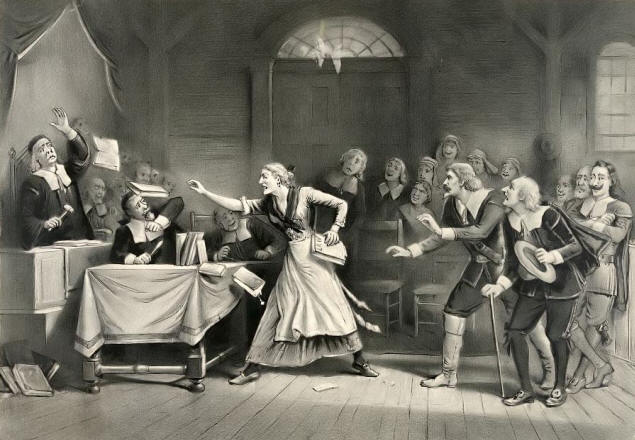
Wednesday, December 10, 2008

You Want Bread and Wine With That Eschatology?

In chapter 2 of his Recovering the Reformed Confession, R. Scott Clark sets his sights on what he call the “Quest for Illegitimate Religious Certainty” (hereafter QIRC). Clark writes:

QIRC is the pursuit to know God in ways he has not revealed himself and to achieve epistemic and moral certainty on questions where such certainty is neither possible nor desirable.
Clark lists three examples of the QIRC that rear their heads in Reformed churches today: six-day, 24-hour creationism, theonomy, and covenant moralism as exemplified in movements such as the Federal Vision. In each of these cases there is an epistemological tension—whether between Scripture and science, the civil and the spiritual, or justification and sanctification—that the Reformed believer simply cannot endure. Hence his quest.

Instead of turning to the Reformed confession, however, many Reformed folk have turned to a kind of rationalism in an attempt to find certainty by elevating a particular interpretation, application, or use of Scripture above the Reformed faith itself. These folk then use their interpretation of Scripture as a mark of orthodoxy and/or sort of prophylaxis against enemies foreign and domestic, real and perceived.
For my own part, I can’t help but wonder why anyone who can’t abide a little tension now and then would ever bother to become Reformed. It is rather ironic that we are often chided by our evangelical friends for wanting our theology airtight and pristine, only to be yelled at ten minutes later for our unwillingness to open the Bible and declare with certainty how long it took God to make the earth or whether Jesus hates Barack Obama as much as James Dobson does.

The Reformed often receive the same tsk tsk-ing from our Catholic friends. Our ecclesiology is anything but tidy (heck, half the time we wouldn’t even have one if there weren’t an evil and corrupt Roman edifice to throw eggs at). But notwithstanding the Reformed refusal to make epistemological certitude the summum bonum of our existence, let it never be said that we walk by sight or lose too much sleep over not knowing everything.

All that thinking gives us a headache anyway, so just let us enjoy our eschatology semi-realized with an appetizer of bread and wine to tide us over until the real meal arrives.

Monday, December 08, 2008

Celebrating the Ecclesiastical Pigpen

Reformed Christians tend to be very skeptical when it comes to putting too much stock in human faithfulness (that pesky Total Depravity thing inevitably rains on our parade). In a word, we like it when God does stuff for us. Appropriately, then, Michael Horton writes:

Taking the catholicity of the church entirely out of our hands, election proscribes all overrealized eschat-ologies, whether they identify the pure church with a universal institution [read Rome] or with the sum total of the regenerate [read Münster]. Only in the eschaton will the visible church be identical with the catholic church. The union of Christ and his body—the one, holy, catholic, and apostolic church—is the eschatological communion of the elect, chosen “in Christ before the foundation of the world to be holy and blameless before him in love” (Eph. 1:4).
Horton argues that Calvin, following the Augustinian heritage generally, seen the Father’s election as the locus of the church’s catholicity.

It is this church that is indefectible. It must always have its visible expression in every era, but this visibility is always ambiguous because the church is a mixed assembly and even the elect are simultaneously justified and sinful.... The covenant of grace is the visible, already/not yet, semirealized form of the glorified communion of the elect in the eschaton.
A properly-realized eschatology necessarily leads to a willingness to settle for faith over sight (a principle betrayed by the Radicals and by Rome, for the former choose sight over faith by their emphasis on the visible piety of church members, while the latter replaces faith with sight by its insistence upon an historical continuity of succession in order to lay claim to ecclesial legitimacy).

The objection on the part of the Catholic or Orthodox believer will undoubtedly be that a so-called mark of the church such as catholicity that is invisible to the human eye is no real mark at all, for “invisible marks” are not only oxymoronic but are also useless for actually helping anyone locate the real church amid a myriad of pretenders. The real question for all of us, then, is how pristine an ecclesiology we have the right to demand, or, how messy an ecclesiology we are willing to tolerate.

Saturday, December 06, 2008

All We Need is Just a Little Patience

As the previous thread of comments aptly demonstrates, Reformed theology is all about faith now and sight later (or to employ Luther’s famous distinction, our present theology is one “of the cross,” while a “theology of glory” is relegated to the future).

Michael Horton applies this eschatological tension between the already and the not yet to ecclesiology, and to the church’s unity and catholicity in particular. “No ecclesiology is adequate,” he writes in People and Place, “that fails to acknowledge the mystery and reality of ongoing sin in the believer and also in the church.”

… our confession of “one holy catholic and apostolic church” remains significantly an article of faith that, like our justification, is not always experienced. [Quoting Oswald Bayer]: “Our age is not short on experiences, but on faith. But only faith creates a genuine experience of the church.”
The church, like the individual, is simultaneously justified and sinful and constantly stands in need of being constituted the people of God by means of covenant renewal. Thus “the visible church is always put in the position of having to receive its identity from outside of itself.”

… the church as it is in this age already participates in the eschatological kingdom. Despite the church’s compromised, ambiguous, schismatic, and sinful character, the covenant of redemption ensures that our unfaithfulness will not have the last word…. In the resurrection of the dead, the so-called invisible church—the communion known only to God—will become fully visible. The totus Christus is affirmed, therefore, but in covenantal rather than Platonic terms. Its frame of reference is treaties of peace rather than ladders of being.
The real question for the Reformed believer (and the amillennialist in particular) is how much we are willing to presently forego. Can we patiently endure the seemingly inglorious and ignoble failure of the church to look to our eyes the way Jesus says she looks to his? Can we walk by faith instead of by sight?

Wednesday, December 03, 2008

What Happens When We Read the Scriptures as Scripture?

Over at the blog Pontifications, the author (Alvin Kimel) makes some interesting observations with respect to biblical hermeneutics. Kimel begins by stating that any biblical passage must be interpreted within its larger context in order to ascertain its literal meaning and authorial intent. Little shock there. But what happens when a six-chapter book like Galatians, a few hundred years after it is written, now finds itself to be but a small part in a sixty six-chapter book like the Bible? All of a sudden, the context of Galatians is much larger than it is when consid-ered in isolation.

Why is this significant? Well, if Galatians is not a book but a chapter in a Book, and if that Book of which Galatians is a chapter is authored ultimately by God, then in the same way that Galatians 4 must be read in the light of the epistle’s other five chapters, so Galatians as a whole must be read in the light of the rest of Scripture in its entirety. And if context determines and expands a text’s meaning, then the epistle’s human authorial intent may not be the same as its divine authorial intent. In a word, when we read Galatians as Scripture, its literal meaning may or may not be identical to its canonical meaning.

This, Kimel argues, is why the grammatical-historical method of interpretation alone is insufficient for determining a biblical text’s true significance. According to this approach, anyone can interpret the Bible provided they have the requisite tools and employ the proper methodology. “Poppycock!” Kimel says (or at least he would have if he appreciated how awesome that word is). The Bible is not like any other book, nor is it merely a species of a broader genus known as “Holy Writings.” Scripture is sui generis, unique, one-of-a-kind, meaning that even if a passage’s literal meaning can be deduced, its sensus plenior—or fuller sense—is beyond the grasp of the mere earthling.

The point, as the Reformers insisted, is that the Bible is the church’s book and must be interpreted in conjunction with, and never in isolation from, those who have gone before us. Moreover, Kimel (citing Swinburne approvingly) draws the conclusion that if Paul himself taught a seminary class on his own writings, his voice would be but one of many seeking to determine the true meaning of the epistles he penned. And further still, since the Bible is unique and one-of-a-kind, the rules for interpreting it cannot arise from Scripture itself (any more than I could invent a new language and then write a book attempting to teach you, in my new language, how to speak it). No, Kimel says, hermeneutical principles must arise from within the community to which Scripture has been given, and from which it has emerged. And more specifically, the task of interpreting Holy Writ is given to those who have been set aside and ordained for the task, i.e., ministers of the Word lawfully called.

So much for American, egalitarian, Bible only-ism….

Monday, December 01, 2008

Leggo My Bible!

After interacting with Calvin’s view of holy orders in which the Geneva reformer admits the sacramental nature of “true and lawful ordinations,” the President of the Upper Crust Theological Society writes:

I wonder what implications might follow for the Protestant (Reformed) Church today if it recovered this sentiment of Calvin.... How might the Protestant (Reformed) Church view differently its ministers if it understood Ordination to constitute a sacrament in some “true and lawful” sense? The egalitarianism which plagues the Protestant Church today is unlikely to accommodate itself to such an obvious distinction among the members of the Church (the distinction, that is, between those who have and those who have not received this “spiritual grace”).... But taking the time to do exactly that might foster a bit of appreciation for what ministers do, and what we (as lay members of the Church) can get from them—something which we can’t get from, say, our personal devotions, or any other number of the various sacraments we create for ourselves (in our dogged determination to be sanctified by sight rather than faith).
This sentiment is expressed more strongly by Methodist theologian Stanley Hauerwas who suggests that “No task is more important than for the Church to take the Bible out of the hands of individual Christians in North America.”

As confessional and Reformed Protestants our position has always been that the Bible is the church’s book and must be read and interpreted within the community of God’s people. The Westminster Confession states: “Unto this catholic and visible Church Christ hath given the ministry, oracles, and ordinances of God...” (XXV.3).

While the Reformed Protestant would surely agree that “all sorts of people are bound to read the Word of God apart by themselves,” it is also true that “The Spirit of God maketh the reading, but especially the preaching of the Word” an effectual means of salvation (Westminster Larger Catechism 155-56). As I hope to bring up in subsequent posts, properly interpreting Holy Scripture is anything but child’s play.

Some questions for further discussion, then, include: (1) Is Hauerwas overstating the remedy for the individualism and egalitarianism of the American church? (2) How can Protestant churches instill in believers a due appreciation for the unique gifts and calling of their ministers? (3) If true and lawful ordination is a sacrament as Calvin seems to admit, how can this be put into practice given the unfortunate fact that very few of Protestantism’s denominations actually recognize one another in an official capacity? And lastly, (4) Do Reformed churches need some Protestant version of Rome’s Magisterium in order to avoid functioning individualistically? And if so, on what basis may we demand to be heard by Christians outside the jurisdiction of our churches?

Friday, November 28, 2008

Happy Buy Nothing Day!

***From the '06 archives, seemed appropriate***

In order to thoroughly depress myself, I've been reading a lot of social critics lately (everything from the more humorous stuff by David Brooks to the more serious Juliet Schor and Paul Stiles).In one such book I ran across the movement started by the good people over at Ad Busters called Buy Nothing Day. The goal is to convince people to set aside their materialism for one full day (the most popular shopping day of the year, incidently: the day after Thanksgiving). An intriguing proposition indeed....

But then it dawned on me that, as a Presbyterian, I don't just have one day a year to make such a statement to this consumer-driven culture, but I can do it every week.

The Lord's Day has been described as a chance for believers -- who are unashamed citizens of the kingdom of culture six days a week -- to plant a flag in Times Square each Sunday in order to protest the rank consumerism of this age by simply saying "No! Not today...."

After all, it's hard enough as it is for Christians to stand out and be different from the culture around them. But once we surrender the Lord's Day to "the tyranny of the clock and the gods who amuse us," it's almost impossible.

Tuesday, November 25, 2008

Semi-Eschatological Porter

In his chapter on apostolicity in People and Place, Michael S. Horton argues that the church's mission is defined by its marks. Concerning the former, Horton echoes the Reformed confessions in stating that the mission of the church can be essentially likened to a porter's opening and shutting doors. The doors in question are those of God's kingdom, and the means of their opening and shutting are the preaching of the Word of God, the administration of the sacraments, and the exercise of church discipline.

"The triumphant indicative ('all authority in heaven and earth is given to me') is the basis for the imperative ('go therefore and make disciples of all nations, baptizing... and teaching,' Matt. 28:18-20)."
The way church discipline is exercised is by means of the keys of the kingdom being entrusted to its ordained officers. By commissioning his disciples with this authority, Horton argues, Jesus "explicitly announced a union of the sign (ministerial binding and loosing 'on earth') and the thing signified (magisterial binding and loosing 'in heaven')." This means that though churchly authority is ministerial and not magisterial, it is more than mere witness.

Now the question could arise about how, given the fractured nature of Protestantism, a particular church's binding and loosing can be taken seriously. I mean, with no visible church but only visible churches, who's to say whose earthly binding and loosing is in fact reflective of the heavenly reality?

Horton answers this question with an appeal to eschatology, one which I find quite interesting. After speaking of the "binding and loosing" nature of all preaching, absolution, baptism, and Communion, he writes:
"On all of these occasions, the age to come is breaking into this present age: both the last judgment and the final vindication of God's elect occur in a semirealized manner, ministerially rather than magisterially. The church's acts are not final--they do not coincide univocally with the eschatological realities, but they are signs and seals. Christ's performative speech is mediated through appointed officers."
Some questions to further discussion: (1) Does Rome's magisterial view of ecclesiastical authority betray an overrealized and romanticized eschatology? (2) Can Protestantism's insistence that there is no necessary coincidence between earthly and heavenly binding and loosing bear the weight of the Scriptural evidence, e.g. Matt. 16:19? and (3) By their respective self-authenticating definitions of the church as either the assembly that gathers around the bishop (Catholicism) or the assembly that gathers around the Word and sacraments (Protestantism), has either side effectively rigged the game?

Sunday, November 23, 2008

On False Gods, False Devils, and the Fear of Two-Timing Jesus

No one appreciates a two-timer, least of all God. I mean, if all those passages about idolatry and spiritual harlotry are any indication, Yahweh does not appreciate being cheated on.

Now when it comes to the Christian’s relationship to culture, it would seem that many feel the typical guilt occasioned by a love triangle of sorts in which God is sometimes snubbed so we can read War and Peace, see a rock show, or engage in political debate. In a word, cultural material is often looked upon by the believer as the kind of stuff you hide under your mattress and pray no one finds.

Enter two-kingdoms theology. One of the greatest strengths of this model is that it protects earth from being either demonized by the fundamentalist or divinized by the liberal. The civil kingdom can be seen by two-kingdoms proponents as a perfectly legitimate occasion for rejoicing, frustration, prayer, marching, or protest, all the while refusing to force earth to bear the burden of becoming anything other than it is.

If man’s fall taught us anything, it is that the cultural work of the sons of Adam, while still worthwhile, can never issue forth in eternal, heavenly blessing. That gig is up, and we lost. Now, the best we can expect of our carnal weaponry such as wrenches, violins, and tennis rackets is that they help build a more just and pleasurable society for us to enjoy.

But at the end of the earthly day will come the great and terrible Day of the Lord, on which “the kingdom of this world will become the kingdom of our Lord and of his Christ.” When “Babylon the great is fallen, is fallen,” there will be no rebuke for the church over the fact that Babylon is still there and hasn’t been transformed into Jerusalem. Rather, the civil kingdom will simply have served its purpose and will be destroyed as God’s people “come out from among her,” rejoicing over her destruction while the earthlings throw dust in the air and lament Babylon's fall.

So by all means, enjoy earth, lament earth, love earth, and hate it. But what we must not do is turn the civil kingdom into a false god on the one hand, or into a false devil on the other.

Friday, November 21, 2008

Of Bully Pupits, Churchly Tyranny, and Prophets in Priest's Clothing

As most who know me are (perhaps painfully) aware, I believe that the next big conversation that the church needs to have is the one about the two kingdoms. Though I have made a lot of exegetical and theological arguments for why this doctrine is so crucial, I’d like to make another, but this time a pastoral one.

The thing about the Protestant and Reformed view of ecclesiastical authority is that it, unlike that of Rome, is not magisterial but ministerial, not legislative but only declarative. In other words, I as a Presbyterian minister don’t get to make up a bunch of stuff that I then place as a burden upon the shoulders of the people in my church. The nature of the office of minister is such that I am ordained to bind the consciences of my people, but with a catch: I can only bind their consciences concerning those things that God specifically addresses in his Word.

This means that I may not use the pulpit as a bully pulpit in order to opine about my favorite theory of economics, or diet, or politics, or any other earthly, temporal matter. To do so would be to abuse my authority, as well as the sacredness of my office, effectively sacralizing what is secular and, by default, trivializing what is sacred.

So just as with other little-understood Reformed doctrines such as the regulative principle of worship, the two-kingdoms paradigm is designed pastorally to safeguard the sheep against my tyrannizing them by stepping into the pulpit and issuing jeremiads against the evils of NAFTA and Nike. After all, we all know that that’s not the kind of thing most believers mean when they demand that their pastors “speak prophetically to the culture.”

Though I have lots of pastoral deficiencies, my people should at least thank me profusely for keeping earth out of heaven. I mean, it’s all fun and games until your culturally prophetic minister starts prophesying falsely, crying, “Universal Healthcare! Universal Healthcare!” when there is no universal healthcare.

Wednesday, November 19, 2008

Determining the Degree of our Debt to the Dead

"Confessional Reformed folk have always had a deep appreciation for the fathers and the medieval theologians," writes R. Scott Clark in his Recovering the Reformed Confession: Our Theology, Piety, and Practice. "It was the Anabaptists, not the Reformed, who sought to do theology without reference to the past." Clark writes:

The Reformed orthodox demonstrated a remarkable catholicity of spirit and knowledge and drew upon the entire Christian tradition to formulate their theology. If we are to follow the classic Reformed pattern, we too must become scholars of the fathers and even of the medieval theologians, who established much of the Christian theological vocabulary and the intellectual categories in which both the Reformers and the post-Refomation theologians did their work.

Indeed, argues Clark, it is indicative of a "Reformed Narcissism" to ignore or dismiss our debt to the past. Yet this debt to the dead notwithstanding, there is a "gulf fixed" between us and such luminaries as Anselm, Aquinas, Lombard, Bradwardine, Gregory of Rimini, Staupitz, and Wycliffe: The Protestant Reformation.

Though we embrace many of the same doctrines as our medieval forebears, we also embrace the conviction that sinners are justified only on the ground of the righteousness of Christ imputed to us and received through faith alone, a theological insight learned from Luther, Calvin, and Reformed orthodoxy, not from the fathers or the medieval theologians (emphasis added).
I can hear a couple objections echoing from the Papist Peanut Gallery that I would like to raise and discuss. First, is Protestant soteriology really a "genuine theological novum" as McGrath is often quoted as saying and as Clark seems to concede? Secondly (and more profoundly), is the Protestant penchant for picking and choosing which bits of the fathers' teachings we embrace (accepting the Trinity but denying historical apostolicity, for example) not an example of the very Naricissim that we decry in evangelicalism?

In short, how ought we confessional Protestants to determine the degree of our debt to the dead?

Tuesday, November 18, 2008

Pilgrim Theology's Table of Contents

Pilgrim Theology: Worship and Life Between the Already and the Not Yet

Table of Contents

Introduction: A Tale of Two Kingdoms

1. Worship and Life: Tearing Asunder What God Hath Joined Together?

Part One: Pilgrim Theology and Christian Worship

2. Corporate Worship: The Covenantal Assembly of a Peculiar People

3. Irrelevance of Relevance: Grits, Salt, and the Assembling of the Saints

4. Resident Aliens: The Church as a Counterculture

5. The Power of Weakness: Why Christianity Works Best as an Underdog

6. Sabbath For Sale: Working for the Weekend, Redeeming the Nation, or None of the Above?

7. “Suburbylon”: Why Not Even White Picket Fences Can Keep the World Out

8. Reformed Piety: Closet Quiet Time or a Table in the Wilderness?

Part Two: Pilgrim Theology and Christian Life

9. The Big Picture: War Is Over! (Whether You Want It Or Not)

10. Egypt’s Unworthiness: Joseph, Moses, and the Vanity of Time

11. The Destiny of the Species: Which Came Last: The Chicken or the Egg?

12. Worldliness: Puritans, Pagans, and the Proper Place for Pleasure

13. New Covenant Sanctification: The Cross, the Spirit, and the Glory to Come

14. The Bragging Calvinist: Why the New Covenant Allows Boasting

15. Blessed Assurance: The Witness and the Whisper, the Earnest and the Ache

Monday, November 17, 2008

The Pioneer Children of the Corn

**Disclaimer** In this post I am poking some fun at the Vision Forum, but I want to make clear that I in no way begrudge them their right to seek to restore what they consider to be a proper understanding of boyhood and girlhood. What I am questioning is their romanticizing of various periods of American history that were characterized by racism and xenophobia. Also, I am troubled by their linking of their stated principles with the Protestant Reformation. So if you like the Vision Forum and will be offended by its being challenged in a semi-jocular manner, then you may want to stop reading at this point....

I don't how how it started, but I occasionally get these catalogues in the mail from the Vision Forum which, as far as I can tell, is an organization whose aim is to harken the Christian family back to the good ol' days when Ma would milk Betsy so's we chillins could churn us up some fresh butter. Or better yet, we could just have our slave do it while we white folk can go down to the courthouse and carve the Ten Commandments into its hallowed walls.

I realize I'm being a tad melodram-atic, but only a tad. Some of the items for sale in the latest Vision Forum catalogue include civil war uniforms, Crusades-era knight costumes with swords and shields to "defend our sisters as protectors of womankind," and for the more contemporary warrior, various modern soldiery parephernalia that looks like the stuff issued to the new recruits at Blackwater U.S.A. right before they're shipped off to Baghdad to protect the interests of Halliburton. Did I say that out loud? I meant "America."

Is it me, or is this stuff seriously spooky?

Don't get me wrong, I love to rock a coonskin cap and hunt Injuns as much as the next red-blooded American boy, but equating the carefree and fun-loving days when we (white, male, land-owning) Americans were realizing our manifest destiny with the Protestant Reformation, well, that's a bit much.

Friday, November 14, 2008

What Do Papal Bulls and Draft Cards Have In Common?


In the Fall 2008 issue of Westminster Seminary California's magazine Evangelium, W. Robert Godfrey opens his article “Calvin and the Bible” by referring to a recent interview of Supreme Court Justice Antonin Scalia by the late Tim Russert. When asked about the role his faith has on the performance of his duties, Scalia, a Catholic and a conservative, replied that his faith had little effect since his role is to interpret the original intention of the Constitution. After all, it’s not like it’s an “evolving document” or anything.

Godfrey then highlights the irony that he sees in a Catholic Justice insisting that the Constitution must be literally interpreted according to the intent of its original framers, while at the same time his faith demands that the Bible be “treated in the very way that his politically liberal counterparts treat the Constitution.” “The Reformation,” writes Godfrey, “can be seen as a conservative return to the original meaning of the Bible as the only revelation of true religion.”

Among the extra-biblical traditions imposed upon the Church by its Catholic Magisterium, argues Godfrey, are the teachings “that the Mass is a propitiatory sacrifice, that the elements of the Lord’s Supper should be worshiped, and that Mary is a mediator between God and men.” In opposition to this, the 1536 Confession of Faith of the Church of Geneva states in Article One: “We affirm that we desire to follow Scripture alone as our rule of faith and religion… without addition or diminution.”

For my own part, I am not convinced that it’s a good move for us Protestants to charge Catholics with a veiled liberalism when it comes to their treatment of Scripture. After all, with nary a non-liberal denomination older than three-quarters of a century, Protestantism doesn’t exactly have a stellar track record when it comes to guarding the deposit. Furthermore, for this two-kingdoms crusader it does not seem irksome whatsoever for a Supreme Court Justice to have one set of rules governing his civil responsibilities, and another his ecclesiastical ones. And lastly, it is not obvious to me that even a necessary movement like the Protestant Reformation can be dubbed “conser-vative,” what with our burning of papal bulls and whatnot (at least, no more conservative than it was for people in the 1960’s to burn their bras and draft cards).

My advice? If Protestants want to go after the Catholics over their handling of Holy Writ, we need to do it not by assuming Sola Scriptura and then tsk tsk-ing Rome for failing to adopt our standard, but by calling into question both the need for a Magisterium and the faithfulness of that body to perform the duties it claims to be ordained to do.

Wednesday, November 12, 2008

The Unity of the Oh-Pavic: Fantasy or Farce?

In the comments under the previous thread it occurred to me that the unity of the Catholic Church is, in some respects, somewhat analogous to evangelical unity.

“Evangelical unity?” you ask, “Isn’t that an oxymoron like ‘a deafening silence’ or ‘an unbiased opinion’?” Well, it kind of depends. To be sure, “evangelicalism” is not a church, it is a movement consisting of various believers and churches who hold certain beliefs in common, most notably the inspiration of Scripture and the need for personal conversion. When defined in this way, the umbrella of evangelicalism is large enough to provide shelter for millions and millions of Americans.

But of course, the whole thing’s a sham.

In his Deconstructing Evangelicalism: Conservative Protestantism in the Age of Billy Graham, D.G. Hart ably demonstrates that “evangelicalism” is a mirage, a façade with little of substance behind it. When you gather together a bunch of widely disparate communions under the very slimmest of criteria, voila! you’ve got a voting bloc. But beyond the flexing of its muscles for the purpose of cultural warfare, there is little significance to any movement that boasts as among its leaders both Joel Osteen and R.C. Sproul.

But imagine, if you will, that the evangelical movement decided to become a church. It then adopts a leader (we’ll go with Hart since the very idea would make him throw up a little in his mouth), subscribes a confession (say, the Westminster), applies for a P.O Box and 501-C3 status, and even comes up with a catchy name like “The Oh-Pavic” (which is obviously short for “The One Holy Protestant and Visible Church”). Can you see it? “Hey, so where do you go to church?” “Ummm… the Oh-Pavic? Where else? (Rolls eyes.)”

Suppose further, if you will, that although the pastors of the Oh-Pavic agree to stick to the Westminster Confession, none of her members are required to actually change their views. So you’ve got a bunch of Baptists, Pentecostals, Lutherans, United Methodists, and Presbyterians all engaged in a group hug while singing “It’s a Small World After All,” despite the fact that the members of the Oh-Pavic have little in common with one another, and even less with their leaders.

My point? The Catholic Church’s institutional unity—which I admit is a better witness than what we Protestants display—still stops short of the ideal doctrinal, spiritual, and moral unity that I can’t help but believe Jesus had in mind in his high-priestly prayer in John 17. And further, the Catholic Church’s unity is little more than what could be achieved by Protestantism with the mere drive to the post office and the filling out of a few forms.

Monday, November 10, 2008

Reformers, Romans, and Radicals

In his chapter on apostolicity in People and Place, Michael Horton seeks to demonstrate that the locus of ecclesiastical authority is not centered in one person or office, but that "both [Peter and Paul] subjected themselves jointly to the broader assembly [in Acts 15]," and that "if the apostles themselves were corrected by the Word, through mutual admonition, then surely the ordinary ministry can assume no greater authority." Horton then cites Calvin as pointing out that Paul, in his list of officer-gifts given to the church by the risen Christ, mysteriously leaves out the (supposedly) most important one of all:

If he knew a primacy which had a fixed residence, was it not his duty, for the benefit of the whole church, to exhibit one ministerial head placed over all the members, under whose goverment we are collected into one body?
Horton's larger aim to to demonstrate that a covenantal ecclesiology is a via media between a hierarchical model of apostolicity rooted in historical succession on the one hand, and a democratic model based on private revelations or inner experiences on the other.

In fact, argues Horton, the Reformers' argument in the sixteenth century was that both Rome and the Radical Anabaptists appealed to the ongoing revelatory ministry of the Spirit, they just diffeed in whether his voice was to be sought in the Magisterium or in the heart of every sincere believer.
The church is not, properly speaking, the magisterium or the ministerium, but the whole body. Yet as the Pastoral Epistles elaborate, the transferable aspects of the extraordinary apostolic vocation have been entrusted to the ordinary offices of pastors and elders. So we must avoid a legalism that subverts the unique authority of Christ and his Word by addition as well as an antinomian spirit of subtraction.
My question for my Catholic friends, then, is: If you can argue that there is no difference in principle between the Reformers and the Radicals since both reject the magisterium, can we not argue the opposite, namely, that due to their rejection of the sufficiency of Scripture, there is little difference in principle between the Radicals and Rome?

Friday, November 07, 2008

Pilgrim Theology: Worship and Life Between the Already and the Not Yet

Here is the first draft of the dust jacket of my book, which is due to be published in June by Reformation Trust (the publishing house of Ligonier Ministries).

Yes, you're expected to buy it, and no, you may not have a free copy....

Thursday, November 06, 2008

Lo Ammi: Not My [Apostolic] People

In Michael Horton’s chapter on apostolicity in People and Place, the author begins by rooting a church’s true apostolicity in its faithfulness to Scripture.

Ecclesia simper reformanda… means the church is always being reformed, not reforming itself, submitting itself to the judgment of God’s Word and asking anew whether its confession and practice are in accord with Scripture. Only in this way is any church truly apostolic.
Arguing with Lesslie Newbigin that Reformed theology “affirms just as strongly as Rome that the church is visibly incorporated into Christ,” it “resists the tendency to collapse the visible into the invisible church or to regard the visible church simply as an event.” Horton then cites Newbigin:

When, on the other hand, the Church is identified simply with whatever society has continued in unbroken succession from the time of the apostles, then the flesh, not the Spirit, has been made determinative. There is in truth no “extension of the Incarnation,” for His incarnation was in order to make an offering of Himself in the flesh “once for all.” The fruit of that offering, of that casting of a corn of wheat into the earth, is the extension of His risen life to all who are made members of His body in the one Spirit—until He comes again…. The fundamental error into which Catholic doctrines of the Church are prone to fall is… the error of subordinating the eschatological to the historical.
“This,” Horton says, “is precisely what is at stake in recognizing that the church is the creation of the word.”

Rather than the church being wherever the bishop is (per Ignatius), the church is wherever the gospel is:

The gospel is the crietion for apostolicity…. Because there is one faith… there is historical continuity with the apostles…. “The faith that was once for all entrusted to the saints” (Jude 3) is the unbroken thread running from the prophets and apostles to us today.
Again citing Newbigin, Horton argues that

The “fundamental flaw” in making a valid episcopate essential to apostolicity “is that it forgets that the substance of the covenant is pure mercy, and that God retains His sovereign freedom to have mercy upon who He will, and to call ‘No People’ His people when they that are called His people deny their calling by unbelief and sin.”
I find this to be a very interesting argument. Reformed ecclesiology is understood to be a kind of post hoc arrangement rooted in God’s sovereign prerogative to call a “new people” from the ruins of the old, not unlike his grafting into the one vine the wild olive branches who replaced the natural ones.

Thoughts?

Wednesday, November 05, 2008

The Northwest Presbytery and Peter Leithart: A Podcast Interview

For those of you who have been following the ongoing issue between Federal Visionist Peter Leithart and the Pacific Northwest Presbytery, you may be interested in this edition of the monthly podcast Ordinary Means. In it, yours truly is interviewed by hosts Shaun Nolan and Matt Bohling concerning the events of last month’s presbytery meeting at which, after much debate, Pastor Leithart’s views were determined by the presbytery to be in accord with the system of doctrine contained in the Westminster Standards.

The status of the issue at present is that a complaint has been filed against the presbytery and submitted to the presbytery’s Standing Judicial Commission (of which I am a member, though I have recused myself for obvious reasons). Whether other actions will be taken I have not heard anything specific.

Enjoy the show....

Monday, November 03, 2008

Navigating the Complexities of Civil Terrain

As we head to the polls on Tuesday, I’d like to draw our attention to some points brought forth by author Jim Wallis. Before I do, though, I need to make the disclaimer that I personally am uncomfortable with his “God’s Politics” language, and I also think it can be anachronistic to seek answers to specific contemporary political issues in the pages of Holy Writ. Still, I think he offers some valid challenges for those who think (somewhat simplistically) that certain hot-button issues make our choice one between good and evil, with one guy wearing the white hat and the other wearing the black one.

First, with all that the Bible says about poverty, it is fitting to “examine the record, plans, policies, and promises made by the candidates on what they will do to overcome the scandal of extreme global poverty and the shame of such unnecessary domestic poverty in the richest nation in the world.”

Second, given the eschatological hope that we will one day beat our swords into plowshares, it is prudent to “choose the candidates who will be least likely to lead us into more disastrous wars and find better ways to resolve the inevitable conflicts in the world and make us all safer.”

Third, a consistent ethic of life is crucial, which includes “addressing all the threats to human life and dignity that we face — not just one. 30,000 children dying globally each day of preventable hunger and disease is a life issue. The genocide in Darfur is a life issue. Health care is a life issue. War is a life issue. The death penalty is a life issue.” Concerning abortion, Wallis adds: “I will choose candidates who have the best chance to pursue the practical and proven policies which could dramatically reduce the number of abortions in America and therefore save precious unborn lives, rather than those who simply repeat the polarized legal debates and ‘pro-choice’ and ‘pro-life’ mantras from either side.”

Fourth, given the issues of pollution and climate change, it is prudent to choose candidates who will “likely be most faithful in our care of the environment… And that choice could accomplish other key moral priorities like the redemption of a dangerous foreign policy built on Middle East oil dependence….”

Fifth, given the fact that all people are made in God’s image and retain human dignity, Wallis says that “torture is completely morally unacceptable, under any circumstances, and I will choose the candidates who are most committed to reversing American policy on the treatment of prisoners.”

Lastly, we ought to affirm family values and choose candidates who will “promise to really deal with the enormous economic and cultural pressures that have made parenting such a ‘countercultural activity’ in America today, rather than those who merely scapegoat gay people for the serious problems of heterosexual family breakdown.”

As we consider these issues, however we end up voting, may we seriously reckon with the difficulties involved in navigating the terrain of the kingdom of man, living as we do in this present age, albeit with one foot in the future.

Friday, October 31, 2008

Bruce Springsteen Concert Totally Changes Area Man's Mind About Voting

PHILADELPHIA—A recent Bruce Springsteen free acoustic set on Philadelphia's Ben Franklin Parkway completely changed the mind of sales associate Grant Garlock regarding the basic democratic process of voting, sources reported Monday. "It hadn't really occurred to me until Bruce said it, but when you think about it, voting really is the most important right we have as Americans," said Garlock, 38, who for various reasons ranging from scheduling mishaps to pure apathy has not voted in a local, state, or national election since 1988. "I used to think that my vote didn't count, but now I realize the Boss was right when he said, 'Every vote counts.'" On Nov. 4, Garlock plans to vote for John McCain because he thinks Sarah Palin is hot.

(From The Onion)

Tuesday, October 28, 2008

Developments, Novelties, or Good and Necessary Consequences?

A couple Sunday evenings ago a church member asked a question about covenant theology: “How long has this stuff been around, anyway?” This got me thinking about the issue of the development of doctrine (you know, that topic that comes up approximately 14 seconds into any dialogue with a Catholic brother or sister).

In a nutshell, doctrinal development refers to the phenomenon of some teaching—such as the Immaculate Conception or the hypostatic union of the divine and human natures in the one Person of Christ—that is affirmed by the church but doesn’t exactly jump off the pages of Scripture and smack you in the face.

Back in August, William G. Witt posted on his blog some thoughts concerning the development of doctrine, arguing for what he calls “Development 1” and “Development 2”:

Development 1 adds nothing to the original content of faith, but rather brings out its necessary implications…. There is another kind of development, however, which I will call “Development 2.” Development 2 is genuinely new development that is not simply the necessary articulation of what is said explicitly in the Scriptures.
Examples of Development 1 include the Nicene doctrine of the Trinity or, to return to my church member above, Reformed covenant theology. All the evidence to put these doctrines together can be found either explicitly or implicitly in the Bible. Doctrines that would fall into the category of Development 2, according to Witt, would be something like the Immaculate Conception (the teaching that Mary was born without original sin). It is a genuine novelty, Witt says, an “entirely new development.”

Now it certainly appears (to this Protestant at least) that there is a real and perhaps categorical difference between a doctrine like the deity of Christ and something like the dogma of papal infallibility. Once formulated, loads of evidence can be adduced for the former, while the evidence for the latter is rather slim (though not altogether non-existent). Some questions that are worth pondering, then, are (1) How would this model account for the church’s decision in Acts 15 to not insist on Gentile circumcision? (2) Whose job is it to determine whether the evidence for a doctrine is explicit, implicit, or non-existent? (3) What should the Protestant do when a Mormon sees less evidence for the Trinity than the rest of us do? Or if a Catholic sees more evidence than we do for the assumption of Mary?

(And I can’t believe I even have to say this, but No, I’m not asking these questions because, gee whiz, I’ve just never thought about these issues before. Just facilitating a little dialogue, people, that’s what blogs are for.)

Monday, October 27, 2008

The Politics of Fear

Ever since issuing its "88 Reasons For '88" enumerating all the reasons why Jesus would return 20 years ago, I, along with all thinking Americans, have let out a loud "Ssshhh!!!" whenever evangelicalism has its collective ear to the ground. Like with E.F. Hutton, when the evangelical movement talks, people should listen.

To hear the latest prognostications, we need look no further than Focus on the Family's "Letter From 2012 in Obama's America." If the Illinois senator is elected, we are told, we have the following events to look forward to: (1) The Boy Scouts will disband rather than being forced to let gay scout masters sleep in the same tents with young boys; (2) Not only "government schools" but private Christian schools will be forced to teach homosexuality as an alternative lifestyle; (3) In 2011 there will cease to be any Protestant or Catholic adoption agencies in the U.S. because they will refuse to place children in homosexual homes; (4) In 2009 Obama will force the military to recruit gays; (5) Public schools will be forced to disallow praying during, before, or after school; (6) Schools will be forced to stop allowing churches to use their facilities; (7) In 2011 all FCC restrictions will be lifted allowing pornography to be shown on all TV channels at every hour of the day; (8) In May of 2010 Al-Qaeda will recapture Iraq because of the withdrawal of U.S. troops from the country; (9) Beginning in 2009 terrorists will detonate bombs in two small and two large U.S. cities, due in part to President Obama stopping the wiretapping of our phone lines; and (10) Nationalized health care will result in long lines for surgery and no access to hospitals for people over 80.
*
So there you have it, America: Vote Obama and, to tweak Pedro Sanchez's campaign slogan, "all your wildest nightmares will come true."

My point is not to contest the likelihood, the goodness, or the badness of any of these predictions. My only observation concerns just how frantic and nervous American evangelicals become when threatened with a diminishment of their power.

Employing such scare tactics may indeed rally the troops, we'll have to wait and see. But more serious than what these tactics communicate to the faithful is the message they send to the world, namely, that Christians are so in love with and invested in earth that we will not sit passively by and accept such a demonic agenda as one that offers free health care for everyone and tarnishes the nobility of all of our wars by letting openly gay soldiers fight in them.

But ask our faithful culture warriors what "justification" means, and prepare for glossed-over eyes and a blank stare....

Saturday, October 25, 2008

All the Evangelist's Men

Much has been said in the previous couple threads about the benefits of having a Christian president. Are there benefits to being represented by a believer, and if so, what are they?

On one level the question is irrelevant and impossible to answer. The reason for this is that America has never had an unbelieving president, so given the historical non-existence of the alternative, we just can't know how good we've had it all these years. I mean, if the only version of The Office you've seen in the American one, then you're in no position to judge whether it is better than the original British version (it's not).

Now I know what you're thinking: "Hold on a second! Are you honestly claiming that all of our presidents have been Christians?" Well, not exactly. But I am claiming that they have all made that claim. "But," you say, "don't you think they're just saying that to get elected?" Probably, at least in the case of some. But that's my point: I have no access to the Book of Life, let alone the jurisdiction over the hearts of all people who claim to trust in Jesus, so as far as I am concerned, the question is moot. Now if McCain or Obama wanted to join Exile Presbyterian Church, then I would do some prodding and render a judgment. But even then, it still often boils down to accepting a person's credible profession in the absence of evidence to the contrary.

"Aha!" you exclaim. "So you admit that we can judge the tree by its fruit." Well, yes, but that's not as easy as it sounds, especially for those of us who are not God. The fact of the matter is that both candidates will pursue policies that I, as a Christian, consider wrong. I can conclude from this that neither candidate is a Christian since they pursue what I consider to be non-Christian policies, but then I am elevating my own opinions about very complex matters to the level of "Thus saith the Lord." On the other hand, I can just reduce the whole election to one or two hot-button issues and decide things based on those. I realize that lots of people do this, and I don't want to begrudge anyone their right to be a one-issue voter.

A third option, however, is to admit that there are a host of issues involved in this election, all of which have some moral aspect to them, all of which are filtered through our theological premises, and most of which are not addressed directly in Scripture. Furthermore, the disagreements surrounding the really major issues are often not over morality (on which both sides often agree) but over factual matters. For example, a pro-choicer will rarely murder her two year-old because he costs too much to feed. This is because she thinks it is wrong to kill defenseless human persons. Then why does she think that a mother should have the right to an abortion? Well, for the same reason that you think you should have the right to have your appendix removed. In other words, the disagreement is not between one person who thinks that unjustified homicide is wrong and another who thinks it's right, but between one person who thinks that abortion is unjustified homicide and another who doesn't.

My point is simply that we need to tone down the sanctimony a smidge. This does not mean we should stop fighting against abortion or seeking to persuade others that the fetus is a real human person with a soul. But it does demand that we think more critically than to assume that the will of God will be served by the election of one candidate and thwarted by the election of the other.

Tuesday, October 21, 2008

The Tender Conscience of King Obamalech

Throughout this election season I have followed with interest the various discussions among Christians concerning the importance of electing a president whose morality is shaped by Scripture. If we vote for a non-believer, we are told, we are sacrificing morality on the altar of some idol or another.

I respectfully demur.

The underlying premise of this position is that pagans have no access to the basic ethical tenets that we believers share, and further, that these ethical norms derive solely from the Bible. To examine this position I will build upon David VanDrunen's argument in A Biblical Case for Natural Law (which I will not actually cite since I can't find my copy).

In Genesis 20 we read of Abraham journeying to Gerar. Fearing that his own life will be taken by the people of this pagan land on account of his wife Sarah's beauty, he lies to them and claims that she is his sister. This backfires, however, emboldening King Abimelech to take Sarah as his own wife. God immediately speaks to the king in a dream and informs him that Sarah is in fact Abraham's wife, and not his sister as he had claimed.

This is where the story gets interesting.

The next morning King Abimelech confronts Abraham and demands an explanation as to why he "brought on me and my kingdom a great sin." The patriarch's defense was the following: "I did it because I thought, 'There is no fear of God in this place.'" In other words, Abraham assumed that since he was in a pagan land with no relationship to the God of Israel or access to divine revelation that it must be the case that these people are unfamiliar with the fact that it is wrong to take another man's wife.

Some things to note in this account are: (1) Abraham's assumption was clearly false; (2) The "fear of God" did exist in the land of Gerar; and (3) King Abimelech recognized a "great sin" as some-thing "not to be done" and rebuked Abraham for almost causing him to fall into it.

Returning to the issue of the upcoming election, then, I would submit that the believer need have no fear that electing a non-Christian will immediately result in widespread immorality and rampant perversion. Natural law is a biblical doctrine, and the works of God's law are written on the hearts of all men.

Even (gasp!) Barack Obama.

Sunday, October 19, 2008

What Would Mary Magdalene Do?

"Ascension and Pentecost work together," writes Michael Horton, "to keep us attentive both to the differences and similarities between Christ and his church." He continues:

Apart from Pentecost, ecclesial performance of this script could only be on the order of imitatio Christi, a hopeless series of attempts to re-create the original work or translate it into a contemporary idiom. Holding on to a few scraps of "sayings" (always ethical), we might focus all of our energies on answering the question, "What would Jesus do?" but then we would have no connection to what Jesus has done, is doing, and will do for the ungodly.
I would concur with Horton that Pentecost ushered in a truly new era of redemptive history of which the previous generations of saints knew nothing other than by way of yet-unfulfilled promise (this is why Horton remarks that "the 'distance' between Peter-the-Disciple and Peter-the-Apostle is greater than that between Peter and us."). Because of the gift of the Spirit at Pentecost,

... the church's performance here and now is not "based on a true story," but is part of it: a living liturgy of covenantal action and response. It originates in the heart of the Father, unfolds in the life of the Son, and is brought to fruition by the graciously disruptive power of the Spirit.
But none of this would be possible without the "real absence of Christ" occasioned by his bodily Ascension. If it is the immediate presence of Christ in the flesh that we desire, then we must await his bodily return in like manner as he left us. It is precisely because of Jesus' bodily absence that the church militant must be content not to be triumphant just yet. Instead, we know him not after the flesh like the disciples did, but by the Spirit, who makes Christ more present to us than he was even to those whose hands handled him. "It is the Spirit who causes us to recognize the Jesus of history as the Christ of faith (II Cor. 5:16-17)."

This Spirit bridges the eschatological distance between the already-consummated Jesus history (the age to come) and our existence in the last days of this present age. Nevertheless, the church is part of that story always at a different place than its lead character. He is ahead of us, in the last act, yet is keeping our history moving toward him by his intercession and work of his Spirit.
Though Horton does not make this connection, one may legitimately wonder if the evangelical-slash-emergent fixation upon the earthly Jesus, and concomitant discomfort with Christ's real absence, is a subtle form of the Maglanenean grip that hopes to prevent the Ascension altogether?

Thursday, October 16, 2008

Coping with the Real Absence of Christ

As I mentioned in an earlier post, the more headway I make into Michael Horton's People and Place: A Covenant Ecclesiology, the more I hope to blog about it. It's dense and only readable in bite-size chunks, so my posts on it will be somewhat scattered.

Horton's argument in Chapter One ("Real Absence, Real Presence") is that the church's tendency to treat Jesus' bodily ascension merely as an exclamation point tagged on to the resurrection results in a discomfort with what he calls "the real absence of Christ." The way many evangelical churches cope with Jesus' absence is by attempting to be "incarnational" while forgetting, apparently, that the incarnation already happened. Ironically, Horton argues, the Catholic Church fails to reckon with Christ's absence as well with an "incarnationalism" of its own, only not missional but Eucharistic, with a parousia of a sacramental rather than historical variety.

"The space between the ascended Christ and his ecclesial body," Horton says, "was increasingly filled by ecclesiastical accessories." He quotes Farrow's Ascension and Ecclesia: "Indeed, [the miracle of transubstantiation] meant that the church now controlled the parousia. At the ringing of a bell the Christus absens became the Christus praesens." Not only is this "ecclesial substitution" occasioned by the bodily absence of Christ, but, Horton argues quoting Farrow, "Western ecclesiology requires a completely absent Christ if it is to provide instead that miraculous eucharistic one who will underwrite the programme of the church."

It was Calvin, following Irenaeus, who directed our attention to the eschatological and economical, forcing us to deal with the problem of Christ's absence. Rather than moving from Eucharist to ascension, Calvin moved in the opposite direction, seeking a Pneumatological rather than ecclesial solution. Horton writes:

When we refuse to collapse the resurrection, ascension, and Parousia into one event, a pneumatological space appears for the time between the times. The Spirit is the mediator of, not the surrogate for, Christ's person and work.... The Spirit's work both measures and mediates the eschatological difference between the head and his members.
Contrariwise, an "overrealized eschatology of the Eucharist... actually undermines the eschatological tension that this event highlights rather than resolves." He continues:

When the Spirit is appealed to as merely the solution to the problem of Christ's absence, and not also as the one whose very presence constantly provokes our sense of the "more" of the Parousia, we are no longer speaking of the Spirit's mediation so much as the Spirit's replacement of Jesus Christ.
The Holy Spirit, Horton insists, should not be treated as a substitute for the absent Christ but as the one who negotiates the eschatological tension between this passing age and the one to come. The ironic result, therefore, is that a supposedly anti-Gnostic focus upon the incarnation may in fact be a refusal to deal with Christ's real absence and instead seek for a false presence. Such replacement, Horton insists, is an idolatrous substitution of a golden calf on the part of those who are bored waiting for Moses to come down the mountain and lead them to the promised land.

Oh, and it's also rather Gnostic....

Tuesday, October 14, 2008

Borrowed Capital, Borrowed Liability

Continuing our look at Christianity in the public square, I'd like to direct our attention to Michael Horton's observation that:

"Because non-Christians are still wired for law, they can build decent civilizations. And because Christ-ians are simultaneously saint and sinner, there is absolutely no guarantee that a 'Christian nation' will be any better than a pagan one. In fact, it may well be worse precisley because of false ex-pectations derived from bad theology" ("Church or Political Action Committee?" in Modern Reformation, October/November 2008).
I know, I know: Everything in you wants to rise up in righteous indignation at such a seemingly preposterous idea, perhaps even suggesting that Horton move to Iran to test his theory out. But before we break into a spontaneous rendition of "God Bless America" complete with hand-holding and swaying back and forth, we need to reckon with a couple of things.

For one, there are plenty of (insert ominous music and thunder-clap here) European countries whose Christian witness has long-since died out, but whose citizens nonetheless somehow manage to resist the temptation to rape, pillage, and murder one another for their own amusement. In fact, violent crime is much less rampant in many post-Christian nations than it is in ostensibly Christian ones.

Further, the U.S., which is arguably the most outwardly Christian country on the planet, is hated by much of the rest of the world, and it's not for our freedom (!). Instead, we are looked upon as a bunch of obese, materialistic bigots who see no problem cloaking our war-mongering and greed (which are connected by the way) in sanctimonious religious rhetoric.

How can these things be if it is true that believing in Jesus supposedly gives us the corner of the morality market?

Unfortunately, the truth of the matter (as Horton points out) is that we Christians, despite our faith in Christ, are every bit as likely to cheat, divorce, or ignore suffering as anyone else (though sometimes this takes a different form for us). But fortunately, the pagan, despite his hatred of Christ, is every bit as likely as anyone else to seek to promote a society that is fair, just, and peaceful.

What is really tragic is when our "Christianity" makes us less peace-loving, compassionate, and family-oriented than those who have to borrow those traits from the theist's world-and-life view. Yes, the pagan borrows capital from the Faith, but it is also true that the believer borrows plenty of liability from the world.

Sunday, October 12, 2008

Grace Elevating Nature, Heaven Legitimizing Earth

In the Modern Reformation article entitled "Church or Political Action Committee?", Michael Horton contrasts the Reformed position concerning the church's role in society with that of Catholicism. He writes:

"In its doctrine of creation, Rome ranges reality on a hierarchy of being. As a consequence, human beings are consituted hierarchically, with the rational spirit at the top of the ladder, animal soul somewhere in the middle, and the body at the bottom. This hierarchy plays itself out in Christendom, with the pope at the highest rung, followed by the magisterium, the priesthood, monks, and the laity, with its own sociopolitical hierarchy of emperor, nobility, gentlemen, and serfs."
The Catholic position with respect to the relationship of the sacred to the secular, according to Horton, is rooted in the Church's "scale of being" ontology. He continues:

"In Rome's view, the purpose of grace is to elevate nature toward the supernatural--away from the lower self (the body with its senses and emotions) toward union with God. The married life is good, but the celibate life is better; the state is legitimate, but only because it participates in the divine grace of the church; the active life of the laity is acceptable, but the contemplative life of the monk or the spiritual service of the priest is better."
Contrariwise, Reformed theology teaches that the "dualism" that Scripture highlights is ethical (sin /grace) and eschatological (earth/heaven) rather than ontological (body/spirit). The result of this is the idea that God is sovereignly exercising lordship over this world by means of divinely-ordained institutions like the state without the need to transform the state or legitimize it with a holy errand or identity.

I am curious to hear your thoughts on this issue. While I am very familiar with the Reformed view on these matters, I would like to hear if the Catholic view does indeed see a connection between "grace elevating nature" and "church validating state" or "heaven legitimizing earth."

Saturday, October 11, 2008

Who Said That?

Here is a double-whammy "Who Said That?" -- two quotes from two authors for you to identify (without Googling).

Without any further ado, then, here is Quote #1:

Scripture also uses "salvation" in two senses, broad and narrow…. Salvation in the narrower sense means just being accepted by God, or justified, forgiven for sin, being in a state of grace.... In this narrower sense of salvation we can be saved by faith alone....

To summarize, then, a. We are neither justified (forgiven) nor sanctified (made holy) by intellectual faith alone (belief); b. We are justified by will-faith, or heart-faith alone; c. But this faith will necessarily produce good works.
… We are not saved by good works alone; that we cannot buy our way into heaven with "enough" good deeds; that none of us can deserve heaven; and therefore if we were to die tonight and meet God, and God were to ask us why he should let us into heaven, if we are Christians our answer should not begin with the word "I" but with the word "Christ."
And Quote #2:

Hence it is evident that the question here does not concern the necessity of merit, causality, and efficiency—whether good works are necessary to effect salvation or to acquire it by right.... Rather the question concerns the necessity of means, of presence and of connection or order—Are good works required as the means and way for possessing salvation? This we hold.

Although the proposition concerning the necessity of good works to salvation… was rejected by various Lutheran theologians as less suitable and dangerous… still we think with others that it can be retained without danger if properly explained…. Although works may be said to contribute nothing to the acquisition of our salvation, still they should be considered necessary to the obtainment of it, so that no one can be saved without them.
Good luck....

Friday, October 10, 2008

How Should We Then Vote?

In his article entitled "Church or Political Action Committee?" Michael Horton contrasts the evangelical, Catholic, and Reformed positions with respect to the role of church in the political arena. Concerning the former he argues that, despite the media's portrayal of church leaders like Rick Warren's P.E.A.C.E. Plan as a departure for evangelicals into broader and deeper political waters than its former leaders like Jerry Falwell swam, it is really nothing new. Men like nineteenth-century revivalist Charles Finney have been there and done that (Finney actually insisted that the church was a society of moral reformers).

Catholics, according to Horton, have "always advocated a broad and active role of the church in cultural affairs," comparing it with Protestant liberalism and its "mandate to create just societies."

As far as the involvement in political affairs of Reformed churches is concerned, Horton asks:

"What makes us think that the church as an institution can meet all of the legitimate needs for community, neighborhood, and social concern that God has designed to be spread across the insitutions that he ordained in creation? Why must one conclude that because they have been entrusted with the special ministry of Word and sacrament and the special message that is 'the power of God unto salvation for everyone who believes,' pastors and churches are called to solve every human problem? What authorization do pastors or churches have to endorse candidates and pronounce on public policies?"
This position is a direct result of the Reformed understanding of ecclesiastical authority. If ministers of the Word are authorized only to proclaim rather than legislate, then it follows that our statements be limited to what the Word of God actually says. This being the case, we have no warrant to opine from the pulpit concerning this or that civil issue. In fact, some have argued that to (ab)use the ministry in this way actually serves to trivialize the sacred and sacralize the secular.

The gospel, in other words, is too precious to be exchanged for an earthly party agenda, whether on the left or the right.

Well...?

Tuesday, October 07, 2008

Does the Church Have a Messianic Complex?

In his article entitled "Transforming Culture with a Messiah Complex," Michael Horton argues that an overemphasis on Christ's incarnation, coupled with an underemphasis on his ascension, causes the church much confusion with respect to her mission in this world. Because the ascension resulted in what Horton calls "the real absence of Christ," many in our day have attempted to fill that void by an "incarnational" approach to ministry that forgets, apparently, that the incarnation already happened.

In fact, "incarnational" is becoming a dominant adjective in evangelical circles, often depriving Christ’s person and work of its specificity and uniqueness. Christ’s person and work easily becomes a "model" or "vision" for ecclesial action (imitatio Christi), rather than a completed event to which the church offers its witness. We increasingly hear about "incarn-ational ministry," as if Christ's unique personal history could be repeated or imitated. The church, whether conceived in "high church" or "low church" terms, rushes in to fill the void, as the substitute for its ascended Lord.
Perhaps it's because we're fidgety or antsy, but it certainly seems to be the case that the American church is way more confortable when it is busy doing stuff. In the same way that the attention span of a high-schooler is such that she cannot sit still for three minutes without whipping out her cell to text a friend, so the church cringes when made to "stay put" (to use Horton's phrase) and think upon Christ's present ansence and future return.
It is this recurring temptation to look away from Christ’s absence—toward a false presence, often substituting itself as an extension of Christ’s incarnation and reconciling work—that distracts it from directing the world’s attention to Christ’s parousia in the future. Yet a church that does not acknowledge Christ’s absence is no longer focused on Christ; instead, it’s tempted to idolatrous substitutions in the attempt to seize Canaan prematurely.
As Horton points out, this is all just deja vu all over again:

When the people saw that Moses delayed to come down from the mountain, the people gathered around Aaron, and said to him, "Come, make gods for us, who shall go before us; as for this Moses, the man who brought us up out of the land of Egypt, we do not know what has become of him" (Ex 32:1).
Could it be that ignoring the ascension results in our also ignoring that which the ascension made possible, namely Pentecost? Does our clinging to the flesh of Christ betray a kind of Magdalenean discomfort with Jesus' presence through his Spirit in Word and sacrament?

In short, is our preference of the second Person of the Godhead over the third a bizarre kind of eschatology that is over- and under-realized at the same time?

Sunday, October 05, 2008

The Real Absence of Christ

Michael Horton begins People and Place, the fourth and final volume of his project to integrate systematic and biblical theology around the locus of covenant, with a description of what he calls the "eucharistic tension" that results from Christ's real absence and real presence.

The key, Horton argues, is a proper doctrine of the ascension. If, as the angel insisted, Jesus will descend from heaven in like manner as he ascended to heaven, then our view of the age to come is bound up in our understanding of what happened 40 days after Easter Sunday.

"One problem in the history of interpretation," Horton argues, "has been to treat the ascension as little more than a dazzling exclammation point for the resurrection rather than as a new event iin its own right." When we do this, Horton argues (citing Maddox), "resurrection comes to mean 'going to heaven,' which in some theologies makes it rather hard to distinguish from dying!" But when we realize that there is a direct correlation between Jesus' going and coming, we will avoid any Gnostic ideas about what the age to come will be like.

"Thus the 'earthiness' of the redeemed creation in the consummation depends entirely on whether the ascension was a historical, bodily, and pneumatologically constituted event. If Jesus is the firstfruits, a docetic ascension requires a docetic consummation."
Horton concludes by saying that the church emerges in the context of Jesus' absence after his ascension. Still, our Lord is not fully absent, nor is he fully present with us. This in-between time that obtains in this present age is defined by the eucharistic tension between this age and the age to come.

It seems to me that evangelicalism's lack of appreciation for the church stems from a faulty notion of the presence of Christ, and correspondingly, a failure to truly recognize his absence. Simply put, Jesus isn't here anymore, at least not in the way he once was. The fact of the matter is, the way we know him is through his church, the way we hear him is through his preached Word, and the way we "taste and see that the Lord is good" is by receiving the bread and cup of Communion.

If this won't cut it, then maybe you're more of a Gnostic than you care to admit....

Saturday, October 04, 2008

How Not to Hunt Witches

For the record, this will be the one and only time I will defend the minority's and my actions with respect to the Pacific Northwest Presbytery and Rev. Peter Leithart. Whatever may be said about us subsequently I will just ignore.

PCA Federal Visionist Mark Horne has publically characterized our actions as "a witch hunt." Allow me to set the record straight.

The PCA's 34th General Assembly formed a Federal Vision study committee, which reported its findings to the 35th General Assembly a couple summers ago. Leithart, on the day that the report was received, correctly complied with the report's recommendations by publishing on his blog an open letter to the clerk of the Pacific Northwest Presbytery, Rob Rayburn, in which he gave his thoughts on each of the nine declarations of the report, saying that he would cheerfully submit to a presbytery enquiry. I drafted a motion some months later, which Peter himself agreed to sign, which requested that the Pacific Northwest Presbytery do precisely what Peter asked to be done, i.e., examine his views in the light of the FV report. I was appointed to this committee along with three other ministers and three elders. Before the committee was appointed, Peter was asked which names he would like to be included. His response was that he was very comfortable with the seven of us being the ones tasked with studying his views.

The fact that this committee, which was my idea, came out four-to-three against me should be evidence enough against any foul play or deck-stacking on my part, as should the fact that the motion to form the committee was submitted by both Leithart and me.

Furthermore, the genius of presbyterial church government is that there is an appellate process designed to allow decisions of lower courts to be reviewed by higher ones. If in civil law we don't question one's patriotism for filing an appeal, why, when the same thing is done in the spiritual kingdom, should we question the person's churchmanship?

Lastly, the vows that all PCA ministers have taken include this one: "Do you promise to be zealous and faithful in maintaining the truths of the Gospel and the purity and peace of the Church, whatever persecution or opposition may arise unto you on that account?"

If Rev. Leithart is in error (which is the real issue, not the false dilemmas and red herrings debated on the floor of presbytery yesterday), then surely it would fall within the jurisdiction of this vow to seek to have those errors corrected, would it not?

But calling it a witch hunt? That is the kind of charge that barely deserves the ten minutes it took to write this post.

Friday, October 03, 2008

More on the PNW Presbytery's Leithart Debate

I promised an update on today’s presbytery proceedings, so here goes (and I’d be happy to answer further questions if you have them).

Before I do, however, I would like to say that I have great respect for Peter Leithart and consider him a sincere brother in Christ. He has demonstrated nothing but humble patience and forthrightness during this process, for which he is to be commended.

As acting chairman of the study committee, I first moved the recommendations of the Majority Report and then immediately presented a substitute motion consisting of the Minority Report’s recommendations. I then spent about 30 minutes presenting the findings of the Minority Report, which highlighted six areas in which the minority of the committee felt Leithart to be out of accord with the system of doctrine contained in our Standards. These areas concerned: (1) the covenant of works, (2) baptismal efficacy, (3) the imputation of Christ’s obedience, (4) the relationship of justification to sanctification, (5) union with Christ, and (6) final justification.

The case I was attempting to make was that the threads of Leithart’s deviations on these core doctrines, when woven together, form a single cloth that is not recognizably Reformed (see the Minority Report for details). In other words, this is not a matter of a mere slip of the pen or the use of infelicitous language, but a very consistent system of doctrine that bears little resemblance to what is taught in the Standards to which Leithart has vowed submission.

The response of the majority, given by Rob Rayburn, was that if the PCA proceeds to squash theological innovation and refuses to allow the Bible to take precedence over our Confession when the two are in opposition, then we will lose our vitality and relevance as a church and run the risk of sinking into ever-increasing obscurity. Furthermore, Rayburn's contention is that unless Leithart admits to explicitly denying what the Standards affirm, or explicitly affirming what they deny, then there can be no basis for finding him out of accord with the Standards on the matters in question.

From where I sat there wasn’t much by way of substantive response to the case that the minority made. The real concern on the part of the presbyters who spoke in favor of Leithart was that we not become overly narrow and that we do not discourage bold, pioneering theology.

The next step will be for some of us to formally complain against the presbytery, which, we expect, the presbytery will dismiss at our January meeting. If/when that happens, our complaint will go to the General Assembly level.

Continued prayers are asked for all involved.

Pacific Northwest Presbytery Overwhelmingly Approves Peter Leithart

Well, the vote was taken about an hour ago, and the Minority Report which I drafted was roundly defeated, meaning that the Pacific Northwest Presbytery has overwhelmingly determined that Peter Leithart's theology is indeed within the bounds of Reformed confessional orthodoxy.

Though the tenor of the three-hour debate was cordial, the level of discourse was rather disappointing in my view.

I will update in detail later tonight.

Peter Leithart and the Pacific Northwest Presbytery

For those of you who have been following the Federal Vision controversy in the PCA, I would ask for your prayers on Friday (today) from 10 am to noon PST, during which the Pacific Northwest Presbytery will be discussing the study committee’s reports concerning the theology of Peter Leithart.

The study committee was composed of seven men (four ministers [including me] and three elders). The majority report was signed by four men and concluded that Leithart’s views do indeed fall within the bounds of confessional Reformed theology, while the minority report, authored by yours truly, concluded that he falls outside the pale. Presbytery will act on the reports one way or another on Friday, and I will attempt to post an update when I can. In the meantime, please pray that God’s will would be done.

Wednesday, October 01, 2008

Of Binding, Loosing, and the Keys of the Kingdom of Heaven

I have posted before on the question of whether the church is visible or invisible, so suffice it to say that the “church” that Jesus promised to build in Matthew 16:13-19 is only as apparent or transparent as its foundation. Whether that foundation is Peter’s confession or Peter himself will determine the visibility or invisibility of the church.

But what’s the deal with those keys?

Jesus tells Peter in v. 19:
“I will give to you the keys of the kingdom of heaven, and whatever you bind on earth shall be bound in heaven, and whatever you loose on earth shall be loosed in heaven.”
The Old Testament background to this statement, according to both Catholic and Protestant commentators, is Isaiah 22. Here Shebna, who had been King Hezekiah’s prime minister, is being removed from his office and replaced by Eliakim. God says:

“I will thrust you from your office, and you will be pulled down from your station. In that day I will call my servant Eliakim the son of Hilkiah, and I will clothe him with your robe, and will bind your sash on him, and will commit your authority to his hand. And he shall be a father to the inhabitants of Jerusalem and to the house of Judah. And I will place on his shoulder the key of the house of David. He shall open, and none shall shut; and he shall shut, and none shall open” (vv. 19-22).
Though the metaphor is a bit muddled, virtually all commentators—whether Jewish, Catholic, or Protestant—agree that the keys and their function of binding and loosing refer to the power to make authoritative judicial pronouncements.

Some questions worth asking include: (1) Is it significant that Jesus used the singular pronoun when he said to Peter, “I will give to you the keys…”? (2) Is the seeming uniqueness of Peter’s role made less so by Jesus giving all the apostles the power to bind and loose two chapters later? (3) Why did Jesus not give a set of keys to all of them? (4) Does the fact that Eliakim’s is an “authoritative office” mean that the same is true of Peter’s role? (5) Was that office intended to outlive its first occupant, or did it die with Peter?

And perhaps the most challenging question of all: How could Jesus promise to ratify in heaven the fallible decrees of his earthly church?