Friday, August 14, 2009

Kinship By Covenant, Part 4: Why Then the Law?

“Paul has argued for a radically different view of salvation history from that of his Jewish opponents,” writes Scott Hahn in Kinship By Covenant. “The foundational covenant with God’s people was not at Sinai but at Moriah.” If the Abrahamic covenant takes precedence over the Mosaic, then the question Paul needs to answer is the one the apostle anticipates in Galatians 3:19, “Why then the law?”

The answer has baffled many commentators, but perhaps unnecessarily: “It was added because of transgressions....” Many argue that what Paul means here is that the law was given in order to accentuate Israel’s lawlessness and heighten their sin. Hahn, on the other hand, argues that the verse is more straightforward, that it means exactly what it says.

It seems that Paul, like Ezekiel before him (Ezek. 20), has recognized an important literary-historical pattern woven into the fabric of the Pentateuch, with its continual oscillation between narrative and law. The pattern is consistently the same: Israel sins and laws are added (p. 264).
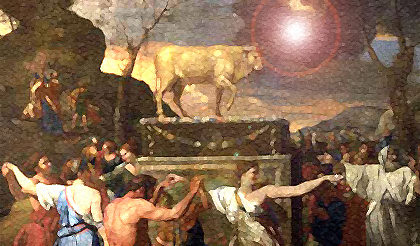
The main episodes in this pattern of sin-to-law, Hahn argues, are Israel’s sin with the golden calf which led to the Tabernacle legislation and imposition of the priestly code, and the idolatrous apostasy of the second generation at Baal-peor which gave rise to the Deuteronomic “book of the law” being imposed on the people.

So, Hahn asks, what does Paul mean in v. 19 by “law”? Is it all law, or an additional body of laws that were added later?

Hahn insists that it must be the latter for a couple reasons that are suggested in the text itself. First, it makes more sense to think of the Deuteronomic covenant as being something that was “added” to something that came earlier (such as the Decalogue). Secondly, if “the law was added because of transgressions,” how does this comport with the view that sees the law as being the Sinaitic covenant? Nothing in the narrative of the giving of the Ten Commandments suggests that some set of transgressions occasioned the giving of the Decalogue. Plus, Paul says explicitly in Romans 4:13 that “where there is no law, there is no transgression,” meaning that whatever “law” the apostle intends in Galatians 3:19 must be given over and above some law already in existence.

The “book of the law” from whose curses Jesus redeems his people, therefore, is the Deuteronomic covenant in particular.

Discuss....

Thursday, August 13, 2009

Elves for Download

My most current lecture in
Exile Presbyterian Church's
series on G.K. Chesterton's Orthodoxy
is titled "The Ethics of Elfland"
and can be downloaded here.

Enjoy.

Monday, August 10, 2009

Kinship By Covenant, Part 3: Curses Rehearsed

Returning to our look at Scott Hahn's Kinship By Covenant, we now come to what is perhaps the most interesting and significant section of the book (for Reformed folks anyway). As we have seen, Hahn argues that Yahweh's initial covenant with Israel was a kinship covenant according to which the nation was constituted as God's firstborn son (Exod.4:22). After Israel's repeated rebellion and idolatry (particularly in the golden calf and Beth-peor episodes), however, Yahweh imposed on the second generation an additional covenant (the Deuteronomic) that was intended to reconfigure Israel's relationship with Yahweh into a more servile form, like that of a vassal to a suzerain rather than a son to a father. In Section Two, Hahn attempts to apply his findings to Paul's epistle to the Galatians, particularly chapters 3-4. Our goal over the next several posts will be to examine, bit by bit, the various NT passages (from Galatians and elsewhere) that bear upon this dictinction between the Sinaitic and Deuteronomic covenants.

Since there's loads of material to cover, my plan will be to keep my posts down to manageable, bite-sized portions. In this one I'll simply draw the reader's attention to Paul's Old Testament citation in Galatians 3:10: "For all who rely on works of the law are under a curse; for it is written, 'Cursed be everyone who does not abide by all things written in the Book of the Law, and do them.'" The quotation is from Deuteronomy 27 in which the Deuteronomic covenant is ratified on Mount Ebal with an utterance of twelve curses, the last of which reads: "Cursed be anyone who does not confirm the words of this law by doing them" (v. 26). The following chapter records the blessings and curses attached to the covenant, but the balance hardly seems fair: there are 14 verses recording the blessings and 53 that rehearse the curses.

Since it is the Deuteronomic covenant in particular that threatens curses for disobedience and not the Sinaitic, Hahn argues, then it stands to reason that when Paul states that "all who rely on the works of the law are under a curse" he understands "works of the law" to refer to the statutes and ordinances that Yahweh imposed on Israel by the Deuteronomic covenant as they moved from infancy to rebellious adolescence.

Discuss....

Saturday, August 08, 2009

A Kinder, Gentler Generation of Bishops?

I just came across this quote from the fifth-century bishop of Ruspe, St. Fulgentius:

Firmly hold and never doubt that every baptized person outside of the Catholic Church cannot share in eternal life, if before the end of his life he does not return and is incorporated into the Church.... Not only pagans but also all Jews, all heretics and schismatics who finish this life outside of the Catholic Church will go into eternal fire, prepared for the devil and his angels (On Faith, To Peter, 37, 38).

I realize that the writings of the fathers are not on par with the Catholic Church's de fide pronouncements or anything, but I would be curious to hear how these sentiments (which are shared by many other fathers) square with the post-Vatican 2 business about the universal Church "subsisting" in the Church of Rome and we Protestants being only "separated brethren" who may still be saved, even though we're Presbyterians.
.
Has the Catholic Church lost the gall to condemn me?

Thursday, August 06, 2009

Kinship By Covenant, Part 2: Israel's Original Sin

Continuing our look at Scott Hahn's Kinship By Covenant, the author in Part Two of his book applies his overview of the Old Testament covenants to the three New Testament pericopes that explicitly deal with the theme of covenant in familial terms: Luke 22, Galatians 3-4, and Hebrews 1-9. For our purposes here I will focus primarily on Hahn's thoughts on Paul's letter to the Galatians.

Hahn tips his hat to E.P. Sanders, insisting that Sanders is largely responsible for the recent "paradigm shift" in Pauline studies and the focus on the centrality of covenant in the apostle's thought. But Sanders is somewhat shortsighted, Hahn argues, in his failure to do justice to Israel's plight to which divine grace is the solution. "Sanders," writes Hahn, "underestimates the degree to which the sins of Israel had introduced tensions and discontinuity into the covenantal relationship." He continues:

Sanders paints a picture of first-century Judaism in which covenant is primary, but there is no internal tension or predicament for which Paul's Gospel of Jesus Christ provided the solution. Thus his famous but hapless conclusion: "This is what Paul finds wrong with Judaism: it is not Christianity." However... a large portion of first-century Judaism embraced considerable internal tension: God's people were under a curse (cf. Gal. 3:10) because of past transgressions (the golden calf and subsequent infidelity) and in need of eschatological deliverance. Paul claims this deliverance has taken place in Christ (pp. 240, 241).
In fact, Hahn, echoing F. Weber, proposes that "the incident of the golden calf was to Israel what the fall was to Adam," a "virtually unpardonable offense... the evil consequences [of which] were never exhausted" (emphasis original).

As I pointed out in my last post, Hahn is of the opinion that it is not the Sinaitic but the Deuteronomic covenant specifically that Paul has in mind when he speaks of the "curse of the law" from which Christ has redeemed his people. It is this covenant, imposed in response to Israel's idolatry, that is called "the book of the law," and it is this covenant that not only threatens curses the likes of which are found nowhere in the Sinaitic, but also promises that the covenant will be broken and the curses will be enacted (Deut. 30:1). In a word, the Deuteronomic covenant was "intended to fail and thus invoke a new initiative of mercy (the circumcision of the heart) from God, which Paul sees realized in Christ" (p. 249).

And just to whet your appetite for our next post, it is the Deuteronomic covenant that Paul had in mind when he wrote in Galatians 3:19, "Why then the law? It was added because of transgressions."

Discuss....

Monday, August 03, 2009

Kinship By Covenant, Part 1: Will the Real Mosaic Covenant Please Stand Up?

As some of you know, I have been reading through Scott Hahn’s recently published doctoral dissertation Kinship By Covenant, and I would like to begin a series of posts considering Hahn’s claims. It’s a hefty volume and I will not be going over every detail, but will stick the stuff I find most interesting.

A quick observation before we jump in: I have been reading the book somewhat defensively, always waiting for some Catholic zinger to be thrown in my face when I’m least expecting it. Like, "So in conclusion, from the evidence adduced concerning the nature of ancient Near Eastern Hittite suzerain-vassal treaties, we clearly see that the Pope is the boss of us, and that Mary’s body was whisked away to heaven. The End." But so far, nothing. The book is primarily exegetical in focus, so the reader will have to do some dot-connecting on his own to determine what systematic conclusions Hahn is putting forth (if any). Now I haven’t finished it yet, but thus far the grinding of any Catholic axes is only implicit and not explicit.

The first bit of interesting exegesis concerns the nature of the Mosaic covenants. Now I expect that some of you are wondering if my use of the plural for of "covenants" is a typo. It’s not. As Kinship By Covenant progresses, it becomes clear that one of Hahn’s key points is that the covenant made with Israel at Sinai (Exod. 19-24) and the covenant made in the book of Deuteronomy are distinct covenants with very different emphases. He writes:

Thus, the two accounts of the Mosaic covenant (Exodus and Deuteronomy) are actually complementary records of two different covenants distinguishable in time and space.... The Exodus narrative of the Sinai covenant accentuates the familial bond which was formed by the covenant ritual (Exod. 24:1-11); whereas the Deuteronomic covenant—ratified by oaths replete with curse-threats (see Deut. 27)—reconfigures that relationship in terms of suzerain-father and vassal-son (p. 65).
And:

Deuteronomy serves to reconfigure the familial bond between Yahweh and Israel in terms of vassalage (i.e., a treaty-type covenant between a suzerain-father and a rebellious vassal-son).... Deuteronomy implicitly recasts the filial status of Israel into a more servile form... (p. 66).
The evidence Hahn adduces for this claim includes: (1) Deut. 29:1 explicitly states that the covenants made at Horeb with the first generation and at Moab with the second generation are different, separated not only by location, but also by forty years time; (2) The Sinai covenant law was to be kept—inaccessibly—inside the ark in the Holy of Holies, whereas the Deuteronomic law was kept by the Levites "by the side of the ark" (Deut. 31:25-26); (3) The purpose of the additional Deuteronomic covenant was directly related to Israel’s idolatrous apostasy at Beth-peor (Num. 25), which was a sin as heinous for the second generation as the golden calf episode was for the first (Exod. 32); (4) Further characteristics of the Deuteronomic covenant include the fact that it was given in order to punish and then restore Israel; it includes many more layers of mediation between Yahweh and Israel than did the Sinai covenant; its focus is primarily upon curses for disobedience, the committal of which is a foregone conclusion (27:9-26; 28:15-68); and it serves to constitute the nation as a theocracy with a centralized cultic ministry.
.
In my next post I will draw out some implications of Hahn’s exegesis, but for now, let’s discuss what we’ve seen so far. Do you agree with this distinction? Can you anticipate where he’s going with it?

Saturday, August 01, 2009

My Life According to U2

Here's my version of Facebook thing that's going around....

***

Using only song names from ONE ARTIST, cleverly answer these questions. Pass it on to people you like and include me. You can't use the band I used. Try not to repeat a song title. It's a lot harder than you think!

Pick your Artist: U2

Are you a male or female: Drowning Man

Describe yourself: Stranger in a Strange Land

How do you feel? Numb

Describe where you currently live: City of Blinding Lights

If you could go anywhere, where would you go? The Playboy Mansion

Your favorite form of transportation: Kite

Your best friend is a: Lady With the Spinning Head

You and your best friends are: Trying to Throw Your Arms Around the World

What's the weather like? Bad

Favorite time of day: 11:00 Tick Tock

If your life was a TV show, what would it be called?: Alex Descends into Hell for a Bottle of Milk

What is life to you: Running to Stand Still

Your current relationship: Party Girl

Your fear: Staring at the Sun

What is the best advice you have to give? Hold Me, Thrill Me, Kiss Me, Kill Me

Thought For the Day: Love Is Blindness

How I would like to die: Miracle Drug

My soul's present condition: So Cruel

My motto: Love and Peace or Else

Anything Else to Add? I’ll Go Crazy if I Don’t Go Crazy Tonight

Wednesday, July 29, 2009

Some Bits of Tid

Chris Donato of Tabletalk magazine is continuing his "walk-through" of Dual Citizens on his blog. Here is Part One, Two, and Three.

By the way, I have been informed that Ligonier has pre-sold 200+ copies of the book thus far, not to mention the ones that have been pre-ordered from places like Amazon and CBD. The publisher seems pleased, and sees this as being indicative of people's interest in the issues the book addresses.

Switching topics, I read this in Hahn's Kinship By Covenant a few hours ago:

Paul's argument [in Gal. 3:15-17] is also a reductio ad absurdum: he shows that his opponent's position leads to an unacceptable conclusion. The Judaizers argue that obedience to the Mosaic law is necessary for the Abrahamic blessings to reach the Gentiles, that is, for them to become children of God and children of Abraham. In Paul's view, this would be tantamount to placing the Mosaic law as a condition for the fulfillment of God's covenant with Abraham to bless the nations through his "seed" (Gen. 22:16-18). Since, at the Aqedah [the binding of Isaac], God put himself under an unconditional, unilaterally binding oath to fulfill his covenant with Abraham, this would be nonsense. To suppose that God added conditions (the Mosaic law) to the Abrahamic covenant, long after it had been unilaterally sworn by God would imply that God acted illegally, reneging on a commitment in a way not tolerated even in human covenants. This would be an unacceptable conclusion; therefore, the premise that obedience to the Mosaic law had become the condition for Gentile inclusion into the Abrahamic covenant blessings must be rejected.
Sheesh, I guess the student of Meredith Kline doesn't fall far from the Klinean tree....

Lastly, a plea to Lamar Odom: Just sign on the dotted line, son. But either way, we're looking pretty good.

Monday, July 27, 2009

Who Said That?

Any guesses as to the source of this quote?

"In Paul's view of salvation history, the Abrahamic covenant has chronological priority and ontological primacy over the Mosaic.... The logical corollary of Paul's view of the Abrahamic covenant is that the Mosaic covenant is secondary and subordinate. Moreover, its definitive shape is achieved, not in the earlier Sinai or Wilderness legislation (Exod 20 - Num 36), but in the book of Deuteronomy (i.e., the Book of the Law), where it is ratified by curses invoked and pronounced by Moses and the Levites (Deut 27-30).... Christ's curse-bearing death on the cross simultaneously bears and expiates the Deuteronomic covenant curses and releases the Abrahamic blessings promised to the nations at the [binding of Isaac]" (emphases original throughout).
And please, no Googling....

Friday, July 24, 2009

Catholics: Heartier Partiers?

Speaking of the Protestant Reformation's crushing of the "creative activity" of the Middle Ages, author Tom Hodgkinson writes (with tongue in cheek):

The Puritan Revolution began to introduce boredom to the masses. Even religion and the path to salvation became boring. In the Middle Ages, religion had been full of blood and gore and death. Churches were centres of economic activity and partying as well as of worship. The Church was a patron of the arts and commissioned local craftsmen to make adornments for its properties. The sermons were attended largely for their entertainment value; they provided real theatre. In medieval Florence, people would queue all night to see a great preacher and then stream out of the church after the service, weeping copiously. All this drama and theatre was removed by the Puritans, who labelled the ways of the old Church "superstition" and "idolatry." In other words, all the pagan fun of the Catholic Church, which it had wisely kept, was taken away.
(I quote Hodgkinson here not because I necessarily agree with him, but because he has a knack for being really amusing, even as he offends just about everyone equally.)

This idea that Catholics are better partiers is perhaps what lay behind Sean P. Dailey's article titled "The Lost Art of Catholic Drinking," in which the author argues that the thing that distinguishes Catholic from Protestant drinking is not necessarily quantity, but control. Citing Chesterton's insistence that the way we thank God for wine is by not drinking too much of it, Dailey says that Catholics can steer the middle course between abstinence and excess that Protestants just can't seem to navigate.

(Oh, and another thing that distinguishes the two methods of imbibement is Hilaire Belloc's insistence that Catholics never drink any beverages that don't predate the Reformation [which supposedly limits their choices to beer and wine]. I suppose this would make The Wire's Jimmy McNulty's dismissing of Bushmills as "Protestant Whiskey" somewhat tautological (he prefers Jameson). Of course, legend does tell us that St. Patrick himself introduced the art of distilling to the Irish in the fifth century. But I digress.)

What's my point, you ask? Umm, I'm not sure I really have one, unless it's that with respect to the enjoyment of beverages, perhaps confessional Protestants are closer to Rome than they are to Saddleback after all. Not exactly a giant leap toward ecumenism or anything, but it's a start.

Wednesday, July 22, 2009

The Big Apple Versus The Growers of Big Apples

Always the provocateur, Darryl Hart has written an interesting piece for Front Porch Republic titled "If Cooking Slowly and Growing Organically are In, Why Is Rural Ministry Out?" In it, Hart highlights the irony that amid all our praise of Slow Food and organic food production, our attitude toward ministry is one area in which we are still unabashed city folk.

Signs are not encour-aging ... that the growing concern among evangelical Protestants about the environment is having any effect on their church’s estimation of the people who work on farms and live near them. A recent story in Christianity Today on Tim Keller, a popular Presbyterian pastor in New York City, suggests that for all the desires that evangelicals have to be cutting edge and socially aware, a ministry accessible to the rhythms of farming and local communities does not qualify as hip. The story fawns over Keller for his ability to carve out a multiple-congregation structure in the Big Apple, for a theology of the city that says cites are where redemption happens, and for the model of ministry he exhibits to a crop of younger pastors who aspire to make an impact.

According to the news story, “New York attracts the best and the most ambitious.” Keller senses this and ministers accordingly. He told the reporter, “Suppose you are the best violist in Tupelo, Mississippi. You go to Manhattan, and when you get out of the subway, you hear a beggar playing, and he’s better than you are.” One of Keller’s former colleagues puts Keller’s understanding of ministering in the city this way: “Paul had this sense of, I really should go talk to Caesar. He’s not above caring for Onesimus the slave, but somebody should go to talk to Caesar. When you go to New York, that’s what you’re doing. Somebody should talk to the editorial committee of The New York Times; somebody should talk to Barnard, to Columbia. Somebody should talk to Wall Street.”
(No offense intended to the violinists of Tupelo, I'm sure. I mean, you're from Mississippi, for crying out loud! Surely you didn't expect to best the Big Apple's beggars, didja? Know your place, is what I'm saying.)

Perhaps lurking behind this infatuation with The City (yes, I capitalized it on purpose), Hart suggests, is the desire to "elevate one's status by hobnobbing with the influential" coupled with a "born-again infatuation with celebrity." Then, when you factor in evangelicalism's absolute fear of the ordinary, you've got a perfect recipe (ahem) for the kind of elitism that sees the inexperience of young ministers as disqualifying them for urban church planting while not standing in the way of their ministering to simple farm folk (at least until they graduate from fly-over country to the corridors of power).

Evangelicals are disposed to understand grace and faith in extraordinary categories and so overlook stories of ordinary believers, routine piety, and even rural congregations as insignficant. Discontent with the average and routine aspects of natural life and of grace appears to breed a similar dissatisfaction with humble ministries in places of little interest to the editors of the Times.
I've said it before and I'll say it again: The appreciation for the ordinary that amillennialism produces is as difficult to reconcile with postmillennial transformationism as faith is with sight, and as the cross is with glory.

Tuesday, July 21, 2009

Of Lunas and Lunatics


The first lecture in Exile Presbyterian Church's series on G.K. Chesterton's Orthodoxy can be downloaded here.

Enjoy....

Monday, July 20, 2009

On Tooting One's Own Horn

(Just an aside, but who else's horn would one toot?)

As the discussion in the previous thread turned to the issue of boasting, I was reminded of an old post that I thought I'd put up again (which, incidentally, was fleshed out to become a chapter in my book).

Enjoy....

The very idea of "boasting" would appear utterly inconsistent with the Pauline doctrines of grace were it not for the fact that Paul himself did it all the time. But in order for boasting to be legitimate, some qualifications are in order. As Walter Sobchak has reminded us, "This is not 'Nam, there are rules...."

First, it is not permissible to boast in the fact that we have done what we were told. Paul says in I Corinthians 9:16 that he cannot boast in preaching the gospel since he has been commanded by Jesus to do so.

Secondly, though, it appears that boasting is an option if we are going above and beyond the call of duty. Now don't misunderstand me, I'm not advocating the Pharisaical practice of inventing laws, fulfilling them, and then bragging about it ("I fast twice a week"). By going "above and beyond the call of duty" I'm referring to what Paul did, namely, denying ourselves the enjoyment of things that are perfectly permissible and voluntarily limiting our rights to benefits to which we are actually entitled (specifically for Paul these benefits included meat, marriage, and money, I Cor. 9:4-6).

This notion could have drastic consequences for American Christians, not the least of which is the distinct possibility that all those passages about suffering may actually apply to us (who says we Reformed ministers never give application?).

In the minds of many believers today, until the antichrist implants microchips into our foreheads and forces us to worship a statue or have our heads chopped off, "suffering" is nothing more than a noble theory that people in heathen lands have to deal with (plus, we'll all be raptured before any of that bad stuff happens anyway).

But could it be that carrying our crosses in more civilized lands like ours may mean that we cease to think in terms of our "rights" and what we're entitled to? It seems to me that the One who told us to carry our crosses had an inalienable right not to be nailed to one.

Wednesday, July 15, 2009

I'm Protestant, Therefore I Shop?

In his post entitled “Ecclesial Consumerism vs. Ecclesial Unity,” Covenant-Seminary-graduate-turned-Catholic Bryan Cross writes:
One is an ecclesial consumerist if one's decision regarding which "church"
to attend is based on anything other than this question: Which institution is
the one founded by the incarnate Christ?
While I appreciate Cross’s attack upon ecclesial consumerism as well as the humble and irenic manner by which he argues his position, I must question, from the perspective of my own experience, the simplistic and reductionistic nature of this statement.

For my own part, one of the things I appreciate about Reformed ecclesiology in general (as well as my own church’s worship in particular, if I may toot my own horn) is the very fact that that we refuse to give people what they want, and instead insist on giving them what they need, even if this results in a lesser degree of “success” as defined by American evangelical criteria. In other words, there are certain things that I, individually speaking, would want in a church, such as an elaborate children’s program, professional-sounding music, and messages that tickle my (fallen) sensibilities as well as funny bone.

You know, like Mark Driscoll does.

But despite the pressure to grow in terms of both nickels and noses, faithful Reformed churches have deliberately and decidedly determined not to give ecclesial consumerists what they want. Do we claim to be the church that Jesus founded? Not exactly. But have we therefore fallen prey to the consumerism that characterizes churches like Saddleback or Mars Hill?

Not by a long shot.

Monday, July 13, 2009

Dual Citizens Reviewed by Chris Donato

Chris Donato, senior associate editor of Tabetalk, has just begun a series of posts reviewing my book, Dual Citizens, on his blog, Growing Grace-full.

Check it out.

Oh, and while you're at it, order the book....

Pierced by a Freeway

Speaking of sacramental worldviews, perhaps no one does a better job of beholding nature through the lens of spiritual reality that Bono himself. In the song "Heartland" from 1988's Rattle and Hum, he sings about the Mississippi River using the metaphor of a woman, and then goes on to sing:

She feels like water in my hand;
Freeway, like a river, cuts through this land
Into the side of love, like a burning spear.

Just like Rich Mullins refers to an open road as "a woman made from a rib cut from the sides of these mountiains, these great sleeping Adams," so Bono sees Route 66 as cutting through America like the spear that pierced the Savior's side, out of which a river of blood and water flowed.

I'll have what he's having....

Thursday, July 09, 2009

Lonely Mountains, Sleeping Adams, Dancing Angels, and the Color Green

I had a great conversation over cigars and stout with my good pal Armando on Wednesday, and we were discussing the way men like Chesterton, Bono, Rich Mullins, C.S. Lewis, and others wrote about God's involvement in the world (I have been told by my Catholic friends that these men have a "sacramental worldview," which I sort of understand, but not really). Anyway, they bring to the table a kind of richness and appreciation of God's immanence that cannot but stir one's heart, especially when you're just not used to that sort of thing.

I have written here before of Chesterton's view that apple blossoms produce apples not from the mere laws of nature but through magic, and that rivers flow downstream because they're enchanted, so I'll not repeat that stuff again. But consider these words of the late Rich Mullins from "The Color Green":

And the moon is a sliver of silver
Like a shaving that fell on the floor
Of a Carpenter's shop.
And every house must have its Builder;
And I awoke in the house of God.

Where the windows are mornings and evenings,
Sretched from the sun, across the sky,
North to south.
And on my way to early meeting
I heard the rocks crying out,
I heard the rocks crying out:

"Be praised for all your tenderness
By these works of Your hands!
Songs that rise, and rains that fall
To bless and bring to life your land!
Look down upon this winter wheat
And be glad that You have made
Blue for the sky, and the color green
That fills these fields with praise!"
Elsewhere Mullins fuses heavenly imagery with that of earth thusly:

And the work trucks come running
With their bellies full of coal,
And their big wheels humming
Down this road that lies open
Like the soul of the woman
Who hid the spies who were looking
For the land of the milk and the honey.

And this road, she is a woman;
She was made from a rib
Cut from the sides of these mounains,
O these great sleeping Adams who are
Lonely, even here in paradise;
Lonely for somebody to kiss them.
(If by God's grace I ever pen lines even remotely comparable to these, I will die a happy man.)

Sometimes I wonder what a man like Rich Mullins saw when he closed his eyes and meditated upon God, and the beauty and fieceness of his majesty. Whether he's singing about "angels dancing on Jacob's stairs" as "the moon moves past Nebraska, spilling laughter on those cold Dakota hills," or how God "takes by its corners this whole world and shakes us bored, and shakes us free," there was a depth (a simple depth actually, if you'll forgive the oxymoron) to his faith that I, for one, am trying to recover in my own life.

It is my conviction that, whether through a sacramental wordview or, even better, by means of a two-kingdoms theology whereby earth is legitimized, the greater our love is for this world, the greater will be our love for the God who made it.

Sunday, July 05, 2009

Abraham's True Sons, Alexandria's True Bishops

The other day I was directed to a fascinating discussion on the Puritan Board (which I've subsequently joined) on the topic of Sola Scriptura. The thread was started because one of the members was being challenged by a friend who had been investigating Catholic and Orthodox theology and began challenging him about whether the Bible and the early church fathers teach that Scripture is the believer's sole authority on matters of doctrine and practice.


Now, as I read the various responses (some characterized by heat, others by light), I did notice a fair bit of straw-man argumentation. But fallacies aside, there were also a lot of quotes from church fathers that seem to indicate that true apostolic succession is what Protestants say it is, namely, a succession primarily of doctrine, with the issue of physical, laying-on-of-hands succession being a matter of historical coincidence and nothing more. Consider this quote from Gregory of Nazianzus (330-389):

Thus, and for these reasons, by the vote of the whole people, not in the evil fashion which has since prevailed, nor by means of bloodshed and oppression, but in an apostolic and spiritual manner, he is led up to the throne of Saint Mark, to succeed him in piety, no less than in office; in the latter indeed at a great distance from him, in the former, which is the genuine right of succession, following him closely. For unity in doctrine deserves unity in office; and a rival teacher sets up a rival throne; the one is a successor in reality, the other but in name. For it is not the intruder, but he whose rights are intruded upon, who is the successor, not the lawbreaker, but the lawfully appointed, not the man of contrary opinions, but the man of the same faith; if this is not what we mean by successor, he succeeds in the same sense as disease to health, darkness to light, storm to calm, and frenzy to sound sense. NPNF2: Vol. VII, Oration XXI - On the Great Athanasius, bishop of Alexandria, §8.
Gregory seems to be saying that "the genuine right of succession" is rooted in a bishop's piety, without which he, though enjoying literal apostolic succession, is "only a successor in name." One is reminded of the argument both of Jesus and Paul that Abraham's true succession of children is traced not through physical lineage but through something not quite as visible, but nonetheless ar more important, namely faith.

Thoughts?

Wednesday, July 01, 2009

Dual Citizens Out Soon

I got some good news from Ligonier today: Dual Citizens has been sent to the printer, with 4000 copies to be available soon (meaning that if you each buy a box-full or two, we can send this baby to a second printing in a couple months!).

One professor at Reformed Theological Seminary in Orlando will be using it as a text for one of his classes, which means a bunch of seminary students will be forced to buy it whether they want to or not, which is fine with me.

I'll keep you posted as I find out more. And remember, it's available for preorder from Amazon, CBD, Ligonier, and wherever else fine books are sold.
.
So go order one already....

Sunday, June 28, 2009

The Complexities of Confessionalism

Say what you will about Peter Leithart, but when it comes to his theology, the man just plain ol' doesn't care about anything other than that it is biblical.

Is this a bad thing?

When the study committee which he and I petitioned the Northwest Presbytery of the PCA to form began its work, Leithart's only request was that, in addition to comparing his views to the Westminster Standards, we also take the time to engage his work from the vantage point of Scripture. It was obvious that this latter concern far outweighed the former in his mind.

The conclusions of the minority report that I authored were that Leithart's positions, though biblically defensible to a certain degree, were nonetheless clearly contrary to the system of doctrine found in our Confession and Catechisms. The problem, the minority argued, was that he failed (or was unwilling) to read the Bible through the lens of the doctrinal standards of the PCA. And Leithart's response, in a nutshell, was "Isn't being biblical enough?"

Hence the complex nature of Reformed confessionalism. On the one hand, we recognize that there is no "view from nowhere," and that we simply cannot read Scripture in a lens-less, objective, Cartesian way. All of us bring presuppositions to the interpretive table. On the other hand, though, we don't want to be accused of simply reducing the Bible to the confession's handmaiden, as if Scripture is merely a collection of prooftexts to buttress one's own systematic theology.

An example from Leithart's own views would be the fact that Paul says in Romans 6:7 that the baptized believer has been "justified from sin." Clearly, Leithart argues, the word "justify" is being used as a kind of synonym for "sanctify," and not to denote God's one-time declarative act of pardon and imputation of alien righteousness. Our understanding of the term "justification," therefore, ought to be broad enough to include this usage, as well as the OT's usage of tsadaq in contexts were the issue is deliverance from enemies, not forensic acquittal.

I admit, I can see Leithart's point and can understand his frustration at being told "No, you must not echo Paul's language since it contradicts our theology." But at the same time, is there not a place for being a team-player and being willing to employ terminology that tries to avoid confusing people unnecessarily?

The options, as I see them, are as follows: confessional denominations like the PCA can either (1) broaden our theological parameters to make room for someone who can make a case that his theology is biblically plausible, or (2) we can insist that our ministers at times must avoid speaking the Bible's language for fear of muddying the systematic waters.

And I must say, I'm not completely thrilled about either of those choices (but then, who ever said being confessional would be easy?).

Wednesday, June 24, 2009

Apostles and Early Fathers: Who Were the Real Morons?

Since Mark Shea's book By What Authority? founds its way into the conversation, I thought I'd clear up what I believe his point to have been, as well as put forth a question to him (or to anyone who feels like trying to answer it).

Shea draws his readers' attention to the way that evangelicals respond to the work of the Jesus Seminar, saying that evangelicalism is certainly correct in highlighting the absurdity of the idea that Jesus, whose knowledge and insight could penetrate into the very souls of men, was nonetheless so shortsighted that he couldn't seem to choose any disciples who would be able to correctly remember a single thing he said. In other words, how likely is it that, nine minutes after our Lord's death, his disciples would both immediately forget everything he really said and did, and invent a bunch of stuff he never said or did?

(This reminds me of the wisdom of Holden Caulfield from The Catcher in the Rye, who insisted that "Jesus needed his disciples like he needed a hole in the head." When challenged with the claim that if you reject the disciples you reject Jesus, Caulfield explained that Jesus picked his dicsiples at random since he didn't have the time to screen them properly, being busy and all.)

Now Shea's argument becomes challenging when he turns to Protestantism's response to Rome. The Protestant, Shea insists, commits the very same fallacy that the proponent of the Jesus Seminar does, only we push it back a generation. So we (rightly) deny the likelihood that the original twelve apostles completely messed up Jesus' teachings, but we also (wrongly) insist that the first generation of post-apostolic fathers misunderstood the apostles' teachings. We roll our eyes at the claim that John invented the idea that the Logos was God, while we nonetheless maintain that Ignatius delibererately inflated the authority of the bishop, or that Irenaeus concocted the theory of apostolic succession as a means to ensure orthodoxy. Thus we dismiss early church teachings on prayers for the dead, the sacrificial nature of the Mass, or veneration of Mary by insisting that the church fathers simply went astray pretty soon after the original twelve died.

The question to my Catholic readers is this: Does not Paul himself marvel at how quickly the churches of Galatia perverted the gospel they received from apostolic messengers? Is it indeed a given that the teachings of the early fathers were apostolic simply because they were in close chronological proximity to the apostles?

Monday, June 22, 2009

Going to California

I'll be on vacation in Orange County for the next few weeks, but I will be blogging as often as the surf is flat. I hope to update the blog tonight or tomorrow.

Cheers....
.
PS - I wonder what this pic has to do with my post?

Thursday, June 18, 2009

Binding and Loosing in Orlando

I'm sitting here in Orlando at the PCA's General Assembly, and the food line is a mile long, so to kill time I figured I'd relay a question I was posing to some fellas last night over smokes and seven-and-sevens:

"Has anything been bound in heaven this week?"

(Insert blank stare and the sound of crickets here.)

The reason for my question is that Jesus says in Matthew 16, "You are Peter, and on this rock I will build my church, and the gates of hell will not prevail against it. And I give to you the keys of the kingdom of heaven, and whatever you bind on earth will be bound in heaven, and whatever you loose on earth will be loosed in heaven." What our Lord is promising here is that the church he will build will have the power to speak in heaven's name on earth, with all authority.

So the question I posed was, "Have we actually concluded anything in Christ's Name that we are confident is now bound in heaven and ratified with heavenly authority?" And my follow up question, if the answer given was "Yes," is, "OK then, should we go through the Yellow Pages once we're home and call all the other churches in our community and inform them of Jesus' decisions that were made at the PCA's GA?"

Again, crickets and stares....

I am certainly not trying to undermine or call into question the importance of the work that we are doing as PCA commissioners. But I guess I'm simply lamenting the fact that the church that Jesus seemed to describe in the Gospels, when compared with our current situation in Protestantism, is not exactly easily recognizable. Instead of declaring with heaven's own authority God's will for all Christians we are setting up the rules that govern our own little corner of the kingdom.

Do I like my corner? Sure. But I can't help but wish there were more unity and true catholicity within Reformed Protestantism. Here endeth the rant.

Monday, June 15, 2009

Off to Orlando....

I will be in beautiful Orlando, Florida for the PCA's General Assembly all week (but still may find the time to update the blog). Prayers are appreciated.

By the way, if any of you regular commenters will be there, please introduce yourself.

Cheers.

Friday, June 12, 2009

The PCA: Present and Future

The following is a piece, written in response to Charles Dunahoo's recent article on the state of the PCA, that will be published in the next issue of the Nicotine Theological Journal (edited by Darryl Hart and John Muether). Let the reader be assured that any snarkiness on the part of the author is to be taken in the spirit in which it was written, i.e., with a grain of good-natured, Spirit-filled, love-thy-neighbor salt. Enjoy....

Just to lay my cards on the table up front, I will admit that both my ecclesiastical background and my geographical location are very different from Mr. Dunahoo’s. Having been reared in megachurch evangelicalism in Southern California, and currently pastoring a PCA in the Seattle area, I have neither the broadness of perspective that Dunahoo enjoys, nor the memories of this denomination’s early days that he retains. Still, I’ll do my best to make some worthwhile remarks about the Presbyterian Church in America, both present and future.

Dunahoo lists five distinct groups within the PCA. In my four years as a member of the Pacific Northwest Presbytery, I can identify groups 1 and 2 (the “Reformed Fundamentalists” and the “Reformed Evangelicals”) in this neck of the ecclesiastical woods. That’s not to say the others don’t exist elsewhere, but as I said, my experience is limited to the fringe of the movement (“fringe” being used literally with respect to my presbytery’s location, and perhaps metaphorically with respect to its self-perception. More on this below). Now although I balk at the label affixed to me by Dunahoo (I happen to think of “Fundamentalist” as rather antithetical to “Reformed”), I do consider myself to fit squarely into his first category. I believe the Westminster Confession and Catechisms to be the most faithful articulation of biblical truth, and I believe that it is my calling and duty as a minister to expound Holy Scripture through the lens of the doctrinal standards to which I have submitted myself.

I would venture to say that Dunahoo’s second group, the Reformed Evangelicals, is the largest subgroup within the PCA. I may be wrong about this, but my excuse for such misperception is that the denomination’s official publications, as well as its seminary, all seem to presuppose the missional model, with hardly a paragraph being written in their literature that doesn’t remind the reader to redeem this or transform that. Words like “contextual” and “incarnational” are nearly as important in church planting circles as the phrases “Word and sacraments” or “the ordinary means of grace.” Apparently, word, water, and wine are all well and good provided they’re dispensed with sufficient cultural exegesis and social sensitivity. But I digress.

What I do find refreshing about Dunahoo’s perspective is, well, its perspective. In other words, he doesn’t simply draw a circle around himself and his friends and act as if there is no one else in the denomination besides his own subgroup. The reason I mention this is that I know what it is like to be treated like a virtual alien simply because I haven’t drunk the contextual Kool-Aid. I still feel the sting from the lashing I received at the PCA’s Church Planters’ Assessment when, in a certain exercise, I dared use the word “covenantal” while giving a mock church planting presentation to a pretend presbytery. Apparently it is a cardinal sin to assume that presbyters in the PCA understand the nomenclature used in chapter 7 of the Westminster Confession (I’m not bitter anymore, honest). My point here is that the sooner the confessionalists and transformationists (or, groups 1 and 2) recognize each other’s existence, the better. True, the two may never become one, but at least they’ll realize they are shacked up as roommates in the same house.

In the Pacific Northwest Presbytery where I am a member, the line dividing the Reformed Fundamentalists from, well, everyone else was recently made painfully apparent. At our stated meeting in October 2007, Rev. Peter Leithart and I jointly requested that presbytery appoint a study committee to evaluate Leithart’s Federal Visionist views and compare them with the Westminster Confession, with a particular emphasis on the nine “Declarations” of the previous summer’s General Assembly report on Federal Vision theology more broadly. The committee ended up split 4-3, with the majority concluding that Leithart’s views, though at times confusing and unhelpful, were nonetheless within the bounds of confessional orthodoxy, while the minority (of which I was a part) found his views to strike at the vitals of the Reformed system of doctrine. When we met a year later to present the reports, the debate on the floor of presbytery was rather telling (to say the least) in that it largely ignored the narrow issues that the committee was charged to address and focused instead on the larger (and, strictly speaking, irrelevant) question, “What is the PCA?” The concerns voiced were primarily focused on self-identity instead of whether Leithart’s theology was Reformed or not. The greatest fear on the part of the members of presbytery was that by voting to depose one of our own we’d become, well, like the OPC. In other words, we already represent a mere fraction of Christian believers anyway, and now, by defrocking everyone who fails to cross their t’s and dot there i’s the way we’d like them to, we will just paint an even smaller circle around ourselves, eventually paling into utter obscurity and irrelevance.

It seems to me that the events of the Pacific Northwest Presbytery’s October 2008 meeting demonstrate, albeit microcosmically, the identity crisis of the PCA as a whole. As the “A” in our name would seem to suggest, we are perhaps unduly fixated on being big, noteworthy, and successful, and whatever stands in the way of such success must be viewed with a measure of suspicion. Hence the ho-hum attitude on the part of Dunahoo’s “Reformed Evangelicals” towards a simple, ordinary-means-of-grace ministry that dismisses the fanfare and obsession with how many artists show up at our wine- and cheese-tasting soirees, and gives attention rather to preaching Christ and administrating the Supper each Lord’s Day. As much as the OPC’s obvious irrelevance (ahem) stands as an ominous warning to the movers and shakers at Covenant Seminary and sends chills down the collective spine of the powers that be in Atlanta, the fact is that our older cousin, though a runt in the Presbyterian litter, enjoys the freedom of Mere Presbyterianism to a degree that the PCA cannot (at least not as long as we’re pining for the approval of the artsy-fartsy, the bohemian, the indy, and the soul-patched).

Not being prone to prognostication, I am loath to guess where the rocky marriage between the confessionalists and transformationists will take the PCA. If Tim Keller’s work with the Gospel Coalition is any indication, it is at least possible that the Reformed Evangelicals will continue to value cultural engagement and renewal more highly than confessional exactitude, perhaps to the point of secession. Or to look at it from the other direction, if the so-called Reformed Fundamentalists continue to be made to feel hopelessly irrelevant and out of touch when we settle for a Sabbath-oriented, means of grace driven piety, a withdrawal could potentially occur. Then again, we could just continue with the live-and-let-live, quasi-congregationalism that we now enjoy, according to which I can be left alone to don my Geneva gown on Sunday provided I don’t hassle the PCA pastor in the next town over for using multimedia and drama to reach the “teenz.”

But either way, the Emergents are certainly right about one thing: the church, if not a mess, is nonetheless messy.

Monday, June 08, 2009

On Misfits and Grandmothers

As I pointed out in an earlier post, many of the writers I have been reading over the past several years (Tolkien, Chesterton, Lewis) had such a unique outlook on the world, one characterized by a humility and wonder that is somewhat lacking in my own theological circles. One of you commented, suggest-ing that these men had a sacramental worldview. When I admitted that I have no idea what that means, another of you directed me to the short stories of Flannery O'Connor as an example of what a sacramental worldview looks like. So, off I went to purchase said volume.

I read a couple of O'Connor's lesser-known stories (one of which involved a boy dressing up as a gorilla for some reason I have yet to ascertain), but was then directed by a church member to read A Good Man Is Hard to Find, which I did yesterday (who, me unteachable?).

I admit, it is a disturbing story to say the least (though how it demonstrates a sacramental worldview I am unsure). The most interesting line is one of the very last, which is uttered by an escaped convict known as "The Misfit." After his cohorts murder a family of four, the only family member still alive is "the Grandmother," who has been engaging The Misfit in conversation, insisting that he is "not common," and indeed "good." She then reaches out to touch him, whereupon he recoils as if bitten by a snake, shoots her three times in the chest, and says:

"She would of been a good woman, if it had been somebody there to shoot her every minute of her life."
Hmmm....

Is the point that O'Connor's Misfit is making that we need to be faced with fear and threat before we will truly demonstrate decency, that real virtue is produced in the crucible of danger?

Is Miss Flannery's Catholic skirt showing?

Thursday, June 04, 2009

Dead Man Walking

Leave it to Gilbert Keith Chesterton to come up with a truly thought-provoking argument against suicide. Most Christian writers would simply say, "Killing is wrong; suicide is killing; therefore, suicide is wrong." Not G.K.: "The man who kills, kills a man. The man who kills himself, kills all men." He's got your attention, no?

The thief is satisfied with diamonds; but the one who commits suicide is not: that is his crime. He cannot be bribed, even by the blazing stones of the Celestial City. The thief compliments the thing he steals (if not the owner of them). But the one who commits suicide insults everything on earth by not stealing it. He defiles every flower by refusing to live for its sake. There is not a tiny creature in the cosmos at whom his death is not a sneer.
I cannot help but think of that obscure little line from Paul in Romans 1 in which, after enumerating the deviant and sinful practices of pagan Gentiles, he adds, "and neither were they thankful." From Chesterton's point of view it is precisely this lack of wonder, this failure to stand in awe of earth and its common blessings that makes suicide so insulting to everyone left in its wake. Suicide indeed kills all men.

Taking this a step further (and I have to give credit to my associate pastor Sy Nease for this insight), could it be that suicide can be committed spiritually rather than literally? In other words, when living people look askance at the world and view it merely with suspicion rather than wonder, could this be a kind of metaphorical equivalent to suicide?

To borrow Chesterton's terminology, if a person is Christian enough to hate the world and die to it, but not pagan enough to love the world and die for it, is he merely a dead man walking?

Sunday, May 31, 2009

The Road to Rome, Constantinople, and the Emergent Village

Every now and again you run across a passage in a book that is just chock-full of fodder for potential discussion and debate. I found just such a passage the other day in Scott Clark's Recovering the Reformed Confession. Under the heading "The Virtues of Being Confessional," he writes:

The evangelical and postevangelical discontent is the result of the two quests that have dominated American evangelical religion for more than two centuries. This explanation accounts for the relatively easy movement of evangelicals into what might seem to be foreign territory. With respect to the QIRE [quest for illegitimate religious experience], having grown up with flannel graphs of the Second Person of the Trinity, it is really only a short step to traditional icons. With respect to the QIRC [quest for illegitimate religious certainty], once one overcomes the predominating ignorance of and bigotry against Rome that permeate North American fundamentalism, once one discovers that Roman Catholics love Jesus and read the Bible, it is not a great step to trade the authoritarianism of fundamentalism for the magisterial authority of the Roman communion. In other words, though they occur in a different setting, Rome, Constantinople, and the Emergent Village each offer to fundamentalism and evangelicalism a more ancient and better-looking version of what already animates them.
As the yutes say, "Oh, snap!"

Discuss....

Saturday, May 30, 2009

"No One Told You It Was Gonna Be This Way...."

We've got a wide variety of readers here at DRD, so I'm hoping some of you can clear up a mystery for me.

Reformed people think they're on the same team with Lutherans, but Lutherans won't even offer the bread and cup to the Reformed. Anglicans often speak of themselves as non-Protestants more akin to Catholics, but Catholics don't understand themselves to be in communion with Anglicans. And it seems that Lutherans think of themselves as being much more Catholic than Calvinistic/Re-formed, while from the vantage point of Rome we're pretty much a gaggle of individualists.

What gives?

Tuesday, May 26, 2009

Elves in Geneva, Fairies in Heidelberg

In G.K. Chesterton's chapter "The Ethics of Elfland" in Orthodoxy, he writes:

All the terms used in the science books (such as law, necessity, order, tendency, and so on) are really unintellectual, because they assume an inner synthesis, which we do not possess. The only words that ever satisfied me as describing Nature are the terms used in the fairy-books: charm, spell, enchantment. They express the arbitrariness of the fact and its mystery. A tree grows fruit because it is a magic tree. Water runs downhill because it is bewitched.
We may smile at the quaintness of Chesterton's sentiments here (though he wouldn't, and neither would he call them "sentiments"), but the fact is that there is an element of wonder, humility, and childlikeness that characterizes Chesterton's writings, as well as that of others like him such as Lewis and Tolkien.

And none of them were Calvinists.

Now, Chesterton was fond of Geneva-bashing, insisting, for example, the the great hymn-writer William Cowper suffered his melancholic bouts of depression as a result of his belief in predest-ination. Of course, it is difficult to know exactly what Chesterton had in mind when he spoke of "Calvinistic determinists," and something tells me it wasn't John Calvin himself, but more likely his late nineteenth-century proponents.

But straw man arguments aside, one has to ask why it is that of all the Christian authors who tend to display the kind of refreshing wonder that Chesterton did, very few are of the Reformed or Presbyterian persuasion.

I, for one, wouldn't mind letting a little bit of Elfland into Geneva, assuming the former would deign to darken the latter's door.

Thursday, May 21, 2009

For the Love of Earth

In his chapter "The Flag of the World" in Orthodoxy, G.K. Chesterton remarks that when he was a boy he was con-stantly told that there were two kinds of men in the world, the optimist and the pessimist. "The optimist," he writes, "thought everything good except the pessimist, and the pessimist thought everything bad, except himself."
.
Chesterton came to conclude that there is a "deep mistake" in categorizing people in this way, for before one can criticize or accept some aspect of the culture he must come to terms with his "primary loyalty" to the world as a whole. "My acceptance of the universe," he says, "is not optimism, it is more like patriotism." Thus the problem with the pessimist is not that he is overly-critical, but that he does not love what he criticizes. And likewise, the problem with the optimist is that he will defend the indefensible with the jingoistic battly cry of "My cosmos, right or wrong."

The way of escape from these two options is in what Chesterton describes as an irrational loyalty to the world, not because is great or even good, but because it is ours.

We do not want joy and anger to neutralize each other and produce a surly content-ment; we want a fiercer delight and a fiercer discontent.... Can [the ordinary man] hate the world enough to change it, and yet love it enough to think it worth changing? ... Is he enough of a pagan to die for the world, and enough of a Christian to die to it?
It is only the "irrational optimist" who can successfully smash the whole universe for the sake of itself, and love the city enough to set it on fire.

Again, Chesterton displays a unique and provocative ability to bring together seemingly disparate ideas (which is what the core doctrine of the Christian faith is all about, when you think about it). I have to think that the late Rich Mullins had been reading Gilbert's work when he penned the line, "Nobody tells you when you get born here how much you'll come to love it, and how you'll never belong here."

While evangelicalism does a pretty good job of making sure we don't love the world too much, Chesterton challenges us to beware of what happens when we love it too little.

Monday, May 18, 2009

Think More, and Harder

There is a distinction that needs to be made when discussing the relationship of religion and politics, but for some reason, very few people seem to recognize it. So here goes (and please pay attention):

There is a difference between a moral principle and the implementation of a moral principle.

In other words, just because a handful of people agree on some point of ethics, that is not to say that they will all agree on what to do next. For example, two people may agree that abortion is wrong (a sentiment I share), but that part's easy. The hard part comes when we get to the "therefore...." Should it be made illegal? If so, by whom, the federal government or the states? What about the economic factors that often contribute to abortion, should we address them, too? What happens when a person thinks that one presidential candidate is against abortion but favors an economic policy that could actually further it, while another candidate is in favor of abortion remaining legal, but promises to address and help eliminate the factors that may lead to abortions?

My point? Simply that it's one thing to have a moral opinion, but the real thinking hasn't started yet.

Take the death penalty. Plenty of Christians believe that capital punishment is biblical, but also feel that it is unjustly administered in the United States. What then? Or what about gay marriage? Is there a legitimate distinction between saying that homosexuality is immoral and saying that the government should enact laws that keep gays from getting married? If not, then are we saying that every immoral practice should be criminalized by the state?

Or what happens when one's pro-life principles force him to choose between voting to outlaw murder in one arena but condone it in another? And even if the murder that happens in one arena (say, abortion) is far more widespread than that which takes place in another (like war), is there still room to weigh the practical chances of eliminating the greater versus eliminating the former, and actually play the odds and vote contrarily to one's preferences?

I don't think there are any easy answers to these questions, and therefore I will not pretend to provide them. All I'm asking for is that, amid our pulpit-pounding and rally cries to one cause or another, we take the time to think a little harder than we are accustomed to doing.

Especially before calling our opponent's faith or character into question.

Saturday, May 16, 2009

Americans Choose Life?

I just came across an interesting article, here's a snippet:

NEW YORK - The Gallup Poll reported Friday that 51 percent of Americans now call themselves "pro-life" rather than "pro-choice" on the issue of abortion, the first time a majority gave that answer in the 15 years that Gallup has asked the question.

The findings, obtained in an annual survey on values and beliefs conducted May 7-10, marked a significant shift from a year ago. A year ago, 50 percent said they were pro-choice and 44 percent pro-life — in the new poll, 42 percent said they were pro-choice.
I must admit, this really surprises me. I wonder what accounts for the shift?

Thursday, May 14, 2009

Tyrants in the Pulpit, Victims in the Pew

There is a pastoral element to the two-kingdoms model that many people fail to appreciate. One of the main functions of this way of thinking is to protect the congregation from ecclesiastical tyranny, and more specifically, from being subjected to a constant onslought of extra-biblical opinions being forced upon them by their ministers.

The reason for the failure to appreciate this, I think, is that when a theory is being implemented properly, you just don't really notice when it avoids potential problems. I mean, if I had cancer or leprosy or some other such malady, I'd probably notice that I suffer from them. But how often do I notice my not-having-cancer-or-leprosy condition? Pretty much never.

Now a pastor could never actually pull this little stunt off, but I think it would be a fun experiment for a minister who holds to the two-kingdoms model to subtly depart from it for a few months without telling anyone. Preach the cross and empty tomb a little less, and preach about social issues a little more. This would work especially well if said pastor's views on cultural matters were not exactly the "correct" ones that the congregation would agree with.

Can you imagine it?

"OK, this Sunday at Random Presbyterian we're beginning a new 16-week series of sermons entitled 'The Christian Worldview.' In the weeks to come we'll be considering from Scripture such exciting topics as 'War ON Terror or War OF Terror?', 'Love Thy Neighbor: A Defense of Universal Healthcare,' and my favorite, 'Nike: Shoe Company or Babylon Mother of Harlots?'"

As silly as this sounds, it demonstrates precisely what the doctrine of the two kingdoms protects the church-goer from. In other words, it's all fine and dandy to beg your minister to speak out against cultural evils, but what happens when he takes your advice and rails against issues you support and defends the ones you decry?

We have six days out of every seven to "do earth," so on Sunday you'll just have to pardon my heavenly-mindedness and forgive me if I want to focus on things like Word, water, and wine. If this is "irrelevance," sue me, because the day I become "relevant" as defined by this age is the day I quit pastoring and take up professional punditry.

Wednesday, May 13, 2009

The Two-Kingdoms Doctrine is Expanding!

Geneva, Switzerland – According to recent reports, the World Council of Churches is set to expand the two kingdoms doctrine in order to include The Magic Kingdom. Speaking on behalf of the Faith and Order Commission, Prof. Constantine Scouteris noted, "Boniface and Luther had no idea of the immense power and glory of The Magic Kingdom, and our recent decision to include the sword in the stone alongside the temporal and spiritual swords reflects present realities."

Responsibilities allocated to the new kingdom include hilarity, exorbitant taxation, and the moral formation of millions upon millions of children. In return The Magic Kingdom was also ordered immediately to stop all further sequels to the Aladdin series and to produce DVDs and videos that self-destruct after three viewings, thus sparing family and friends infinite viewings of Beverly Hills Chihuahua and Space Buddies.


Monday, May 11, 2009

Pope Versus Hope

I have one of those MSNBC news-ticker things on my PC gadget bar (a sentence, by the way, that none of us would have been able to decipher a decade ago), and this headline caught my eye: Archbishop: Obama Advances Anti-Life Agenda. The story continues:

WASHINGTON - A powerful Catholic leader on Friday accused President Barack Obama of pushing an anti-life, anti-family agenda and called Notre Dame's invitation for him to speak scandalous.

Archbishop Raymond Burke, the first American to lead the Vatican supreme court, said Catholic universities should not give a platform, let alone honor, "those who teach and act publicly against the moral law."
Now, under a one-kingdom framework I can totally see how hopelessly at-a-loss the American Christian must be when it comes to navigating these this-worldly waters. After all, there’s no question that Archbishop Burke’s charge is correct—President Obama is unapologetically pro-choice, espousing a position on the abortion issue that is inescapably at odds with the Christian religion. What’s a believing American to do?

Well, distinguishing heaven from earth is a good place to start.

You see, there’s nothing particularly new about this dilemma we find ourselves in. Paul urged the Romans to submit to the civil magistrate, even calling the secular rulers of his own day “servants of God” ordained to bear the sword (13:1ff, and that was when Nero was in power, someone who makes Obama look like Tinkerbell). Moreover, Peter instructs his readers to “submit yourselves to every human institution,” even mentioning the “emperor as supreme” (I Pet. 2:13). Like it or not, Barack Obama is the leader that God has chosen to govern the United States, for he exalts and demotes whomever he sees fit, and none of us are allowed to question his wisdom on such matters (Dan. 4:35).

Given what is said above, we must be willing to differentiate between the civil and spiritual kingdoms if we ever hope to live as God’s faithful servants in this present age. President Obama’s job is not to inaugurate Christ’s kingdom or further its interests, that job falls to the ministers of Jesus’ Church. And likewise, it is not my job as a minister of the Word and Sacraments to meddle in civil affairs.

Of course, the abortion issue is not merely a political matter, but a moral one, too, and there is certainly no rule that prohibits concerned citizens (even believing ones) from making sure their voice is heard. In fact, I would argue that engaging in civil and secular matters is a logical outcome of a strong two-kingdoms theology (if, of course, one is prone to such things, but I also wouldn’t want to begrudge anyone his political cynicism and resultant sloth, either).

But saying that we oughtn’t even honor our president because he is anti-life on the abortion question? That seems to be taking matters too far, especially for a Reformation Christian.

Sunday, May 03, 2009

Linguistic or Liturgical Intelligibility?

In his book The Lord’s Service, Jeff Meyers makes a great point about the difference between intelligibility and familiarity, and how that often a lack of the latter is confused with a lack of the former.

Why does this matter?

Well, in discussions about the need for contextualization in worship, the claim is often made that all that’s being argued for is that pastors be intelligible in their presentation of the gospel. "Just speak in a language that people can understand," we often hear. If we reply, "Oh, you mean English and not Farsi?", we begin to see by the answer given that intelligibility involves a lot more than it seems at first glance.

On top of linguistic intelligibility, there also seems to be the need for liturgical intelligibility, which is far more controversial an issue.

But here’s where Meyers’s distinction between intelligibility and familiarity becomes very helpful. If we’re honest we will admit that a visitor at our church, whether a believer or not, will be able to understand lots of practices and concepts with which he still may be unfamiliar. For example, there’s nothing inherent in the practice of kneeling during a confession of sin or raising hands during the singing of the Doxology that is unintelligible to everyday Americans. Assuming a normal level of intelligence, anyone can look at a group of people bowing and asking God for forgiveness and conclude, "Hmm, it seems that these people think they’ve done something wrong, and they want the God whom they think they’ve offended to pardon them." The same goes for the lifting of hands during the Doxology: sure, the words and melody may be new, but the posture and practice themselves are perfectly understandable, albeit unfamiliar.

So the question that arises (but is not "begged") is, Is it legitimate to alter the church’s forms of, or practices in, worship for the sake of those for whom they may seem odd, foreign, or irrelevant?

Friday, May 01, 2009

With Friends Like This....

I guess it shouldn't surprise me that I am now the object of the imprecatory curses of Federal Visionist Mark Horne (I have felt his wrath before), but this little gem did cause me to do a double-take:

My wife and my children know the weight of the demands of that [ordination] vow (at least relative to what can happen in a North American micro-denomination) while you will always be a stranger to it, Jason, because you are on the other side of the assault. I wouldn't compare what I am going through to Burke Shade or Norman Shepherd, but may God remember your false posturing and the tears of my loved ones.
(Taken from the comments of this thread.)

Thursday, April 30, 2009

How to Reach Non-Whites

Michael Horton makes a great point about context-ualization in his recent article "Does Anybody Really know What Time It Is?" He writes:

If we are going to understand our times--and how the gospel addresses us in them--con-textualization itself will have to be "context-ualized." In other words, we have to realize that this concept too belongs a particular pattern of thinking and web of assumptions we have inherited as denizens of a certain time and place.
"The gospel," adds Horton, "has been around a lot longer than has the doctrine of contextualizing."

I can hear the objection as I type: "But doesn't Paul claim to have become 'all things to all men'? Doesn't this prove that contextualizing has been around since the very beginning?" The problem with this line of reasoning is that it assumes, without attempting to prove, that there is a one-to-one correspondence between Paul's "becoming a Gentile" in his own day and a church planter's attempt to pull out all stops to relate to his target audience in our own.

The reason these dots don't connect is simple: The division between Jews and Gentiles was not primarily racial, but theological. In other words, it wasn't merely that Jews hated non-Jews and Paul decided to break those illegitimate barriers down. Rather, the wall of division was erected by God himself under the Mosaic covenant, with a whole bunch of rules and rituals bequeathed from on high to reinforce it. The purpose of this separation was so that God could illustrate what holiness and privilege looked like, and ultimately, to illustrate the weakness and inability of his privileged people to retain their unique, set-apart status.

Turning to today, there simply is no demographic category that even comes close to mirroring Paul's concern in I Corinthians 9. Whether we're talking about race, gender, or socioeconomic status, the fact is that in Christ Jesus there is no longer male or female, Jew or Gentile, bond or free, for we are all one in Christ. To put it simply, the gospel makes these categories irrelevant. The new covenant is catholic in the truest sense of that word, for it opens up God's promises to all tribes, tongues, peoples, and nations.

Furthermore, do we really want to mirror the apostle's supposed demographic sensitivity? What if I taught a seminar at a missions conference titled, "How to Reach Non-Whites"? After all, since Paul lumped all non-Jews into one catch-all category, why can't I do the same? Asian? African? Hispanic? Arab? Oh, I totally understand all those people. They are non-white, after all.

To be honest, if my vast experience at being both an earthling and Adamic cannot qualify me to relate to other Adamic earthlings without also having to learn about monster trucks, fine cigars, or teenage vampires, then I may as well quit now, because I just don't have the time.
.
For two of those pursuits, anyway....

Tuesday, April 28, 2009

Some Questions Concerning Contextualization

Mike Horton wrote a great piece for Modern Reformation recently critiquing the dogma of contextualization with which I hope to interact in subse-quent posts.

(For those of you unfamiliar with contextualization, it refers to the practice of presenting the message of God’s Word in such a way that it will be intelligible to those who are listening. There’s much more to it, of course. Included is the idea that we need to take demographics into account when preaching so as to understand our audience and meet them where they’re at, as the saying goes.)

To kick things off, I thought I’d ask a couple questions to get the conversation flowing:

Can we not say that the categories that contextualizers consider so important—such as socioeconomics, race, and gender—are the very categories Paul insists are now irrelevant under the New Covenant (Gal. 3:28)?

Is there really a one-to-one correspondence between Paul’s becoming all things to all men on the one hand, and our incarnating the gospel to our hearers on the other? In other words, are Jew/Gentile relations analogous to Black/White ones?

Discuss.

Sunday, April 26, 2009

Report to Presbytery of the Judicial Commission of the Pacific Northwest Presbytery in the Matters of TE Jason Stellman et. al. VS. PNWP

Below is the ruling of the PNWP's standing judicial commission regarding our complaint filed against the presbytery last October. The reason for the complaint was that, by rejecting the study committee's minority report, the presbytery judged Rev. Peter Leithart's views to be not in violation of the Westminster Standards at any point.

I admit that I'm not a polity guy, and I haven't really taken the time to absorb the ruling or understand it completely (and it would have been out of order to debate it on the floor). I have absolutely no desire to push this thing any further, though I feel that it's probably the correct thing to do from the standpoint of confessional fidelity. This is not the kind of thing you sign up for when you become a pastor, and I find absolutely no pleasure in seeking to remove a good man from the ministry of the PCA.

Prayers for all concerned are appreciated....


Friday, April 24, 2009

Update on Peter Leithart and the Pacific Northwest Presbytery

I don't have time to get into specifics, but I thought I should update you all on the latest news with respect to Rev. Peter Leithart and the Pacific Northwest Presbytery.

The Standing Judicial Commission of the PNWP ruled a couple hours ago against the complaint that I and a few others filed due to presbytery's failure to receive our study committee's Minority Report. In other words, the PNWP's position that Rev. Leithart's views are within the bounds of the Westminster Standards has been officially and finally ratified with no further recourse from within this particular court.

I hope to reproduce the SJC's actual ruling in a day or two.

Not sure what's next....