It looks like Haloscan is a bit sluggish in processing all the comments on the last thread, so let's move the party here.
Thanks.
Thursday, July 31, 2008

Tuesday, July 29, 2008
Protestant Unity: Oxymoronic, or Just Plain Moronic?
 All this talk about inter- and intra-denominational unity can be viewed by some as utterly disingenuous. To Roman Catholics, for example, the very notion of "Protestant unity" is moronic at worst, and oxymoronic at best.
I've been thinking lately about the arguments of Covenant Seminary graduate (!) Bryan Cross, whose spiritual pilgrimage has taken him from Presbyterianism to Anglicanism, and then finally to Roman Catholicism. His recent posts argue that all Protestant versions of Sola Scriptura are necessarily individualistic. Even the so-called Reformed position of "Tradition 1," which (contra evangelicalism's view of Solo Scriptura) insists that the Bible is the church's book and therefore must be interpreted collectively rather than individually, is, according to Cross, individualistic.
Here's how Cross's argument works: Even the confessional Reformed believer who submits his personal beliefs to the authority of the Westminster Standards is ultimately guilty of individualism, albeit of a masked variety. The reason for this is that before he bowed in submission to the Confession and Catechisms he determined within himself, as a result of his personal Bible study, that those documents best comported with his own individual understanding of Scripture.
In other words, one's "submission" to the church is somewhat suspect when he first spends a year searching for the church that already agrees with him. Such submission, Cross argues, is tantamount to shooting an arrow at the wall and then drawing the target around the point where the arrow happened to land. Simply put, it's kind of hard to miss the mark that way. To interpret the simile, the Protestant understanding of Sola Scriptura makes it virtually impossible for the individual believer's theological views to actually be challenged by the church and found wanting.
There are only two real options, Cross argues: individualism or apostolic succession. All claims of Sola Scriptura necessary devolve into the former, and all true respect for ecclesiastical authority necessary demands the latter.
How would you answer this charge?
Sunday, July 27, 2008
What Would You Trade for Unity?
 Our discussions concerning liturgical similarity (or the lack of it) among and within Reformed denominations must necessarily give way to the discussion of unity in general. When Jesus spoke of unity in his high-priestly prayer, was it institutional and visible unity that he had in mind, or was it unity of a more spiritual, mystical kind? And what is it that grounds our unity with other believers?
The other day I found my half-finished copy of D.G. Hart's history of American Presbyterianism (Seeking a Better Country) under the passenger seat of my car. As I continued reading where I left off ten months ago -- with the pan-Presbyterian and pan-Protestant "unity" of the post-civil war churches -- I couldn't help but notice an interesting contrast between ecclesiastical and political unity (hey, two-kingdoms observations are my bread and butter, remember?).
As Darryl points out in his book, the unity that arose among post-war Protestants was one that circumvented theology and replaced it with ethics. If two doctrinally-diverse churches shared some common position with respect to the culture war (like, say, "Drinking is wrong" or "Catholics are evil"), then their respective theological differences were happily trumped by a common social vision.
By contrast, a couple books I've recently read that explore the supposed distinction between the Republican and Democratic parties (The Uprising by David Sirota and The Great Derangement by Matt Taibbi) highlight the very opposite phenomenon in the kingdom of culture. Since the Clinton-era '90s at least there has been a lessening of the gap between the left and the right when it comes to economic- and foreign policy (both parties are pro-NAFTA, pro-globalization, and pro-war). The only thing that really distinguishes the right-leaners from the left-leaners is the culture war: Interventionist foreign policy? Check. Free markets? Check. But what about gay marriage?
To summarize, then, right-wing culture warriors will set aside their economic security and beat their plowshares into swords in order to clean up the neighborhoods and fix the gays. But if that sounds like acting against one's own interests, what do we say about those who, under the guise of "kingdom work," set aside not Mammon but heaven for those same goals?
Friday, July 25, 2008
Memento Mori
 Memento Mori. “Remember Death.” That’s the title of the sermon I am supposed to preach this Sunday. Only I don’t feel like preaching it, nor do I feel like remembering death.
An old friend of mine died earlier today in a car accident in CA (if you were driving on the 91 Freeway between Riverside and the 55 at midday you know what I’m talking about). His name was Chris Laurie; I knew his parents, they lived down the road from us. I used to drive him to school. We’d go surfing afterwards at 54th Street in Newport. In fact, the last thing he did with his Facebook page was add me as a friend.
Last I checked, his father Greg’s blog had around 3,000 comments offering comfort, so I’ll just add mine here in the off-chance he and Cathe and Jonathan will actually see it. I grieve for your loss, and I am angry and confused and am taking this harder than I would have expected given the fact that I haven’t seen Chris in years.
This world is fallen and cruel, and death is a relentless enemy who stakes his earthly claim on us all, often sooner than expected. But the resurrection gets the last word, and this allows us to grieve and lament not as those who have no hope beyond the cursed confines of this present age.
Grace and comfort to the Lauries.
Sunday, July 20, 2008
Of Style and Dogma, Carts and Horses
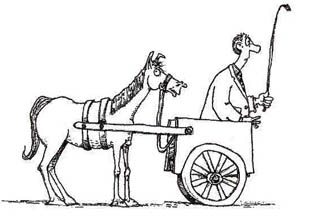 In Mark 7:1-23 we gain some subtle insight into the relationship between outward religious rituals (lex orandi) and the beliefs of those who practice them (lex credendi). After highlighting the extrabiblical nature of the Pharisees' demand that people scupulously wash themselves before eating bread (vv. 6-13), Jesus then gets to the heart of the matter:
And he called the people to him again and said to them, "Hear me, all of you, and understand: There is nothing outside a person that by going into him can defile him, but the things that come out of a person are what defile him" (vv. 14-16).
Why the abstract lesson on sin? Wasn't the issue supposed to be the amount of hygiene necessary to eat a sandwich?
Well if, as I have been arguing, a church's worship shapes its member's beliefs every bit as profoundly as its beliefs shape its worship, then Jesus' excursus on indwelling sin may not be as random as it initially appears.
You see, what certainly seems like a harmless religious ritual (ceremonially washing one's hands before eating) had clearly led to a deficient view of sin. In other words, the Pharisees' lex orandi (law of worship) had adversely affected their lex credendi (law of belief). Because they had for so many years been seeking to lessen their defilement by scrubbing their hands every few minutes, they had begun to think of defilement as primarily outward and circumstantial rather than inward and substantial.
Here's how this works in the church today: A church's leaders begin with the question, "What style of music should we have?" They decide that in order to reach the youth, they had better scrap the piano in favor of an acoustic guitar. They quickly realize that certain songs aren't easy to play on a guitar ("A Mighty Fortress"), while others are ("As the Deer"). Before long, the church's worship style (mellow acoustic music) defines its content (songs with a mellow acoustic feel). And then lo! and behold!, a movement is spawned that sees Jesus as that friendly guy at Woodstock with some real groovy spiritual insight.
But then, the Emergent Church has rescued us from the Jesus Movement, and I, for one, am thankful that none of these concerns can be applied to them....
Tuesday, July 15, 2008
Lex Orandi, Lex Credendi

At least, so the theory goes.
Unfortunately, this is only half the story. As indicated by the historic slogan lex orandi, lex credendi (literally, "The rule of prayer influences the rule of belief"), the relationship between confession and worship, dogma and liturgy, cuts both ways. In other words, it's not simply the case that a church's worship is the result of her beliefs about God, but it is equally true that her beliefs about God are largely shaped by the way she worships.
History bears this out. Well before the church's Christology assumed its mature, Chalcedonian definition believers were already worshiping a God who subsisted in three divine Persons. Both Augustine and Prosper of Auquitatine appealed to the church's practice of infant baptism in order to refute the Pelagian heresy that children are born without original sin. They were saying, in effect, "If infants are innocent, then why have we been baptizing them all this time?" In Prosper's own words: "Legem credendi lex statuat supplicandi" ("Let the law of prayer establish the law of belief").
If it is true that worship shapes belief as significantly as belief shapes worship, then the ramifications are pretty serious for those churches—whether evangelical or Reformed—that insist on making style a leading factor in how they conduct divine worship. Whether their aim is to woo the unchurched or demonstrate their "relevance" to those coveted artsy-fartsy soul-patched bohemians, the ever-present danger is that Jesus will be transformed from Deus homo into some guyliner-wearing dude in an indy band hoping to land a record deal.
Luther was right, the church will sing its way into idolatry long before its dogmaticians join the party.
Sunday, July 13, 2008
Ties That Bind, Ties That Divide
 One of my mates in the OPC recently accused us in the PCA of being "functional congregation-alists." He was responding to something I said about the diversity of our presbytery in areas like worship, theology, and overall philosophy of ministry. As it is elsewhere, it's pretty much live-and-let-live here in the Pacific Northwest.
He certainly has a point.
A denomination as broad as the PCA is bound to get messy and confusing, especially with respect to where we draw our various lines in the sand. On issues of worship, for example, one may identify himself with one set of allies, while he may disagree with those men over issues concerning biblical theology and Pauline eschatology. Conversely, those who share a similar view of the importance of eschatology may differ over whether justification or union with Christ is more central to Christian doctrine and life. And don't get me started on the bedfellows of a confessionalist who believes in women deacons.
I suppose what I'm wondering is whether the diversity and broadness of a denomination like the PCA is an asset or a liability. And if the latter, which issues represent ties that bind, and which are ties that divide?
Thursday, July 03, 2008
A Little Help?
 OK, so I'm feeling a tad under-inspired. If anyone has some ideas for topics to discuss, let's hear 'em, because the well's a bit dry at the moment.
Cheers.
Sunday, June 29, 2008
Where to Begin?
 As I argued in the comments under the "Bishops, Elders, and Deacons" post, one's position with respect to the number and nature of church offices is informed--if not determined--by where one begins his investigation of the biblical data.
If we start with I Timothy 5:17, a verse that speaks of "elders who rule" and "elders who labor in the Word and doctrine" ("elder" = presbyteros), it would not be surprising that we would conclude that the elder is an ordinary officer in the NT church, and that there are two kinds of elders: the ruling kind and the teaching kind. Then we simply add deacons, stir, let cool, and voila! we have a three-office ecclesiology (or at least 2 1/2).
But it is not altogether obvious to me that this is the most prudent approach. I Timothy 5:17 is a single verse whose context doesn't really have anything to do with the specifics of church office. In fact, it is not certain whether Paul is talking about church offices at all (when you look at the entire chapter, particularly its discussion of fathers, young men, brothers, old women, mothers, young women, sisters, and widows, it is at least possible he is using presbyteroi to refer literally to old men, not the office of elder).
If we seek to understand the nature and number of church offices, therefore, we should begin by looking to I Timothy 3:1-7 and 8-13. When we begin there, we see that Paul lists bishops and deacons with no mention of elders at all (cf. Phil. 1:1). When the clear passages illuminate the less-than-clear ones, it becomes possible, if not likely, that I Timothy 5:17's "elders who labor in the Word" are bishops (or ministers), and its "elders who rule" are deacons (or servant rulers).
So do me a favor and try this experiment: Read Paul's description and qualifications for the deacon, doing your best to forget everything you know about how that officer functions in the modern Reformed church. What we see is that the deacon must be dignified, he must hold to the deep things of the faith, and he must rule his house well.
Kinda sounds like what we expect from a "ruling elder," doesn't it?
Saturday, June 28, 2008
Happy Birthday, Nelson
I don't know about you, but this clip makes me pretty excited about U2's new album due out later this year (it was performed via satellite for Nelson Mandela's birthday). Bono's hitting those high notes like it ain't no thang.
Enjoy.
Wednesday, June 25, 2008
On Bishops, Elders, and Deacons


The series of questions I asked in my last post was meant to soften you all up for the proposal that I, as devil's advocate, will now attempt to make concerning officers in the church. Let the record show that I am merely wrestling with these things and have by no means landed on terra firma yet. Still, I will argue as though I'm convinced of this position, if for no other reason than to see if the view can bear your scrutiny.
My (hypothetical) thesis is as follows: There are two ordinary and perpetual offices in the New Testament church, bishops and deacons. The bishop (or overseer, Greek episkopos) is the minister of the Word, and the deacon (Greek diakonos) is a servant-ruler, an office that combines what we today separate, i.e., the "ruling elder" and the "deacon." And the Greek word presbyteros ("elder") can refer to either bishops or deacons.
Calm down, I haven't even made my case yet....
Paul writes his Philippian epistle "to the church in Philippi, with the bishops and deacons" (1:1). The omission of "ruling elders" can be explained (1) By saying that this church unfortunately didn't have any, (2) By saying that they were included under the category of bishops, or (3) By saying that no such distinct office existed in the churches Paul planted, but the "ruling" and "serving" was done by the deacons.
Option #1 is pure speculation. Option #2 is unlikely given Paul's description of the responsibility of the bishop in Titus 1:9 and Acts 20:28, one that sounds a lot like a trained minister and not a layman. Option #3, however, is most consistent with Paul's instruction to Timothy concerning how to order the church. In I Tim. 3:1-7 and 3:8-13 he lists the qualifications for (drumroll please)... bishops and deacons. "Ruling elders" are, once again, omited.
But when we flip ahead to I Tim. 5:17 we come to what many see as the only real Scriptural support for the contemporary notion of "ruling elders." But given that Paul specifically lists "bishops and deacons" as the church officers in Philippi, and given the apostle's qualifications for bishops and deacons specifically a couple chapters earlier, it makes a lot of sense to let Scripture interpret Scripture by saying that in this verse, the "elder who labors in the Word" is the bishop, and the "elder who rules" is the deacon.
Finally, when we observe (1) That the qualifications in Acts 6:3-7 for members of "the diaconate" include things like being "filled with wisdom and the Holy Spirit" and the ability to, essentially, determine who is a church member and who is not, and (2) That the requirements for deacons listed in I Timothy 3:8-13 include "ruling" their own households well, it seems possible (and even probable) that the "deacon" in the churches Paul planted was responsible to do what we today assign to the diaconate and the session.In a word, the bishop ministers the Word and sacraments, while the deacons both rule and serve.
Tuesday, June 24, 2008
And Now For Something Completely Different
I realize we're supposed to be talking about D.A. Carson on Christ and culture, but I wouldn't be the über-hip, edgy, ever-relevant PCA guy that I am unless I took up the topic du jour and spent some time talking about officers in the church.
Now, I have a bunch of stuff I'd like to dig into regarding elders and deacons, but since I am going to be at Disneyland all day Wednesday with my family (and thence away from the computer), for now I will kick the discussion off by asking some questions I've been wrestling with.
Until then, answer away....
Now, I have a bunch of stuff I'd like to dig into regarding elders and deacons, but since I am going to be at Disneyland all day Wednesday with my family (and thence away from the computer), for now I will kick the discussion off by asking some questions I've been wrestling with.
1. What is the relationship between episkopoi/presbyteroi/ diakonoi, and ministers/elders/deacons?The proposal I've been thinking through is, shall we say, rather dissimilar to anything I've heard advocated in Reformed circles (until a private discussion at the PCA's General Assembly a couple weeks ago, that is). I'll put it out there for discussion and critique, hopefully, tomorrow night.
2. If the episkopos (bishop or overseer) is a minister of the Word as many argue, then why does Paul address his Philippian letter "to the church in Philippi, with the bishops and deacons"? Why does he omit the "ruling elders"?
3. Why does Paul only list qualifications for episkopoi and diakonoi in I Tim. 3, again leaving out the elders?
4. Who are "the [presbyteroi] who rule" and "the [presbyteroi] who labor in the Word and doctrine" in I Tim. 5:17?
5. Were the seven men ordained in Acts 6 "deacons" as we commonly define them today?
6. What was Phoebe (Rom. 16:1)?
Until then, answer away....
Sunday, June 22, 2008
Speaking Prophetically to the Church
 As much as I hate to disagree with my brother Lane Keister, I just can't help myself on this one.
In his recent post entitled How to Avoid a Recession, Lane argues that the way the government must respond to our current economic downturn is by cutting spending and cutting taxes. Now, when libertarian-type arguments begin to take this form, what is almost always meant by "cutting spending" is "cutting spending on programs that the poor benefit from." Characteristically Lane, like many Reformed limited-government advocates, lists such programs as public schooling, Social Security, and welfare as among those areas in which Big Brother has no business sticking his nose.
Maybe Lane's right (but I, for one, don't think this question is solved by an appeal to Romans 13). Still, if he were consistent he would have to include the military-industrial complex as an example of massive government spending of U.S. taxpayer dollars (around $626,000,000,000 in 2007).
But that aside, what irked me about Lane's post and subsequent comments was the idea that the church is to "speak prophetically" to the culture about its sin:
"It is very disappointing to me to see that the church is not seeking to be prophetic in its critique of the government. Should the church ignore sin when the church sees sin? I think not."Now, what I almost never hear in these kinds of calls to speak prophetically to the state is any defense of what exactly the church, speaking as such, has the authority to tell the government to do or stop doing.
If we're to tell the state to stop overspending, does that include the hundreds of billions spent on the war? If we're to tell the state to enforce the Decalogue's moral demands, does that include covetousness and greed? If we're to tell the state to be tough on crime, does that include the kinds of crime wealthy white people commit?
Rather than speaking prophetically to the culture on earthly matters as a minister of the Word (a task I hardly feel competent to do), I would rather just do what my presbytery actually ordained me to do: to speak prophetically to my church, giving them the law, the gospel, the bread, and the wine.
You know what they say about the Jack of All Trades....
Wednesday, June 18, 2008
What Hath Cairo To Do With Beaverton?
 As I mentioned in my last post, D.A. Carson's main criticism of the "pessimism" of D.G. Hart's and Frederica Matthewes-Green's respective positions on the role of the church in culture is that they "fail to see the temporally good things we can do to improve and even transform social structures." Carson then cites abolishing slavery, curing disease, and reducing sex traffic as concrete ways (among "countless others") that "God's redeemed people" can fulfill our "responsibility to do good to the city."
Judging by the number of comments in the last thread, I'd say this has hit a nerve. Let's delve deeper and in greater detail, shall we?
For now, let's start with Carson's first example of how Christians can impact society: abolishing slavery. As has been pointed out already, "slavery" is hardly a univocal concept. The Egyptian subjugation of the Hebrews was evidently bad (though it got the divine thumbs-up later on when the Hebrews were the ones holding the whips). The Roman Empire's version of slavery, however, was apparently not evil enough to elicit a condemnation from Jesus, Peter, or Paul. American slavery was clearly an abomination, not only in this writer's opinion but in that of most people outside the bearded of Moscow, Idaho.
Whether or not the "wage slavery" that many have attributed to capitalism, or the sweatshop labor that the "free market" works so hard to perpetuate, qualifies as the kind of slavery that Carson thinks the church should abolish is unclear (I kind of doubt it, since it's always easier to tsk-tsk the crimes that Americans no longer commit than those that we presently associate with God's Own Politics [GOP for short]).
Either way, though, I'm not sure which book of the Bible provides the best tactical approach for putting Nike out of business (maybe Romans or Galatians, since they clearly repudiate the Mosaic works principle of "Just Do It").
But then, if Paul fails to suffice there's always Naomi Klein....
Sunday, June 15, 2008
Gimme an "S"! Gimme an "L"! Gimme an "A-V-E-R-Y!"
 In his discussion of the options vying for favor in the contemporary Christ/culture conversation, D.A. Carson interacts with those whose expectations he deems “minimalist” (such as Darryl Hart and Frederica Mathewes-Green).
Citing Hart’s insistence that Kuyperian attempts to integrate faith and scholarship are misguided, and Mathewes-Green’s likening of culture to the weather (we live in it and can even predict it with some accuracy, but changing it is not really an option), Carson argues that if all these authors were doing were offering a warning against utopianism, then all would be well. But such pessimism “fail[s] to see the temporally good things we can do to improve and even transform social structures” (p. 217-18, emphasis original).
Listing examples such as abolishing slavery, curing disease, and reducing sex traffic, Carson maintains that “in these and countless other ways cultural change is possible. More importantly, doing good to the city... is part of our responsibility as God’s redeemed people in this time of tension between the ‘already’ and the ‘not yet.’”
Hmmm....
If “God's redeemed people” are the ones uniquely fit to end slavery and cure cancer, then it must follow that all people who dislike cancer are God's redeemed people, and all who are God's redeemed people dislike slavery. Unfortunately for us all, many anti-abolitionists were southern Presbyterians, but fortunately for us all, many pagans are not huge fans of cancer.
And for my own part, I am not a big slavery- or cancer aficionado. But as I recall, I wasn't much of a fan in my BC days either.
Maybe there is common ground between the old and new me after all.
Saturday, June 14, 2008
High on a Desert Plane
 This week's U2 concert is from Paris on their 1987 Johua Tree Tour. It is a really strong performance as well as a perfect recording. As is my wont, I made a few artistic changes, such as:
1. It was one of the only shows on that tour that didn't open with "Where the Streets Have No Name," so I added the version from the Rattle and Hum DVD.
2. On the Joshua Tree tour U2 would alternate their setlists, playing "The Unforgettable Fire" one night and "One Tree Hill" the next. At this show they played the former, so I added a version of the latter as well. The quality isn't quite as perfect, but the performance of the song is great.
3. I added the well-known live (ahem) version of "A Sort of Homecoming" after Electric Co.
4. I edited a bit out of "With Or Without You" where Bono makes the band stop playing so he can yell at a security guy for hassling a fan.
Enjoy.
Tuesday, June 10, 2008
Off to Dallas....
 I'll be heading off to Dallas for the PCA's General Assembly in a few hours (it is 4o degrees warmer there than it is here, by the way). I'm not sure if I'll have access to the interweb or not, but either way, U2 Friday will be U2 Saturday this week.
Cheers....
Monday, June 09, 2008
The Clarion Call to Live Quietly
The last of Niebuhr's five options for discerning the relationship between Christ and culture is dubbed "Christ the Transformer of Culture" which, according to Carson's reading of Niebuhr, is not concerned so much with individual conversions, but the conversion of culture itself.
Niebuhr argues that for the proponent of this transformationist motif, eschatology is more "realized" than it is for most other Christians of differing persuasions.
I hope to deal with the methodological problems with Niebuhr's approach in a subsequent post, but I do trust that the careful reader will at least scratch his head in confusion over the placing of John Calvin and John Wesley on the same team, regardless of the game.
There are others who could deal with the questionable historical-theological claim that Calvin was a transformationist better than I (Hart? Wenger? Clark? acd?), but I will say that the idea that Calvin was all about transforming Geneva is somewhat suspect, not in the least because, as a French refugee in the city, he had no real power in the first place.
Biblically-theologically, though, I am certainly more than competent enough to challenge the idea that Niebuhr, by his lack of negative criticism, tacitly endorses, i.e., that Jesus wants to change the culture from common to holy. Despite the fact that Jesus, Paul, and Peter all spoke of the role of the believer in society, none of them waxed more inspiring than simply calling their hearers to live quietly and mind their own business.
No, such a message won't sell many best-selling books, but if the goal is to call out from this present earthly kingdom a holy city for the glory of God, then it sounds just about right.
Niebuhr argues that for the proponent of this transformationist motif, eschatology is more "realized" than it is for most other Christians of differing persuasions.
"[The conversionist] lives somewhat less 'between the times' and somewhat more in the divine 'Now' than do his brother Christians. The eschatological future has become for him an eschatological present."Interestingly, Niebuhr places both John Calvin and John Wesley within this trajectory. According to Carson, Wesley actually strengthens his conversionist heritage by espousing the doctrine of sinless perfection.
I hope to deal with the methodological problems with Niebuhr's approach in a subsequent post, but I do trust that the careful reader will at least scratch his head in confusion over the placing of John Calvin and John Wesley on the same team, regardless of the game.
There are others who could deal with the questionable historical-theological claim that Calvin was a transformationist better than I (Hart? Wenger? Clark? acd?), but I will say that the idea that Calvin was all about transforming Geneva is somewhat suspect, not in the least because, as a French refugee in the city, he had no real power in the first place.
Biblically-theologically, though, I am certainly more than competent enough to challenge the idea that Niebuhr, by his lack of negative criticism, tacitly endorses, i.e., that Jesus wants to change the culture from common to holy. Despite the fact that Jesus, Paul, and Peter all spoke of the role of the believer in society, none of them waxed more inspiring than simply calling their hearers to live quietly and mind their own business.
No, such a message won't sell many best-selling books, but if the goal is to call out from this present earthly kingdom a holy city for the glory of God, then it sounds just about right.
Friday, June 06, 2008
The Vertigo Tour As It Should Have Sounded
 Sorry for beginning this week's U2 Friday a few hours late (I was up late watching the Lakers lose, but I'd rather not go there).
This week's free download is a really superb show, despite all the negative things I said last week about the "New Millennium" incarnation of the band: U2 Live from Chicago (Vertigo Tour, 2005). The band, as always, sounds perfect, and Bono's voice is incredibly strong (it was early in the tour, after all).
Now, I must say a word to those of you who own the DVD from which this audio is ripped. As you may have discerned by now, I am very opinionated about U2's concert setlists, which is why I have taken some liberties here, such as:
1. I have replaced "Elevation" with "Gone" from their Boston 2001 show. This song should remain in U2's live arsenal, even though it's from Pop (which is a much better album than most will admit). Plus, "Elevation" is kind of lame, at least in the way they played it this time around. The transition from "Vertigo" to "Gone" is pretty seamless, as I always combine edited tracks into one file to make the transtition less noticeable.
2. I added "Until the End of the World" after "An Cat Dubh/Into the Heart," which is where the band should have played it.
3. I got rid of "New Year's Day." Lads, either reinterpret the song or move on, please.
4. I added "Kite" before "Sometimes You Can't Make It On Your Own." It fits, and it's one of those songs that deserves to be played for longer than just the tour that supports the album it's on. How the band doesn't get this is beyond me.
5. I replaced "Pride" with "Please" from Rotterdam '97. "Please" is another song that gets overlooked because it's from Pop, but in my view it deserves a place is the band's ongoing live repertoire (from which "Pride" needs to be mercifully expunged).
6. Lastly, just before "40" I added "Walk On." Again, it annoys me that U2 claims not to want to become a Greatest Hits Band, but they almost always fall back on their '80s classics while letting their good new material die after its respective tour ends. "Walk On" holds up, and they should have played it.
Enjoy the show....
Thursday, June 05, 2008
Between Heaven and Earth
 Niebuhr's fourth option, "Christ and Culture in Paradox," is assigned to "dualists" such as the "true Lutheran [who] finds life both tragic and joyful." The dualist motif is also found in Paul, Marcion, and Augustine.
Although D.A. Carson finds all five of Niebuhr's categories for determining the relationship of Christ and culture to be problematic (an assessment with which I heartily concur), it is difficult not to sympathize with this paradoxical option, however falsely arrived at.
"Living between time and eternity, between wrath and mercy, between culture and Christ, the true Lutheran finds life both tragic and joyful. There is no solution to this dilemma this side of death."It is precisely this tension between the already and the not yet (not to mention between iustus and peccator) that accounts for the love/hate relationship the believer has with the world around him. He hates the world while loving it, and both legitimately. He fears turning earth into a false god, but resists turning it into a false devil either. He insists that secular culture is not demonic, but also admits that it's not divine.
In a word, the Christian experiences all the messiness (forgive the emergent rhetoric) of dual citizenship, while rarely, if ever, feeling truly "at home" anywhere. As Conor Oberst put it, "My mind races with all my longings, but can't keep up with what I've got."
For my own part, while I know that all my unfulfilled longings are really longings for heaven in disguise, such knowledge doesn't change the fact that earth can look pretty good, too.
Subscribe to:
Comment Feed (RSS)


