Monday, April 20, 2009

Is Romans 2 Good or Bad News?

As I pointed out in my post last Wednesday, the standard Catholic position with respect to Paul and James on the relationship of works to justification states that, while man can never bring God into his debt or earn any reward from him, he nonetheless may (and must) perform Spirit-wrought good works in order to be saved. Romans 2:6-13 is often quoted in favor of this view:

He will render to each one according to his works: to those who by patience in well-doing seek for glory and honor and immortality, he will give eternal life; but for those who are self-seeking and do not obey the truth, but obey unrighteousness, there will be wrath and fury. There will be tribulation and distress for every human being who does evil, the Jew first and also the Greek, but glory and honor and peace for everyone who does good, the Jew first and also the Greek. For God shows no partiality.

For all who have sinned without the law will also perish without the law, and all who have sinned under the law will be judged by the law. For it is not the hearers of the law who are righteous before God, but the doers of the law who will be justified.
Now the traditional Protestant response is that Paul is explaining to his Jewish readers that if they insist on relating to God on the basis of works, then they'll have to go the distance. "Don’t just listen to the law," Paul sarcastically urges, "but go ahead and do it. All of it." Paul then proceeds to demonstrate both the Jews' and Gentiles' failure to perfectly obey the law, showing that God's solution is a "righteousness apart from the law" that has been revealed in Christ.

The Catholic will not relent at this point, however, but will argue that Paul is not pitting perfect law-keeping against faith, but rather, is contrasting the perfect kind of obedience that cannot justify with a less-than-perfect kind that can.

Their argument follows these points: (1) If Paul is speaking in Romans 2 of a covenant-of-works type of righteousness that is unattainable, then he would not have immediately referred his Jewish readers to "Gentiles who by nature do what the law requires" (v. 14). Unless such Gentiles exist, his argument has no force; (2) The whole context of Paul's chiding of his kinsmen is "repentance" and "continuance in well-doing" (vv. 4, 7), which makes no sense under the original Edenic covenant; (3) Every other New Testament reference to final judgment states that it will take place "according to works," and none of them are said to be hypothetical by Protestant exegetes, so why single out this one? (4) Paul describes the entire doing-the-law-to-be-justified and judgment-according-to-works processes as things that happen "according to my gospel" (v. 16), meaning that his message in Romans 2 is not meant to be taken as bad news, but as good news.

Two questions arise. First, how weak or strong are these points? And second, how consistent or inconsistent are they with the confessional Reformed position?

Saturday, April 18, 2009

Who Said That?

Here is this week's "Who Said That?":

"[Believers] are not under a legal system administered according to the principles of retributive justice, a system which requires perfect obedience as the condition of acceptance with God, and which says, 'Cursed is every one that continueth not in all things which are written in the book of the law to do them.' They are under grace, that is, under a system in which believers are not dealt with on the principles of justice, but on the principles of undeserved mercy, in which God does not impute 'their trespasses unto them.' There is therefore to them no condemnation. They are not condemned for their sins, not because they are not sins and do not deserve condemnation, but because Christ has already made expiation for their guilt and makes continual intercession for them."
There's a double challenge here: First guess the source of the quotation, and then guess who cited it approvingly. And as always, no Googling....
.
**Update**
.
The original quotation is from Princeton theologian Charles Hodge, and it was cited approvingly by Catholic apologist Robert Sungenis in his book Not By Faith Alone.

Friday, April 17, 2009

Dual Citizens: Worship and Life Between the Already and the Not Yet

"The subject of Christ and culture has never been as popular among conserva­tive Protestants in the United States as it is today, and the topic has never needed as much attention from the perspective of the church. It gets that attention in this important book by Jason Stellman. Dual Citizens will certainly upset those used to thinking of Christ as mainly the transformer of culture. But for genuine wisdom not only on the culture wars, but on the culture, ways, and habits of the church, Stellman’s discussion is the place to go."

Dr. D. G. Hart
Director of academic programs Intercollegiate Studies Institute
Wilmington, Delaware

"For too long I struggled to recommend reading on the subject of living the Christian life as a ‘resident alien.’ Often I was reduced to directing readers to liberal Methodists (such as Hauerwas and Willimon) as the best embodiment of Christian convictions. At last I can point to practice that is firmly grounded in Reformed theology. Dual Citizens is written by someone who loves the world: its movies, its music, and its authors. But this is a rightly ordered love because it is a penultimate love. Here is a robust pilgrim theology that marches on to Zion while avoiding the pitfalls of asceticism and legalism. By putting earthly king­doms in their proper place, Pastor Stellman demonstrates how rightly to use the present world even as one eagerly awaits the next."

Mr. John Muether
Professor of church history/library director
Reformed Theological Seminary
Orlando, Florida

Wednesday, April 15, 2009

Rome's Reconciliation of Paul and James

I think I’m beginning to get a handle on the Catholic approach to reconciling Paul and James. Unless I’ve totally misunderstood their position, I think it goes something like this:

There are two kinds of faith, and two kinds of works. (1) Dead Faith is a bare intellectual assent akin to that of devils; (2) Living Faith is the genuine kind of faith that produces heartfelt obed-ience; (3) Dead Works are works done without living faith; and (4) Living Works (not the best way of putting it, but I’m trying to keep this simple and consistent) are those acts of obedience that spring from living faith.

How does this apply to the apparent contradiction between Paul and James, with the former saying that Abraham was justified apart from works and the latter saying that the patriarch was justified not by faith alone, but by faith and works?

Well, the Catholic would say that Paul is not concerned with answering the question "What kind of faith justifies?", and likewise, James is not addressing the question "What kind of works do not justify?" In fact, it’s the other way around. Paul’s concern is to dispel the idea that the works done by the Judaizers (and by extension, by faithless Gentiles as well) can garner any favor with God whatsoever. James's concern, on the other hand, is to dismantle the notion that a mere cognitive assent of the mind can justify anyone. But, Rome maintains, what both writers agree on is the idea that a living faith justifies.

So as you can see, both Protestants and Catholics insist that certain words are used equivocally by Paul and James, we just disagree on which words those are. The Catholic maintains that they are using "justification" identically but are using "faith" and "works" differently, while the Protestant says that the interpretive key is the different definitions of "justification" that are in play (Paul's has to do with legal acquittal before God, and James's with demonstrative vindication before men).

To the Scriptures, then.

Avoiding the silly accusations that fault Catholics for not being more Protestant and Protestants for not seeing things like Catholics, which position makes the most sense out of the data? And can either approach be adopted by either side?

Monday, April 13, 2009

When Grace Loses Its Graciousness

Forgive me for the harping, but I just can't figure out the Catholic position with respect to justification in general, and Abraham's in particular.

Paul takes up this point in Romans 4. He begins not by stating that Abraham was not justified by the boastful kind of works, but rather that the reason Abraham did not boast was because he did not work at all, but believed on him who justifies the ungodly.

For if Abraham was justified by works, he has something to boast about, but not be-fore God. For what does the Scripture say? "Abraham believed God, and it was counted to him as righteousness." Now to the one who works, his wages are not counted as a gift but as his due. And to the one who does not work but believes in him who justifies the ungodly, his faith is counted as righteousness (vv. 2-5).
Clearly Abraham is not justified by works according to Paul, meaning that whatever James is talking about when he says that the patriarch was justified by works, it must be something different than what Paul is referring to.

Moreover, the apostle makes it clear elsewhere that the fact that salvation is by grace demands that it be by faith, for if works are mingled into the justification equation, the principle of grace has been undermined: "But if it is by grace, it is no longer on the basis of works; otherwise grace would no longer be grace" (Rom. 11:6; cf. 4:14-16).

And lest the reply be offered that it is only Jewish ceremonial "works of the law" that cannot justify, both Paul and Peter state that these ethnic boundary markers, which all good Jews meticulously kept, only serve to bind their adherents with an unbearable yoke and curse them along with all who are in Adam. Why would laws that the Judaizers obeyed serve to curse and not justify, unless the point being made is that Israel is but a microcosm of all people who trust in works of any kind to gain God's gracious acquittal?

It seems to me that the Reformed formula of guilt/grace/gratitude does a much better job of guarding the graciousness of the gospel on the one hand, while still retaining a place for holiness and obedience on the other.

Saturday, April 11, 2009

Who Said That?

Please, no Googling:

"We live in a society whose whole policy is to excite every nerve in the human body and keep it at the highest pitch of artificial tension, to strain every human desire to the limit and to create as many desires and synthetic passions as possible.... We live in a society that tries to keep us dazzled with euphoria in a bright cloud of lively and joy-loving slogans. Yet nothing is more empty and more dead, nothing is more insultingly insincere and destructive than the vapid grins on the billboards and the moronic beatitudes in the magazines which assure us that we are all in bliss right now. I know, of course, that we are fools, but I do not think any of us are fools enough to believe that we are now in heaven.... I think the constant realization that we are exhausting our vital spiritual energy in a waste, the inescapable disgust at the idolatrous vulgarity of our commercial milieu is one of the main sources of our universal desperation."

Good luck....
.
***Update***
.
The answer is Thomas Merton (well done, Rob).

Wednesday, April 08, 2009

Isn't It Ironic?

I like irony, and when I detect it I like to point it out. And I'm not talking about rain on your wedding day or ten thousand spoons when all you need is a knife.

I have been chuckling to myself recently about how that Catholics deny the Protestant idea of the perspicuity of Scripture (that the Bible is clear enough on its basic teachings that even children can understand its message), but at the same time, Rome's doctrines represent the conclusions that any child would reach by just reading the Scripture for what it says. And contrariwise, we Protestants insist that the Bible is perfectly clear and understandable while employing our most impressive systematic and exegetical acumen to highlight just how complicated the seemingly-plain language of Scripture really is.

For example, if my four-year-old daughter were to read the words, "This is My body," she would probably conclude that the bread is Jesus' body in the most basic and literal sense of the word, and I would have to try my hardest to explain that what Jesus really meant was that the bread is his body truly, but spiritually and not physically since insistence upon the ubiquity of Jesus' human nature betrays an erroneous, indeed Eutychean, understanding of the communicatio idiomatum.

Or, if she read the instruction of Ananias to Saul to "be baptized and wash away your sins," she would most likely assume that baptism washes away sins, leaving me to point out that the administration of the signum and the reception of the res significata are not necessarily simultaneous, and that it's not the waters of baptism that really wash away sins anyway, but the blood of Christ (of which baptism is a sign and seal).

And heaven help me if I ever let her read the book of James, for then she'll probably get the idea that Abraham was not justified by faith alone, but by faith and works (which, in turn, will force me to patiently point out that Paul and James use the words pistis and dikaioo in quite different ways, even though they sound the same in Greek and English).

Does all this hassle tempt me to abandon my complex theology? Of course not. But it does make me wonder if Geneva should trade the notion of perspicuity to Rome for something that they claim, but would look better sitting exclusively on our mantle.

How about sola gratia?

Monday, April 06, 2009

On Elves, Centaurs, and the Ease of Cultural Eutycheanism

I'd like to follow up on something I said in my review of C.J. Mahaney's Worldliness.

I certainly appreciate the way Worldliness concludes with some instruction concerning how to love the world without loving it—affirming, as it were, that “This Is My Father’s World” and that “This World Is Not My Home”—but I still feel that the world gets a bit short-changed by Mahaney and the other contributors.... The Reformed distinction between the sacred and secular realms can be understood within this framework, with the former referring to heavenly realities and the latter denoting earthly ones. But Worldliness explicitly denies this distinction, with Purswell actually calling for its “demolition.” According to him, the dominion mandate should guard us from being “plagued by the tendency to compartmentalize some aspects of our lives as spiritual, good, and holy and others as unspiritual, unimportant, and amoral” (p. 155). Setting aside his failure to read the dominion mandate through the lens of New Testament eschatology, Purswell’s forcing us to choose between an earthly pursuit’s being either “holy” or “unimportant” is a false dilemma that omits the option of “common.” If art, sports, or cooking are neither demonic nor divine, then there is no reason why they cannot be enjoyed for their own sakes without the added pressure to baptize, redeem, or in some sense Christianize them.
If we "demolish" the distinction between the sacred and secular, it seems to me that all we are doing is allowing the former to swallow the latter, with all of life now becoming holy. The problem here is that the very definition of "holy" is "set apart." Now, if something, whether a place or a day or a vessel, is to be "set apart," there must be something it is set apart from. But if everything is holy, then does this not empty "holiness" of all its meaning?

(Kind of like how for Calvinists God's mercy only makes sense in the light of the doctrine of reprobation, Rom. 9:22-23.)

I really appreciate Chesterton's point about the core doctrine of Christianity, the hypostatic union, involving two seemingly antithetical ideas (the human- and divine natures of Christ) perfectly united in one Person. Jesus wasn't an elf (a non-man) or a centaur (a half-man), but he was at the same time truly Man and truly God. Taking this and applying it more broadly, Chesterton argues that when the prophecy that the lion will lie with the lamb is fulfilled, it will not be due to the lion's becoming lamb-like (which would be brutal annexation and imperialism on the part of the lamb). Rather, the lion will retain its ferocity while choosing not to give expression to it at that moment.

What does this all have to do with the sacred and the secular? Well, allowing one to swallow the other is easy, but it's also a kind of cultural Eutycheanism (which, when done in Christology, is heretical). Rather, we ought to be true lovers of the world and true haters of it, affirming that "This is My Father's World" and that "This World is Not My Home" (which, when you think about it, sort of necessitates two kingdoms).

Paradoxical, yes. But what about our religion isn't?

Saturday, April 04, 2009

My Anti-Bucket List, Part 3

Continuing to document my monumental lacks-of-achievement (things which I hope to continue to fail to do until I die), I give you these amazing non-feats:
.
I have never eaten a pecan, an olive (black or green), a lima bean, an egg, a mushroom, or an entire piece of beef jerky.

Here's to hoping I can keep this streak up, because I feel great!

Wednesday, April 01, 2009

Review of Worldliness by C. J. Mahaney

This review will be published in an upcoming issue of Modern Reformation magazine.

***

As the editor and contributor, C. J. Mahaney begins the book Worldliness by posing the provocative question of whether I John 2:15 is still in our Bibles, or if we have, in true Jeffersonian fashion, simply cut out the beloved disciple’s exhortation: “Do not love the world” (p. 15).

The reason for such a metaphorical excision is that the very command gives rise to more questions than it does answers, such as:

Does it mean I can’t watch MTV or go to an R-rated movie? Do I have to give up my favorite TV shows? … How do I know if I’m spending too much time playing games or watching YouTube clips on my computer? … Can a Christian try to make lots of money, own a second home, drive a nice car, and enjoy the luxuries of modern life? … How do I know if I’m guilty of the sin of worldliness? (p. 17)
These are certainly important questions to ask, particularly in light of Mahaney’s observation, borrowed from James Hunter, that Christians have “lost a measure of clarity” with respect to how we relate to the world (p. 21). “We have softened,” says Mahaney, to the point where the adjective worldly and the noun worldliness have lost much of their meaning in the contemporary church (p. 22). Against the Christian culture of capitulation Mahaney rightly insists that “The greater our difference from the world, the more true our testimony for Christ—and the more potent our witness against sin” (p. 23). Worldliness, Mahaney writes, “is a passionate plea to a generation for whom the dangers of worldliness are perhaps more perilous than for any that has gone before” (p. 24).

Mahaney continues in his introductory chapter to define what it is, exactly, we’re not to love: “The world we’re not to love is the organized system of human civilization that is actively hostile to God and alienated from God” (p. 26, emphasis original). More specifically, worldliness is “a love for this fallen world. It’s loving the values and pursuits of the world that stand opposed to God” (p. 27). Some specific issues that the authors address throughout the book are the media, music, stuff, and clothes.

Worldliness closes with a chapter whose title is meant to be something of an ironic surprise: “How to Love the World” (written by Jeff Purswell). Here the author insists that “to read the message of this book as a call merely to avoidance is to misunderstand it…. It would be equally tragic if we defined our relationship with the world simply in terms of negation” (p. 140). In this chapter, Purswell seeks to demonstrate how it is that a Christian should love, and faithfully live in, this present world.

After providing a brief biography of the human story following the pattern of creation, fall, redemption, and consummation, Purswell draws or attention to the all-important (and often ignored) fact that it is not the created order per se that we are called to avoid (as if the physical world, as such, is evil as the Gnostics insist). On the contrary, writes Purswell, the believer is a spiritual exile and a geographical earthling, and the lens of Scripture allows the Christian pilgrim an “enhanced enjoyment of the world” (p. 148):

Although the fall brought frustration and corruption even to natural creation, it remains a gift from God to be acknowledged, appreciated, and enjoyed…. It may sound strange to ears tuned to discern danger in all talk about “the world,” but Paul seems just as concerned about a failure to appreciate creation as he is about the tendency to worship it (pp. 150, 151).
“For the heart transformed by the gospel,” Purswell writes, “the physical world holds great promise as a worship-producing source of pleasure and provision that opens the eyes to God and engenders worship of God” (p. 151).

I certainly appreciate the way Worldliness concludes with some instruction concerning how to love the world without loving it—affirming, as it were, that “This Is My Father’s World” and that “This World Is Not My Home”—but I still feel that the world gets a bit short-changed by Mahaney and the other contributors. Despite the very helpful biblical-theological emphases throughout, Worldliness fails to adequately appreciate just how significant the fourth category is in the creation-fall-redemption-consummation motif. If this present age is provisional and will one day be overthrown by an eternal age to come, and if the transformation for which we long is to be experienced in the resurrection, then it follows (especially if one is an amillennialist) that earth and its common blessings are simply that: earthly and common. Furthermore, the Reformed distinction between the sacred and secular realms can be understood within this framework, with the former referring to heavenly realities and the latter denoting earthly ones. But Worldliness explicitly denies this distinction, with Purswell actually calling for its “demolition.” According to him, the dominion mandate should guard us from being “plagued by the tendency to compartmentalize some aspects of our lives as spiritual, good, and holy and others as unspiritual, unimportant, and amoral” (p. 155). Setting aside his failure to read the dominion mandate through the lens of New Testament eschatology, Purswell’s forcing us to choose between an earthly pursuit’s being either “holy” or “unimportant” is a false dilemma that omits the option of “common.” If art, sports, or cooking are neither demonic nor divine, then there is no reason why they cannot be enjoyed for their own sakes without the added pressure to baptize, redeem, or in some sense Christianize them.

The only other area of disappointment with this book centers on the fact that, for the authors of Worldliness, the all-important task of distinguishing ourselves from the world is pursued on an almost completely individual level. While there is little doubt that the believer needs instruction on how to combat his own worldliness and sin, no Reformed Christian should underestimate the role that the visible church plays in setting ourselves apart from the citizens of this present evil age. In fact, one may go as far as to suggest that the primary way that we distinguish ourselves from nonbelievers is by our sacred activity, which primarily occurs in worship every Lord’s Day as we are ushered into glory and truly leave the world behind.

These issues aside, Worldliness is a very necessary and helpful book which will undoubtedly aid believers in the task of living in the world while not being of it.

Monday, March 30, 2009

My Anti-Bucket List, Part 2

As I mentioned in an earlier post, the idea of a "bucket list" (a list of things to do before I kick the bucket) is pretty unappealing to me. Instead, I have begun compiling an anti-bucket list consisting of things I have never done and genuinely hope never to accomplish before I die. This post contains my anti-bucket list item #2.

I have never watched a football game.

Of course, I have seen football on TV (usually at a restaurant or some other public place), but I have never actually watched an entire game from start to finish. Of course, my overall lack of exposure to this sport in no way disqualifies me from opining about it publically, so here goes:

First off, you gotta admit that football isn’t all that physically strenuous (unless you compare it to baseball). Think about it: not only are the players completely covered in padding from head to toe (to protect them against what the refs call "unnecessary roughness"), but the total amount of actual playing time for someone who's in for the entire game can't be more than around 10 minutes or so. Each play, from the snap to the tackle, touchdown, or incompletion only averages around 5 seconds, 10 at the most. And when you take into account the fact that there are separate teams playing offense and defense, well, it begins to look like the most running these guys do is to and from the bench. Any soccer, rugby, or basketball player expends way more energy than a football player. I may have even exerted myself more strenuously by writing this sentence.

And enough already with the whole running the ball up the middle thing. If I were given the chance to coach an NFL team—a job I would be awesome at—I would tell my players, "Hey fellas, see that big pack of defenders clogging up the middle? Yeah, them. Maybe try to, I don't know, avoid those guys. Go around them is what I'm saying." Or just pass the ball more, that's at least interesting.

So there you have it, another feat I am very proud not to have accomplished.

Friday, March 27, 2009

The Paradox of Parallel Passions

In his book Orthodoxy, G.K. Chester-ton takes the mystery of the hypo-static union and just does some fascinating and creative things with it. Maybe this kind of thing is par for the course in Rome, I don't know. But from where I stand, it's pretty remarkable.

For example, Chesterton argues that our Lord's two seemingly contradic-tory natures being united in one Person without in any way dimin-ishing either the human or the divine can act as a kind of paradigm for our faith's ability to unite other disparate qualities as well.
By defining its main doctrine, the church not only kept seemingly inconsistent things side by side, but, what was more, allowed them to break out in a sort of artistic violence otherwise possible only to anarchists.
Speaking of the various applications of this principle, Chesterton writes:
[The church] has kept [the emphases on celibacy and family] side by side like two strong colors, red and white, like the red and white upon the shield of St. George. It has always had a healthy hatred of pink.
Chesterton then turns to the biblical prophecy of the lion dwelling with the lamb, insisting that it is too facile simply to think that this odd arrangement of bedfellows is made possible by the lion becoming lamb-like, for
... that is brutal annexation and imperialism on the part of the lamb. That is simply the lamb absorbing the lion instead of the lion eating the lamb. The real problem is, Can the lion lie down with the lamb and still retain his royal ferocity? That is the problem the church attempted; that is the miracle she achieved.
He concludes:
Anyone might say, "Neither swagger nor grovel"; and it would have been a limit. But to say, "Here you can swagger and there you can grovel"—that was an emancipation.
It's not difficult to see some implications for a two-kingdoms ethic begin to arise from Chesterton's points here. To borrow his nomenclature from elsewhere, there needs to be a balance between puritanism and paganism, or, between heavenly- and earthly citizenship. If our Lord was "at once complete in Godhead and complete in manhood, truly God and truly man" while remaining "one and the same Christ, Son, Lord, only-begotten, recognized in two natures, without confusion, without change, without division, without separation," then we mustn't allow either legitimate side of a dilemma to swallow the other.

Could it be that the temptation to which the American church often falls prey, namely, to fear the world as a constant threat, is simply an example of its sloppy Christology playing itself out?

Tuesday, March 24, 2009

The Oligarchy of the Living Versus the Democracy of the Dead

I think G.K. Chesterton is alive and well, and I'm pretty sure he reads this blog:

The man who quotes some German historian against the Catholic Church... is strictly appealing to aristocracy. He is appealing to the superiority of one expert against the awful authority of the mob. It is quite easy to see why a legend is treated, and ought to be treated, more respectfully than a book of history.... Tradition means giving votes to the most obscure of all classes, our ancestors. It is the democracy of the dead. Tradition refuses to submit to the small and arrogant oligarchy of those who merely happen to be walking about.... Democracy tells us not to neglect a good man's opinion, even if he is our [servant]; tradition asks us not to neglect a good man's opinion, even if he is our father (Chesterton, Orthodoxy, pp. 64-65).
The reason I did a double-take when I read this the other day was that Chesterton may as well be arguing with one of the commenters here at DRD who loves to, well, "quote some German historian against the Catholic Church."

Now, I do appreciate Chesterton's position, especially his sense of childlike wonder and appeal to fairy tale and legend in arguing for the Christian religion in general, and the Catholic faith in particular. His chapter "The Ethics of Elfland" is among my all-time favorite passages in all of literature. Still, it must be said that not all those who appeal to German historians to disprove the Catholic Church are doing to simply in order to be aristocratic or elitist. Sometimes such an appeal is made because said German historian has actually marshalled a good bit of evidence to demand that we take another look at the facts.

Plus, if citing contemporary historians is to automatically fall prey to Chesterton's charge of preferring the oligarchy of the living to the democracy of the dead, what happens when those historians themselves die?

Can we listen to them then?

Monday, March 23, 2009

My Anti Bucket List, Part1

I first heard the term "bucket list" when I saw the trailer for the film with that title starring Jack Nicholson and Morgan Freeman (no, I didn’t see it, nor would I ever stoop that low). Anyway, a bucket list, apparently, is a list of things you hope to accomplish before you "kick the bucket," to use the parlance of our times.
.
Well, this got me thinking....

Not being the most motivated person in the world, a couple years ago I started compiling a growing list of things that I genuinely hope not to accomplish before I die. Although not doing stuff is way easier than the opposite and not necessarily something to brag about, I trust that you all will be truly surprised by my various lacks of accomplishment. And of course, if you can honestly claim to have not done these things, then by all means speak up and share the glory with me.

So for the first item on my anti-bucket list, I provide the following: I have never owned a beeper, a pager, or a cell phone, nor have I ever sent or received a text message.

Here’s my reasoning: (1) I am a bit of a Luddite anyway with a healthy suspicion toward technology in general; (2) the last thing I need in my life is some new thing that in six months I won’t be able to live without; (3) none of the scenarios that you’re imagining that would necessitate my having a cell phone have ever happened to me, nor are they likely to (read: no, my car has never broken down in the middle of nowhere with no means of rescue); (4) I inwardly belittle (read: despise) people who can’t seem to sit still in a coffee house waiting for whoever they’re waiting for without pulling out their cell phone after 26 seconds and fiddling with it because their own thoughts are so utterly shallow and boring. Here’s a tip: try thinking about something; (5) I think the more dependent we are on gadgets the less human we become; (6) I relish in the fact that I’m not easily reachable at all times. It made me happy the other day when the guy who was tuning up my car at Goodyear actually came across the street to Starbucks to ask me if I approve the work that needed to be done; (7) I like asking total strangers if I can use their phones if I need to make a call for some reason while away from home. They always give a look of combined confusion and either awe or pity.

You’ve probably heard the slogan that says that "necessity is the mother of invention," but in our day of technological acumen, I think that slogan’s a total farce. In fact, I think the exact opposite is true.

(Put down your cell and think about it.)

Saturday, March 21, 2009

The Peculiarity of Christianity's Peculiarity

I read this in Chesterton's Orthodoxy yesterday, and liked it for many reasons:

"It is commonly the loose and latitudinarian Christians who pay quite indefensible compliments to Christianity. They talk as if there had never been any piety or pity until Christianity came.... They represent that the remarkable thing about Christianity was that it was the first to preach simplicity or self-restraint, or inwardness and sincerity. They will think me very narrow (whatever that means) if I say that the remarkable thing about Christianity was that it was the first to preach Christianity. Its peculiarity was that it was peculiar, and simplicity and sincerity are not peculiar, but obvious ideals for all mankind. Christianity was the answer to a riddle, not the last truism uttered after a long talk."

If I were forced to give up every non-canoincal book save one and read it continually for the rest of my life, I have to admit it just may be this one.

Wednesday, March 18, 2009

Arrested Development?

One of the most interesting and challenging arguments used by Catholics to defend doctrines that Protestants consider pure novelties is the argument from the devel-opment of doctrine, which states that though the initial deposit of the faith was given intact to the apostles and from the apostles to the first generation of bishops, the church’s understanding of the deposit develops over time, usually as a result of controversy or heresy.

There are a couple examples that are commonly used by Catholics to demonstrate their point. One is the canon of Scripture. Though by the year 90 AD (or thereabouts) the final book of the New Testament had been written, it took the church a good number of years to arrive at this conclusion. Likewise with the doctrine of the Trinity or the hypostatic union of the two natures in the one Person of Christ. The fact that these doctrines were not formally propounded until the fourth- and fifth centuries does not in any way diminish their validity. Therefore, insists the Catholic, just because the dogmas of papal infallibility or the assumption of the blessed virgin Mary were not formulated until the nineteenth century does not mean we should balk at them. If the Trinity had taken another thousand years to state officially, would it be any less true?

Now on the one hand this makes a lot of sense. I mean, a case could certainly be made that the church of Acts 2 would barely have recognized the church of Acts 15 if it had been given a crystal ball. Elders? Deacons? Gentiles? What happened to our simple movement, how did it get so complex?

But on the other hand, I fail to see how certain dogmas can honestly be said to be developments in the church’s understanding of the original deposit of faith, and when I hear Catholics insist that they would never think of adding anything to what God has revealed in his Word, I just scratch my head. Take the sale of indulgences as one example (does that one count as dogma?), or take as another the immaculate conception and assumption of Mary. Sure, I’ve read the arguments and heard the logic behind these teachings, and though they are unpersuasive they are certainly plausible. But insisting that they are actually biblical, well, that’s another issue.

What am I missing?

Monday, March 16, 2009

Remember, With Moxy, Your Own Orthodoxy....

I have touched on this topic before, but perhaps it merits a revisiting in light of recent comments. There are two kinds of "orthodoxy" in my view. The first (we'll call it Big-O Ortho-doxy) represents those things which must be believed in order for a person to be a Christian in any meaningful sense of that word. Most traditions look to the Apostle's and Nicene Creeds as examples of Big-O Orthodoxy.
.
Then there are various little-o orthodoxies that compete with one another for the other, umm, non-essential doctrines (I shuddered a little just now).

So while any claim to Orthodoxy must include a correct understanding of, say, the divinity of Christ and the hypostatic union of his two natures in one Person, where one stands on the issue of the metaphysics of the Eucharist or the timing of Christ's return may play a part in the orthodoxy of whichever tradition one may be a part of, but they do not affect Orthodoxy with a Big-O.

So for example, Calvary Chapel's orthodoxy demands a belief in the pretribulational rapture, while the PCA's insists on the doctrine of imputation, and Rome's orthodoxy includes the immaculate conception and assumption of the blessed virgin Mary. But all three of these traditions would affirm the tenets of the Nicene Creed (even if, as in our first example, they've never heard of it).

So when the question is asked, "Can your tradition guarantee orthodoxy?", we need to determine what the interlocutor means by "orthodoxy" before we can answer. If he means Big-O Orthodoxy, the answer is "Yes," because if a person in just about any Christian church denies the tenets of the Nicene Creed he will be disciplined, and if the entire church denies them, they will be relegated to the status of a false religion such as Mormonism or the Watchtower Bible and Tract Society.

But if the questioner is asking whether a tradition can guarantee little-o orthodoxy, well, the question is somewhat redundant. Can the PCA guarantee belief among its members in the doctrine of imputation? Can Calvary Chapel ensure that its pastors hold to Dispensational eschatology? Can Rome guarantee that those in her communion affirm transubstantiation? Well, with varying degrees of success, the answer is pretty much "Yes."

But when we identify Orthodoxy with orthodoxies of whatever stripe, the question "Can your tradition guarantee orthodoxy?" becomes meaningless. No, the PCA cannot guarantee belief in the immaculate conception any more than Rome can protect the sanctity of the seven-year tribulation or the "Moses Model" of pastoral ministry.

And for the record, all churches hold to this distinction, whether they admit it or not.

Saturday, March 14, 2009

You Two and Three

Why is U2 obsessed with the number three?

On the song "Breathe" from their latest al-bum No Line on the Horizon (which was released, [co]incidentally, on 3/3/09), Bono sings,

16th of June, 9:05, doorbell rings,
Man at the door says if I want to stay alive a bit longer,
There's three things I need you to know. Three.
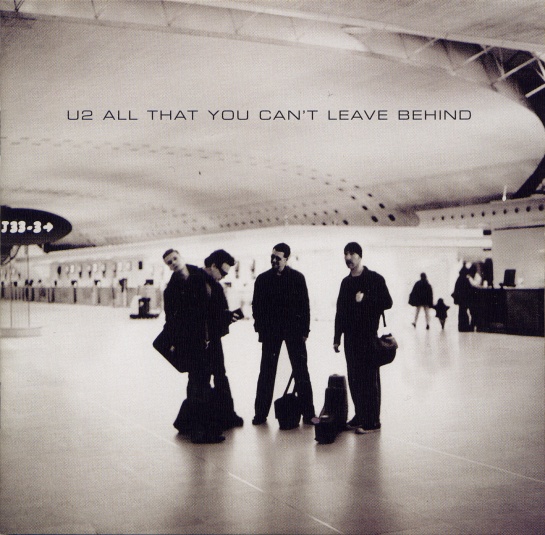
In "Unknown Caller," the protagonist finds himself "lost between the midnight and the dawning, in a place of no consequence or company." Then, at "3:33, the numbers fell off the clock face." This may be a veiled reference to the cover of the band's 2000 album All That You Can't Leave Behind, on which they had the display in the upper left altered to reference Jeremiah 33:3, which Bono calls calls "God's phone number."

Referring to the fact that we tend to kill those whom we admire ("Every artist is a cannibal, every poet is a thief. All kill their inspiration, then sing about the grief"), Bono sings in "Hold Me, Thrill me, Kiss Me, Kill Me":

They want you to be Jesus,
They're going down on one knee;
But they'll want their money back,
If you're alive at thirty-three.
And then, of course, it was "three o'clock in the morning," when "it was quiet with no one around," that the character portrayed in "Stay (Faraway, So Close)" heard "a bang and a clatter, as an angel hits the ground."
.
If you've got an interpretation, then by all means weigh in, because I haven't a clue....

Thursday, March 12, 2009

Let Them Eat Cake!

I like cake. But the thing is, I like to eat it, too.

Because of this tendency, I often shy away from arguments against Catholicism that take as their launching point the various abuses and aberrations of the church throughout the centuries, as if the Protestant's only problem with Rome is the occasionally opulent pope or abused altar boy. In other words, a robust Reformed argument against Rome would focus not only on what it became, but also on how it began.

If all we focus on are the incidentals, then is not this a tacit admission not only that the solution to Rome is not Protestantism but reformed Catholicism, but also that our entire ecclesiology is a convention arising post hoc, a reaction to biblical Christianity gone awry instead of a return biblical Christianity itself? Don't miss the import of what I'm saying: if we focus solely upon Rome's abuses, we are surrendering not only all exegesis, but also conceding that Jesus did in fact intend to found a visible church characterized by apostolic succession and Petrine primacy, but once that church messed things up, we came along with a bunch of new ideas about invisible churches and Sola Scriptura.

To put it bluntly, Protestants need to argue for Protestantism, not just against Catholicism, and we need to do it from Scripture, as if (gasp!) Jesus actually intended something akin to Reformed ecclesiology all along. Why would we be comfortable with anything less? I mean, what are we, Protestants or simply non-Catholics?

So let's not shoot ourselves in the foot by just settling for cake. Let's go the next step and demand to eat it, too.

Monday, March 09, 2009

Rationalists, Mormons, and the Validity of Folk History

After attending an excellent seminar on Saturday by Dr. Tracy McKenzie (Professor of U.S. History at the University of Washington, erstwhile opponent of Doug Wilson and his romanticized view of slavery, and member of the church I pastor) on the topic of "Thinking Christianly About History," I got to thinking....

Is there, or ought there to be, such a thing as folk history?

I guess what I'm asking is, What is the relationship between the actual events of the past and the lens of tradition through which we evaluate them? Take for an example the issue of the resurrection of Christ. No matter how many articles appear in Time or Newsweek quoting some scholar who claims to have discredited the doctrine, or some archaeologist who thinks he found the bones of Jesus, most Christians will not believe it. Our faith makes such claims highly suspicious.

The resurrection may not be the best example, though, since the event is recorded in Scripture. But what about the Johannine authorship of the fourth Gospel? Despite the fact that it is nowhere attested to in the New Testament itself, it is unlikely that any sincere Christian will come to reject it after reading some liberal scholar's arguments, no matter how well-reasoned.

Or, take the debate between Catholics and Protestants over the issue of the papacy. Because Catholic tradition states that Clement wrote to the Corinthians at the end of the first century exercising the authority belonging to the bishop of Rome, it really doesn't matter what contemporary historians may say to discredit the presence of a monarchical bishop in Rome in the first 150 years of church history. This is because the Catholic's lens of tradition functions more powerfully than does the testimony of some historian out there with an axe to grind (and I'm not faulting the Catholic for this, I'm just pointing it out).

So it seems to me that there are two distinct but related pitfalls to avoid as we seek to relate our faith to the study of the history on which it relies. On the one hand, we can accept the testimony of historians based solely on the merit of their research. On the other, we can cling to our story with such devotion that it becomes unfalsifiable.

If we adopt the former approach, what distinguishes us from rationalists? And if we choose the latter, how are we principally different from Mormons?

Friday, March 06, 2009

Finding Grace Inside a Sound

Following Scripture, Reformed theology has always placed great emphasis on the ear over the eye. The gospel is called by Paul "the word of faith," a message that produces belief "by hearing the Word of Christ." The opposite of faith, of course, is not doubt but sight. A person is most faithless, therefore, not when disbelief is mingled with his belief, but when he demands to see, to experience, to feel the truth before he'll believe it. "We walk by faith," says Paul, "and not by sight."

Go ahead and roll your eyes, but I maintain that Bono understands this. U2's music often elevates faith over sight as, for example, in 1987's "I Still Haven't Found What I'm Looking For," where Bono sings:

I believe in the Kingdom Come,
When all the colors will bleed into one,
But yes I'm still running.
You broke the bonds, you loosed the chains,
Carried the cross, and all my shame, all my shame;
You know I believe it,
But I still aven't found what I'm looking for.
On 2000's All That You Can't Leave Behind, Bono sings of the "grace that travels outside of karma," which, "when she goes to work, you can hear the strings." Get it? Grace is something you hear.

This theme is prevalent on their new release, No Line on the Horizon, as well. In the song "Moment of Surrender" Bono sings:
At the moment of surrender,
I folded to my knees;
I did not notice the passers-by,
And they did not notice me.

At the moment of surrender,
Of vision over visibility,
I did not notice the passers-by,
And they did not notice me.
True surrender, in other words, can only happen with "visibility" is relinquished.
.
In their lead single "Get On Your Boots," Bono repeats the line "Let me in the sound!" over and over (the same line is also sampled in "Fez - Being Born"). Lest we scratch our heads over what this "sound" is, the song "Breathe" tells us:

We are people borne of sound;
The songs are in our eyes,
Gonna wear them like a crown ...
I’ve found grace inside a sound,
I found grace, it’s all that I found;
And I can breathe,
Breathe now.
Remember, Newton told us that God's grace is not only "amazing," but that it's "the sound that saved a wretch like me." This is why ears are better than eyes, and why blindness is to be preferred over deafness.

Wednesday, March 04, 2009

Men at Work: Cool Band, Bad Theology

Continuing our look at Louis Bouyer’s The Spirit and Forms of Protestantism, we now turn specifically to the “negative principles” that, the author argues, constituted the Church’s real problems with the Reformation and precipitated her rejection of it.

Bouyer insists that sola gratia, sola fide (salvation by grace alone through faith alone) is perfectly within the pale of Catholic orthodoxy, and it is only when the Reformers waxed polemical that they got all negative and carried away.

The affirmation of sola fide is not content with excluding works in the Jewish sense or works done before faith is received or works done by the believer apart from the agency of faith in grace or even apart from this as the unique means giving man power to do good works. The Catholic faith could not do otherwise than take all these exclusions as its own and ratify them. [But] Luther, and Protestantism after him… declared that all possible and imaginable works are harmful, that faith itself has not to produce them for salvation, cannot, should not, do so.
Bouyer goes on to wonder at the fact that Protestants “attack the scholastic idea of faith ‘informed’ by charity, contrasted with faith without charity as living faith to dead.”

Setting aside for the moment Bouyer’s characterization of Protestantism as arguing that faith not only need not but indeed should not produce good works for salvation (a statement that is false on its face), I would like to offer a brief exegetical rebuttal to Bouyer’s claim that the Protestant Reformers went overboard on their negative statements about works.

According to Bouyer, there are four senses in which the Catholic may agree that works do not contribute to man’s acceptance by God. First, he admits Catholics agree with Protestants that “works in the Jewish sense” are inadmissible. I assume he means what some theologians call “Jewish boundary markers,” those works of the law such as circumcision and dietary restrictions that divided Jews from Gentiles. Second, Bouyer lists “works done before faith is received,” by which he most likely means the good deeds done by the unregenerate pagan before he is converted. Third are “works done by the believer apart from the agency of faith in grace.” I guess what Bouyer is referring to here are the Christian’s attempts to please God in the arm of the flesh. And the last kind of works that the Catholic would agree are useless for pleasing God is works “apart from this [Option 3] as the unique means giving man power to do good works.” I have no idea what Bouyer is talking about here.

So here’s my question: Which type of works was Peter referring to when he insisted at the Jerusalem council that Gentiles need not be circumcised since such practice would “place upon them a burden that neither we nor our fathers could bear?”

The option that seems most obvious at first is #1 (works in the Jewish sense), since the whole debate in Acts 15 was over Jewish boundary markers. But not so fast. If the Judaizers of Peter’s and Paul’s day were so meticulous about adhering to circumcision and dietary laws—even going above and beyond by fasting twice a week (Luke 18:12)—then how can Peter call these works an unbearable burden? They kept them, didn’t they? So what was the problem?

Paul says something similar in Gal. 3:10ff, arguing that the Galatians should not submit to circumcision for the specific reason that “all who rely on works of the law are under a curse.” Now this curse is obviously not solely due to failing to keep the Jewish ceremonies since, as we have seen, the Jews kept them scrupulously (I mean, how circumcised can a man be?). And the “works” Paul is referring to cannot be works done apart from faith or before receiving grace since he is holding up his own kinsman as his foil, arguing that even faithful, circumcised, ham-shunning Jews are under God’s curse.

The only answer that seems to make any sense of these passages is that circumcision binds a man to the entire law (Gal. 5:3) and that failure on just one point is tantamount to failure on all (Epistle of Straw 2:10). In fact, Paul says as much in the verse under consideration, quoting Lev. 18:5 to the effect that the Israelites were bound to perform “all things written in the Book of the Law.” That's the kind of works that curse: not the Jewish kind, the ceremonial kind, the prideful kind, or the faithless kind. All kinds.

The conclusion of all this, therefore, is that even faithful Christians, if they bring works of any kind into the justification equation (even ceremonial boundary markers), thereby bind themselves to a law whose only function this side of the fall is to curse, accuse and condemn.

Better, in my view, to affirm what Trent anathematizes, namely, that whatever good works we perform are but results of grace received and in no way contribute to God’s acceptance of us.

If I’m wrong, please show me how.

Monday, March 02, 2009

Which of the Seven Dwarfs Best Sums Up Protestantism?

Lutheran-turned-Catholic Louis Bouyer argues in his The Spirit and Forms of Protestantism that the expulsion of the Protestant Reformers from the Catholic Church was in no way a response to the "positive principles" of the Reformation such as Sola Gratia and the emphasis on divine sovereignty (principles which, according to Bouyer, had "the power to rejuvenate and restore traditional Christianity"). Instead, the Reformers were tossed out for "something else," namely, the unnecessary negative principles that were also insisted upon but were, Bouyer maintains, "so far from following from the principles already examined or from being necessarily implied by them or even useful or expedient."

The question that must be pondered, according to Bouyer, is not "If the positive principles of the Reformation are perfectly consistent with Catholic tradition, then why did the Church reject them?" but rather, "What was present in the Reformation that forced the Church to reject it despite its clearly orthodox positive principles?"

Before we look at the specific examples Bouyer cites, I'd like to examine his general claim. Is there a "mysterious fatality" resident within Protestantism that inevitably moves its adherents to attach a "negative significance" to its positive principles?

It's a good question.

Just answering the challenge in general terms, it seems necessary to insist that if A is true, then non-A must be equally false. That being said, however, is it absolutely necessary to say that if, say, the Bible is uniquely authoritative then the Church has no real authority beyond that which I attribute to it? Or is it inevitable that if salvation is a sovereign work of divine grace alone, and that works play no role in disposing God towards the sinner, that therefore all works are eliminated from the salvation equation altogether?

I guess what Bouyer is asking is, "Why do Protestants have to be so grumpy all the time?"

Friday, February 27, 2009

Who Said That?

"... lest the universal monarchy should become a universal tyranny, a check is needed upon the Empire. This, in Dante's scheme, is provided by the Church, which at every point interfuses and penetrates the secular order, not by directly intervening in politics (since this can only corrupt the spiritual power by worldly greed and ambition), but by forming men of such character that they will produce a temporal society in which it is possible to live a full and a Christian life.

"It is at this point we find Dante clearly distinguishing between Reason and Revelation. The secular order is founded upon Reason, and its task is to lead happiness in this world; the spiritual order is founded upon Revelation, and its task is to lead men to eternal beatitude. "


If you know the answer straight away, keep it to yourself in order to give others a chance to guess. And as always, no Googling.... .

***UPDATE***
.
Commenter Barrett Turner got the answer right, the quote is from Dorothy Sayers's introduction to Dante's Inferno.

Wednesday, February 25, 2009

Could Luther and Leo Have Ironed Things Out Over a Few Pints?

In his book The Spirit and Forms of Protest-antism, French Lutheran-minister-turned-Catholic Louis Bouyer argues that Protestantism, positively considered, is completely consistent with Catholic tradition both ancient and modern. He writes concerning sola gratia:

... this assertion, taken in its essence as we have sought to define it, is a genuine-ly Christian one and fully in accord, of course, with Catholic tradition properly understood.... Luther's basic intuition, on which Protestantism continuously draws for its abiding vitality, so far from being difficult to reconcile with Catholic tradition or inconsistent with the teaching of the apostles, was a return to the clearest elements of their teaching and is in the most direct line of that tradition.
Bouyer even goes as far as to say:

Protestantism, reduced to what Protestants regard as its essence, was under no necessity to embody itself in schism and heresy. On the contrary, by the very logic of its nature, it should have initiated in the Church itself a powerful movement of regeneration.... Unfortunately, that is not what happened, though the blame, in any case, does not lie exclusively with the basic principle of the Reformation.
Bouyer goes on to argue that Protestantism's central principles such as divine sovereignty, the unique authority of Scripture, and salvation by grace alone are not fallacious in what they affirm, only in what they deny (which things, he argues, are unnecessary and incidental to the heart of the Reformation).

This line of argument seems to be along the same lines as the sentiments of the late Richard John Neuhaus, who insisted that when he abandoned Wittenberg for Rome he relinquished nothing of what he formerly believed, but instead just picked up a bunch of extra stuff.

I'm interested to hear your thoughts on this, because I find it incredibly interesting (not to mention baffling and suspicious) that former Lutheran clergymen like Bouyer and Neuhaus would say such things. My initial reaction is to dismiss such sentiments as indicative of their never really having understood their own tradition, but I am also aware of how much of an ass that makes me look.

So what gives? Did Luther and the pope just need a heart-to-heart over a few ales in order to smooth things over?

Monday, February 23, 2009

Some Random Thoughts on the Two Kingdoms

In this post I’ll just make a few observations about the doctrine of the two kingdoms, in no particular order.

First, I have yet to hear anyone either challenge it exegetically or argue exegetically for some alternative or another. What I have been hearing is general statements like, “Missionaries should help supply fresh water for villagers,” or “How can ministers not bind the consciences of their people to vote pro-life?” Those are good and challenging questions, but what I would like to hear is an actual argument from Scripture that the church’s task includes transforming society. It seems to us two-kingdoms folks that Jesus, Peter, and Paul all had perfect opportunities to argue for this very thing, but instead took those opportunities to tell us to mind our own business and pay our taxes (Matt. 22:21; Rom. 13:1-7; I Thess. 4:11-12; I Pet. 2:13-17).

Secondly, it has been asked, “What exactly, does the two-kingdoms position actually provide for the church?” Apparently it looks to some like all we do is complain without offering anything constructive or helpful. This is a great question and I am happy to answer it. One of the things the doctrine of the two kingdoms offers is a proper understanding of the New Testament dualism between this age and the age to come (Gal. 1:4; I Tim. 6:17; Tit. 2:12; Matt. 12:32; Eph. 1:21; Heb. 6:5). Though we’re sometimes accused of Manichaeism or some other form of Gnosticism (because after all, dualism must be Gnostic), the fact is that there is dualism all over the New Testament. But the thing about biblical dualism is that it’s not a matter/spirit dualism, but an already/not yet one. In other words, it’s eschatological (this age/the age to come) and ethical (sin/grace), not Manichaean (matter/spirit).

Another thing the two-kingdoms position provides is both an appreciation for creation (qua creation, and not just for its redemptive potential) as well as the liberty of conscience to determine how to interact with it. When earth’s institutions, art, and sports are said to be in need of transformation in order to be enjoyed, a low view of creation is implied. What the doctrine of the two kingdoms does is carve out legitimate space for earth to just be earth, and as such, to be enjoyable. Moreover, when one believer’s conscience forbids him from drinking alcohol or voting Republican, his right to his opinion is protected by the two-kingdoms doctrine. In a word, no believer will ever have to sit in church and be tyrannized by a pastor’s pet opinions about this or that theory of domestic or foreign policy. Such things are not only wasteful of people’s time (they could just stay at home and read the newspaper), but also are an abuse of the minister’s holy office, a casting of his swine before pearls.

But more important than the reasons why I like the doctrine of the two kingdoms or the fact that it is the historic Reformed position is the fact that it is taught implicitly and explicitly in Scripture. So if anyone out there wants to challenge the two-kingdoms position exegetically, the comment button is conveniently located just below this line.

Friday, February 20, 2009

Some First Impressions of U2's New Album

I posted this on Facebook, and I thought I’d put it here as well (especially since I am rather uninspired of late).

So I downloaded U2’s new album No Line on the Horizon on Tuesday night (it doesn’t come out until March 3, but it was leaked early, being accidentally sold online for a couple hours that night. I was in the right place at the right time).

I am hesitant to say too much about it because No Line on the Horizon, like the best of U2’s albums, is not the kind of thing that just walks into the light, undresses, and suggests itself to you. It is subtle and complex. When I first listened to 1991’s Achtung Baby, I remember not liking it very much at first. In fact, it took a good two years before I realized that it was the best album U2 had ever made.

So turning to No Line on the Horizon, I would definitely say that, unlike 2000’s All That You Can’t Leave Behind or 2004’s How to Dismantle an Atomic Bomb (neither of which I find particularly remarkable), this one’s a grower. There are certain songs that are immediately catchy like “I’ll Go Crazy If I Don’t Go Crazy Tonight” and “Get On Your Boots” (the latter of which is easily the album’s worst song), but more often it is the case that No Line on the Horizon’s songs are so layered and interesting that they’ll need some time to sit with the listener and let him get to know them a bit before he feels ready to opine too much about them.

If I had to venture an opinion about No Line on the Horizon at this early stage, I would say that it is a cross between 1984’s The Unforgettable Fire and 1993’s Zooropa. There's ambience as well as experimentation. As one reviewer put it, this current incarnation of U2 “has one leg in the shallow, concentrate-version of U2 that the world has taken at face value for a decade, and one leg in a future as exciting as anything they have hitherto allowed us to glimpse.”

For my own part, I am very excited about this album, I think it is the best thing they have done since the early ‘90s. Sure, I’ve got some nit-picky complaints about this or that lyric or production decision, but after almost a decade of U2 putting out albums that were decidedly less than the sum of their parts, it’s nice to hear an album that can be described or debated as a whole, on its own terms, without even mentioning what the individual songs sound like.

So well done, lads. You’ve given us an album that is bold, unpredictable, and when it comes to song structure, quite unconventional. Thanks for not playing it (too) safe.

Monday, February 16, 2009

From Bones to Bach, Savagery to Shakespeare

I have always been a bit bemused when I hear proponents of the idea that Christianity has an inevitable transformative effect on a culture say things like, "Look at a society after the Christian religion has penetrated it, and you'll see how much progress it always makes." The question that arises in my mind is, "Progress towards what?"

Well, towards American values, of course....

You see, the notion of progress or improvement is meaningless without some standard toward which said progress or improvement is made. And in the case we're discussing, the standard is always us. To put it bluntly, to whatever degree some African nation begins to resemble a western one after embracing Christianity, it can therefore be said that the nation in question has improved or made progress.

(And coupled with such cheers over improvement, of course, are jeers over the hopelessly backward and primitive ways the newly-Christianized culture has thankfully left behind.)

For my own part, this all seems quite ethnocentric and racist, not to mention extremely selective when it comes to evaluating Christianity's influence. For example, to gush over the fact that even black people can be trained to listen to Bach instead of savagely killing one another is to assume that Bach's music (along with that of other white European composers) is objectively good. And moreover, such criteria also forgets that Christians themselves are often rather bloodthirsty and prone to beat the drums for war.

Come to think of it, wasn't our religion used as justification for killing and enslaving the very people whom we claim our religion is supposed to civilize? "Isn't it ironic, don'tcha think?"

On that note, how are we to deal with the fact that America, upon which Christianity has enjoyed near-exclusive rights of influence for 400 years, is still in the business of exploiting Asia's and Africa's poor? Now I suspect the retort will be something along the lines of "Well, that's not Christianity's fault, it's the fault of other political and economic factors." OK, so let me get this straight: If there's something good about America then Christianity gets the credit, but if there's something bad, Christianity avoids the blame? Sounds like the game has been rigged from the get-go.

I think it would be prudent at this point to remind us all of what Christianity actually is. Christianity is a religion (not a world-and-life view) whose central tenet is that God assumed a human nature in order to live, die, and rise again to save sinners. If that's a fair summary, then I must admit that it completely escapes me how such a faith can be expected to instill in its adherents an appreciation for fine cuisine or, for that matter, an appreciation for silverware with which to eat it.

If we're being honest in our transformationism, we should lay at the foot of the church both the credit for our society's virtues as well as the blame for its vices. But even better, in my opinion, would be to let the earthly kingdom worry about earth, and let the church provide water, word, and wine to those whose thirst can be quenched by nothing else.

Saturday, February 14, 2009

Shall We Take Obama's Will for a Canon?

I came across this passage yesterday in Kenneth Whitehead's One, Holy, Catholic, and Apostolic:

St. Athanasius described how the Arianizing Emperor Constantius, in 355, dealt with a group of recalcitrant bishops at a local meeting in Milan. These bishops were refusing to sign a condemnation of Athanasius and "to communicate with the heretics. And when they in astonishment at this strange order said that there was no ecclesiastical canon for it, he instantly retorted: 'Take my will for a canon! ... Either obey or go yourselves into exile!'" (St. Athanasius, History of the Arians, 33).

In the course of nearly a half century during which he never wavered in defense of the doctrinal teaching of Nicaea, the great Athanasius regularly fought attempts by the imperial power and by bishops allied with it who sought to dictate Church decisions on the basis of considerations other than the traditional faith that had been handed down from the apostles.
Call me a cynic, but I can't help but wonder about the naivete on the part of those who desire the civil magistrate to be a protector of orthodoxy and guarantor of proper worship in the churches under his jurisdiction. Think about it: Whose orthodoxy would the magistrate enforce? Catholic? Pentecostal? Reformed? And according to whose understanding would the powers that be seek to ensure worship with reverence and awe?

It seems to me that in order to live up to the desires of our Reformed theocratic forebears we must banish all religious freedom so that we all worship and think according to what President Obama deems appropriate.

The collective shudder I just felt indicates to me that this whole ideal is more about power than it is about guaranteeing doctrinal and liturgical orthodoxy. If "our guy" wins the White House then sure, we'll let him call the ecclesiastical shots. But if, as is almost always the case, the president doesn't have a clue about religious matters, then why would we want to anything but escape the trappings of our theocratic ancestors?
.
After all, it is now, in a religiously pluralistic context, that our forefathers' two-kingdoms sentiments can actually be taken out for a spin to see how they handle.

Wednesday, February 11, 2009

Could John Calvin Get a Faculty Position at Westminster Seminary California?

In his Institutes of the Christian Religion (3.19.15, under the heading "The Two Kingdoms"), John Calvin writes:

Therefore, in order that no one can stumble upon that stone, let us first consider that there is a twofold government in man: one aspect is spiritual, whereby the conscience is instructed in piety and in reverence towards God; the second is political, whereby man is educated for the duties of humanity and citizenship that must be maintained among men. These are usually called the "spiritual" and the "temporal" jurisdiction (not improper terms) by which is meant that the former sort of government applies to the life of the soul, while the latter has to do with the concerns of the present life.... The one we may call the spiritual kingdom, the other, the political kingdom. Now these two, as we have divided them, must always be examined separately, and while the one is being considered, we must turn aside from thinking about the other. There are in men, so to speak, two worlds, over which different kings and different laws have an authority.
I’ll go on the record and state that the two-kingdoms doctrine that I espouse is identical to what Calvin says above. Man is under a twofold government because he is a citizen of both heaven and earth, and accordingly, he receives his marching orders from two sources. The church instructs him on matters relating to spiritual piety and heavenly life, while the civil magistrate teaches him how to do earth.

Calvin goes on to make a qualification:
Through this distinction it comes about that we are not to misapply to the political order the gospel teaching upon spiritual freedom, as if Christians were less subject, as concerns outwards government, to human laws because their consciences have been set free in God's sight; as if they were released from all bodily servitude because they are free according to the spirit.
Calvin’s point here is that spiritual liberty is just that, spiritual and not civil. This means that it is wrong to interpret biblical promises about being free from the tyranny of the devil and dominion of sin to mean that we are free from the tyranny of the king and dominion of his unjust tax laws.

The Westminster Confession makes precisely this same point:

They who, upon pretence of Christian liberty, shall oppose any lawful power, or the lawful exercise of it, whether it be civil or ecclesiastical, resist the ordinance of God (XX.4).
Now for the purpose of fruitful discussion I think we need to distinguish between the doctrine of the two kingdoms and its application to the world in which we live. I would maintain that when it comes to the former, the two-kingdoms model espoused by Westminster Seminary California faculty such as Michael Horton, D.G. Hart, and David VanDrunen is much closer to that of Calvin than the infinitely more popular transformationism advocated by the majority of the PCA.

If I’m wrong, please show me where.

Monday, February 09, 2009

Is the Doctrine of the Two Kingdoms the Historically Reformed Position?

In his essay titled "The Two Kingdoms Doctrine and the Relationship of Church and State in the Early Reformed Tradition" (Journal of Church and State, Autumn, 2007), David VanDrunen points to Calvin as advocating the position that has become known as the doctrine of the two kingdoms (hereafter 2K).

The Geneva Reformer explicitly distinguishes between what he calls the civil and spiritual kingdoms, highlighting three distinctions between them. First, the spiritual kingdom is redemptive in character while the civil kingdom is a realm of God’s providence rather than his redeeming grace. Second, the spiritual kingdom is heavenly while the civil kingdom is earthly. Lastly, Calvin argues that the spiritual kingdom finds its present expression exclusively in the church, while the civil kingdom expresses itself in such realms as government, science, and the arts.

VanDrunen then turns his attention to theologians from the heyday of Reformed orthodoxy. Rutherford, for example, distinguishes between "the kingdom that is of this world" that "fights with the sword," and "the kingdom that is not of this world" that "fights not with the sword." He calls the former "the magistrate’s kingdom," while referring to the latter as "the church and kingdom of Christ." Elsewhere, Rutherford speaks of "the kingdom of this world" and "Christ’s other kingdom, that is not of this world."

Turretin also follows Calvin in distinguishing the two kingdoms: "Before all things we must distinguish the twofold kingdom belonging to Christ; one natural or essential; the other mediatorial and economical." The "natural" kingdom, writes Turretin, is "over all creatures," while the "mediatorial" kingdom is "terminated specially on the church."

One can say what one will about the 2K doctrine, but he will be hard pressed to demonstrate that it was not held by Calvin and the seventeenth-century theologians who followed him. Look where you please, what you will find is a distinction between the sacred and the secular, between the civil and spiritual, and between cult and culture.

So I guess my question is, If the 2K position is thoroughly Reformed, why are those who hold it today looked upon with such suspicion?

Saturday, February 07, 2009

An Open Letter to U2

Dear U2,

OK, we get it: Your new album, No Line on the Horizon, is coming out in a month, and it’s "the best thing you’ve ever done," blah, blah, blah. Allow me to remind you that we’re not morons, and that we realize you would make the claim that your new album is your best ever whether you believed it or not. You know your last album, the one about the Atomic Bomb? You also claimed that was your best work, remember? Guess what? It wasn’t. Not even close.

Your new single, "Get On Your Boots," makes us nervous, mainly because it’s completely unremarkable. It sounds like "Vertigo" (as in, almost exactly like "Vertigo"), except the chorus is worse (if possible). So far, no good.
.
But I will admit this much: Bono, your voice has been sounding really good lately. After hearing your last two albums I wanted to write the band and beg them to let you sing in a range with notes you could actually hit. But lately you’ve been sounding pretty comfortable in that upper register, which gives us hope.

So please, don’t embarrass us. No more songs about moles digging in holes or monkeys stealing honey. No more lines about New York being hot as a hair dryer or people in Ireland tearing down trees and using them on their enemies (what does that even mean?).

Take us back to the experimental vibe of the ‘90s. Give us fat grooves and filthy, give us sensuality, give us a bit more tenebras and a bit less lux. Give us more songs like "Acrobat."

We’re counting on you, lads. The reviews have all been positive, but you’ll have to forgive us for keeping our enthusiasm to a minimum. We don’t want an album that we have to convince ourselves to like because it’s by U2. The Joshua Tree wasn’t brilliant because you made it, it was brilliant regardless. We didn’t have to force ourselves to like Achtung Baby, it was a masterpiece in its own right. So all we’re asking with No Line on the Horizon is that you don’t put us in the awkward position of having to keep re-convincing ourselves that you’re the best band in the world.

You are. So please—prove it to us again, just once more....

Wednesday, February 04, 2009

Orthodoxy (Generous and Otherwise)

I’ve been thinking lately about how to relate the idiosyncratic beliefs and emphases of a particular Christian tradition to the Christian faith as a whole, and it seems to me that there are a few approaches we may take, at least.

First, we can choose the course that minimizes the specific idiosyncrasies in order to emphasize commonality. Accordingly, if a particular doctrine gets in the way of ecumenicity, it should be either deemphasized or jettisoned altogether. Protestant liberalism seems to prefer this approach.

A second option would be to do the very opposite, willingly sacrificing broad catholicity in order to maintain faithful adherence to the tenets of some Christian tradition or another. When I think of this approach, the Orthodox Presbyterian Church comes immediately to mind. Say what you will about its relevance or lack thereof in the culture, the OPC has the stones to say, "Look, we don’t give a frak about how small we are, we’re maintaining fidelity to our confessions, whatever the cost." Agree or not, you gotta give props to the OPC for their audacious lack of interest in success as defined by their transformationist peers. And for their bow ties.

A third option would be to attempt some hybrid of these two, which is where the PCA seems to fall. Should we ordain women as deacons? Well, that would certainly gain us some street cred in "the city" (you know, the place God really cares about). But then, whatever tolerance we display on the diaconate is canceled out if we oust all the Federal Visionists because they cross their "i"s and dot their "t"s instead of the other way around.

What this all boils down to is the relationship of Orthodoxy and orthodoxies. The former, I would maintain, consists of all the stuff you have to believe to be a Christian. The latter includes the stuff over and above the former, all the peculiar beliefs that make Pentecostals Pentecostal (like the Second Blessing), Calvary Chapel people Calvary Chapel people (like the Rapture), and Presbyterians Presbyterian (like the doctrine of Imputation).

The Protestant belief in the invisible church usually precludes us from equating our various orthodoxies with Orthodoxy with a big O, meaning that we treat the former more as house-rules and not as the actual apostolic paradosis and deposit of faith. There is one church, of course, that sees no distinction between its every dogma and Orthodoxy itself, but they’ve been around long enough to brag a bit, even if they get carried away at times.

But when it comes to the PCA, I hardly think it would be appropriate for me to make such lofty claims, especially about a denomination that was born the same year I was.

Monday, February 02, 2009

Is Being Right a Sufficient Tactic Against Heresy?

First off, I am sicker than I ever remember being, so if the following makes little sense or sounds half-baked, just back off and cut me some slack or I’ll cough the bubonic plague on you.

My Catholic readers make a big fuss over the fact that, according to them, there is no "principled difference" between Protestant theology and heresy. What they mean is that when a Protestant debates a Mormon, the conversation may go something like this:

Protestant: "You’re wrong about Jesus, you know. He was God."
Mormon: "Nuh-uh."
Protestant: "Yeah-huh!"
Mormon: "Prove that I’m wrong."
Protestant: "OK, look at these verses."
Mormon: "Fine, but first I want you to look at these verses."
Protestant: "Nice ten-speed" (slams door).

The Catholic (claims the Catholic) is not doomed to forever spin in a circular prooftext battle, for he alone can appeal to the historic succession of bishops stretching back to the apostles. His position, in other words, rests both on appeal to Scripture but also upon a version of apostolicity that is actually verifiable rather than invisible.

So here's my question: How does Paul the apostle tell his readers to deal with heresy that would eventually arise?

Let's consider a couple texts. In Acts 20, Paul bids farewell to the Ephesians, telling them that savage wolves would invade the flock from within and without. He then says, "Therefore I commend you to God and to the Word of his grace."

To his protégé, Timothy, Paul says that his heretical opponents must be dealt with gently and peaceably, without quarrelsomeness, if perhaps God might grant them repentance and the ability to know the truth and be spared the devil's snare.

In both cases, doctrinal error is to be combated with doctrinal truth, and in neither case is there any sentiment that says, "Riiight.... Can we have a look-see at your list of bishops? Oooh, don’t got one, do ya? Thanks for playing, the consolation prize is available in the losers' lounge."

I’m not denying the role that such succession may have played in the early church, but I am wondering if something that began as an circumstance of history has become a litmus test that excludes others who may actually be right.

I mean, once the locus of our worship ascended to heaven, the significance of historical succession seems to have ceased. Jesus is not a priest after the order of Aaron, but it doesn't matter. Gentiles can't trace their heritage back to Abraham, but so what, they were spiritual Israelites. So why can't apostolicity be spiritual as well, rooted in truth rather than genealogy?