Saturday, May 30, 2009

"No One Told You It Was Gonna Be This Way...."

We've got a wide variety of readers here at DRD, so I'm hoping some of you can clear up a mystery for me.

Reformed people think they're on the same team with Lutherans, but Lutherans won't even offer the bread and cup to the Reformed. Anglicans often speak of themselves as non-Protestants more akin to Catholics, but Catholics don't understand themselves to be in communion with Anglicans. And it seems that Lutherans think of themselves as being much more Catholic than Calvinistic/Re-formed, while from the vantage point of Rome we're pretty much a gaggle of individualists.

What gives?

Tuesday, May 26, 2009

Elves in Geneva, Fairies in Heidelberg

In G.K. Chesterton's chapter "The Ethics of Elfland" in Orthodoxy, he writes:

All the terms used in the science books (such as law, necessity, order, tendency, and so on) are really unintellectual, because they assume an inner synthesis, which we do not possess. The only words that ever satisfied me as describing Nature are the terms used in the fairy-books: charm, spell, enchantment. They express the arbitrariness of the fact and its mystery. A tree grows fruit because it is a magic tree. Water runs downhill because it is bewitched.
We may smile at the quaintness of Chesterton's sentiments here (though he wouldn't, and neither would he call them "sentiments"), but the fact is that there is an element of wonder, humility, and childlikeness that characterizes Chesterton's writings, as well as that of others like him such as Lewis and Tolkien.

And none of them were Calvinists.

Now, Chesterton was fond of Geneva-bashing, insisting, for example, the the great hymn-writer William Cowper suffered his melancholic bouts of depression as a result of his belief in predest-ination. Of course, it is difficult to know exactly what Chesterton had in mind when he spoke of "Calvinistic determinists," and something tells me it wasn't John Calvin himself, but more likely his late nineteenth-century proponents.

But straw man arguments aside, one has to ask why it is that of all the Christian authors who tend to display the kind of refreshing wonder that Chesterton did, very few are of the Reformed or Presbyterian persuasion.

I, for one, wouldn't mind letting a little bit of Elfland into Geneva, assuming the former would deign to darken the latter's door.

Thursday, May 21, 2009

For the Love of Earth

In his chapter "The Flag of the World" in Orthodoxy, G.K. Chesterton remarks that when he was a boy he was con-stantly told that there were two kinds of men in the world, the optimist and the pessimist. "The optimist," he writes, "thought everything good except the pessimist, and the pessimist thought everything bad, except himself."
.
Chesterton came to conclude that there is a "deep mistake" in categorizing people in this way, for before one can criticize or accept some aspect of the culture he must come to terms with his "primary loyalty" to the world as a whole. "My acceptance of the universe," he says, "is not optimism, it is more like patriotism." Thus the problem with the pessimist is not that he is overly-critical, but that he does not love what he criticizes. And likewise, the problem with the optimist is that he will defend the indefensible with the jingoistic battly cry of "My cosmos, right or wrong."

The way of escape from these two options is in what Chesterton describes as an irrational loyalty to the world, not because is great or even good, but because it is ours.

We do not want joy and anger to neutralize each other and produce a surly content-ment; we want a fiercer delight and a fiercer discontent.... Can [the ordinary man] hate the world enough to change it, and yet love it enough to think it worth changing? ... Is he enough of a pagan to die for the world, and enough of a Christian to die to it?
It is only the "irrational optimist" who can successfully smash the whole universe for the sake of itself, and love the city enough to set it on fire.

Again, Chesterton displays a unique and provocative ability to bring together seemingly disparate ideas (which is what the core doctrine of the Christian faith is all about, when you think about it). I have to think that the late Rich Mullins had been reading Gilbert's work when he penned the line, "Nobody tells you when you get born here how much you'll come to love it, and how you'll never belong here."

While evangelicalism does a pretty good job of making sure we don't love the world too much, Chesterton challenges us to beware of what happens when we love it too little.

Monday, May 18, 2009

Think More, and Harder

There is a distinction that needs to be made when discussing the relationship of religion and politics, but for some reason, very few people seem to recognize it. So here goes (and please pay attention):

There is a difference between a moral principle and the implementation of a moral principle.

In other words, just because a handful of people agree on some point of ethics, that is not to say that they will all agree on what to do next. For example, two people may agree that abortion is wrong (a sentiment I share), but that part's easy. The hard part comes when we get to the "therefore...." Should it be made illegal? If so, by whom, the federal government or the states? What about the economic factors that often contribute to abortion, should we address them, too? What happens when a person thinks that one presidential candidate is against abortion but favors an economic policy that could actually further it, while another candidate is in favor of abortion remaining legal, but promises to address and help eliminate the factors that may lead to abortions?

My point? Simply that it's one thing to have a moral opinion, but the real thinking hasn't started yet.

Take the death penalty. Plenty of Christians believe that capital punishment is biblical, but also feel that it is unjustly administered in the United States. What then? Or what about gay marriage? Is there a legitimate distinction between saying that homosexuality is immoral and saying that the government should enact laws that keep gays from getting married? If not, then are we saying that every immoral practice should be criminalized by the state?

Or what happens when one's pro-life principles force him to choose between voting to outlaw murder in one arena but condone it in another? And even if the murder that happens in one arena (say, abortion) is far more widespread than that which takes place in another (like war), is there still room to weigh the practical chances of eliminating the greater versus eliminating the former, and actually play the odds and vote contrarily to one's preferences?

I don't think there are any easy answers to these questions, and therefore I will not pretend to provide them. All I'm asking for is that, amid our pulpit-pounding and rally cries to one cause or another, we take the time to think a little harder than we are accustomed to doing.

Especially before calling our opponent's faith or character into question.

Saturday, May 16, 2009

Americans Choose Life?

I just came across an interesting article, here's a snippet:

NEW YORK - The Gallup Poll reported Friday that 51 percent of Americans now call themselves "pro-life" rather than "pro-choice" on the issue of abortion, the first time a majority gave that answer in the 15 years that Gallup has asked the question.

The findings, obtained in an annual survey on values and beliefs conducted May 7-10, marked a significant shift from a year ago. A year ago, 50 percent said they were pro-choice and 44 percent pro-life — in the new poll, 42 percent said they were pro-choice.
I must admit, this really surprises me. I wonder what accounts for the shift?

Thursday, May 14, 2009

Tyrants in the Pulpit, Victims in the Pew

There is a pastoral element to the two-kingdoms model that many people fail to appreciate. One of the main functions of this way of thinking is to protect the congregation from ecclesiastical tyranny, and more specifically, from being subjected to a constant onslought of extra-biblical opinions being forced upon them by their ministers.

The reason for the failure to appreciate this, I think, is that when a theory is being implemented properly, you just don't really notice when it avoids potential problems. I mean, if I had cancer or leprosy or some other such malady, I'd probably notice that I suffer from them. But how often do I notice my not-having-cancer-or-leprosy condition? Pretty much never.

Now a pastor could never actually pull this little stunt off, but I think it would be a fun experiment for a minister who holds to the two-kingdoms model to subtly depart from it for a few months without telling anyone. Preach the cross and empty tomb a little less, and preach about social issues a little more. This would work especially well if said pastor's views on cultural matters were not exactly the "correct" ones that the congregation would agree with.

Can you imagine it?

"OK, this Sunday at Random Presbyterian we're beginning a new 16-week series of sermons entitled 'The Christian Worldview.' In the weeks to come we'll be considering from Scripture such exciting topics as 'War ON Terror or War OF Terror?', 'Love Thy Neighbor: A Defense of Universal Healthcare,' and my favorite, 'Nike: Shoe Company or Babylon Mother of Harlots?'"

As silly as this sounds, it demonstrates precisely what the doctrine of the two kingdoms protects the church-goer from. In other words, it's all fine and dandy to beg your minister to speak out against cultural evils, but what happens when he takes your advice and rails against issues you support and defends the ones you decry?

We have six days out of every seven to "do earth," so on Sunday you'll just have to pardon my heavenly-mindedness and forgive me if I want to focus on things like Word, water, and wine. If this is "irrelevance," sue me, because the day I become "relevant" as defined by this age is the day I quit pastoring and take up professional punditry.

Wednesday, May 13, 2009

The Two-Kingdoms Doctrine is Expanding!

Geneva, Switzerland – According to recent reports, the World Council of Churches is set to expand the two kingdoms doctrine in order to include The Magic Kingdom. Speaking on behalf of the Faith and Order Commission, Prof. Constantine Scouteris noted, "Boniface and Luther had no idea of the immense power and glory of The Magic Kingdom, and our recent decision to include the sword in the stone alongside the temporal and spiritual swords reflects present realities."

Responsibilities allocated to the new kingdom include hilarity, exorbitant taxation, and the moral formation of millions upon millions of children. In return The Magic Kingdom was also ordered immediately to stop all further sequels to the Aladdin series and to produce DVDs and videos that self-destruct after three viewings, thus sparing family and friends infinite viewings of Beverly Hills Chihuahua and Space Buddies.


Monday, May 11, 2009

Pope Versus Hope

I have one of those MSNBC news-ticker things on my PC gadget bar (a sentence, by the way, that none of us would have been able to decipher a decade ago), and this headline caught my eye: Archbishop: Obama Advances Anti-Life Agenda. The story continues:

WASHINGTON - A powerful Catholic leader on Friday accused President Barack Obama of pushing an anti-life, anti-family agenda and called Notre Dame's invitation for him to speak scandalous.

Archbishop Raymond Burke, the first American to lead the Vatican supreme court, said Catholic universities should not give a platform, let alone honor, "those who teach and act publicly against the moral law."
Now, under a one-kingdom framework I can totally see how hopelessly at-a-loss the American Christian must be when it comes to navigating these this-worldly waters. After all, there’s no question that Archbishop Burke’s charge is correct—President Obama is unapologetically pro-choice, espousing a position on the abortion issue that is inescapably at odds with the Christian religion. What’s a believing American to do?

Well, distinguishing heaven from earth is a good place to start.

You see, there’s nothing particularly new about this dilemma we find ourselves in. Paul urged the Romans to submit to the civil magistrate, even calling the secular rulers of his own day “servants of God” ordained to bear the sword (13:1ff, and that was when Nero was in power, someone who makes Obama look like Tinkerbell). Moreover, Peter instructs his readers to “submit yourselves to every human institution,” even mentioning the “emperor as supreme” (I Pet. 2:13). Like it or not, Barack Obama is the leader that God has chosen to govern the United States, for he exalts and demotes whomever he sees fit, and none of us are allowed to question his wisdom on such matters (Dan. 4:35).

Given what is said above, we must be willing to differentiate between the civil and spiritual kingdoms if we ever hope to live as God’s faithful servants in this present age. President Obama’s job is not to inaugurate Christ’s kingdom or further its interests, that job falls to the ministers of Jesus’ Church. And likewise, it is not my job as a minister of the Word and Sacraments to meddle in civil affairs.

Of course, the abortion issue is not merely a political matter, but a moral one, too, and there is certainly no rule that prohibits concerned citizens (even believing ones) from making sure their voice is heard. In fact, I would argue that engaging in civil and secular matters is a logical outcome of a strong two-kingdoms theology (if, of course, one is prone to such things, but I also wouldn’t want to begrudge anyone his political cynicism and resultant sloth, either).

But saying that we oughtn’t even honor our president because he is anti-life on the abortion question? That seems to be taking matters too far, especially for a Reformation Christian.

Sunday, May 03, 2009

Linguistic or Liturgical Intelligibility?

In his book The Lord’s Service, Jeff Meyers makes a great point about the difference between intelligibility and familiarity, and how that often a lack of the latter is confused with a lack of the former.

Why does this matter?

Well, in discussions about the need for contextualization in worship, the claim is often made that all that’s being argued for is that pastors be intelligible in their presentation of the gospel. "Just speak in a language that people can understand," we often hear. If we reply, "Oh, you mean English and not Farsi?", we begin to see by the answer given that intelligibility involves a lot more than it seems at first glance.

On top of linguistic intelligibility, there also seems to be the need for liturgical intelligibility, which is far more controversial an issue.

But here’s where Meyers’s distinction between intelligibility and familiarity becomes very helpful. If we’re honest we will admit that a visitor at our church, whether a believer or not, will be able to understand lots of practices and concepts with which he still may be unfamiliar. For example, there’s nothing inherent in the practice of kneeling during a confession of sin or raising hands during the singing of the Doxology that is unintelligible to everyday Americans. Assuming a normal level of intelligence, anyone can look at a group of people bowing and asking God for forgiveness and conclude, "Hmm, it seems that these people think they’ve done something wrong, and they want the God whom they think they’ve offended to pardon them." The same goes for the lifting of hands during the Doxology: sure, the words and melody may be new, but the posture and practice themselves are perfectly understandable, albeit unfamiliar.

So the question that arises (but is not "begged") is, Is it legitimate to alter the church’s forms of, or practices in, worship for the sake of those for whom they may seem odd, foreign, or irrelevant?

Friday, May 01, 2009

With Friends Like This....

I guess it shouldn't surprise me that I am now the object of the imprecatory curses of Federal Visionist Mark Horne (I have felt his wrath before), but this little gem did cause me to do a double-take:

My wife and my children know the weight of the demands of that [ordination] vow (at least relative to what can happen in a North American micro-denomination) while you will always be a stranger to it, Jason, because you are on the other side of the assault. I wouldn't compare what I am going through to Burke Shade or Norman Shepherd, but may God remember your false posturing and the tears of my loved ones.
(Taken from the comments of this thread.)

Thursday, April 30, 2009

How to Reach Non-Whites

Michael Horton makes a great point about context-ualization in his recent article "Does Anybody Really know What Time It Is?" He writes:

If we are going to understand our times--and how the gospel addresses us in them--con-textualization itself will have to be "context-ualized." In other words, we have to realize that this concept too belongs a particular pattern of thinking and web of assumptions we have inherited as denizens of a certain time and place.
"The gospel," adds Horton, "has been around a lot longer than has the doctrine of contextualizing."

I can hear the objection as I type: "But doesn't Paul claim to have become 'all things to all men'? Doesn't this prove that contextualizing has been around since the very beginning?" The problem with this line of reasoning is that it assumes, without attempting to prove, that there is a one-to-one correspondence between Paul's "becoming a Gentile" in his own day and a church planter's attempt to pull out all stops to relate to his target audience in our own.

The reason these dots don't connect is simple: The division between Jews and Gentiles was not primarily racial, but theological. In other words, it wasn't merely that Jews hated non-Jews and Paul decided to break those illegitimate barriers down. Rather, the wall of division was erected by God himself under the Mosaic covenant, with a whole bunch of rules and rituals bequeathed from on high to reinforce it. The purpose of this separation was so that God could illustrate what holiness and privilege looked like, and ultimately, to illustrate the weakness and inability of his privileged people to retain their unique, set-apart status.

Turning to today, there simply is no demographic category that even comes close to mirroring Paul's concern in I Corinthians 9. Whether we're talking about race, gender, or socioeconomic status, the fact is that in Christ Jesus there is no longer male or female, Jew or Gentile, bond or free, for we are all one in Christ. To put it simply, the gospel makes these categories irrelevant. The new covenant is catholic in the truest sense of that word, for it opens up God's promises to all tribes, tongues, peoples, and nations.

Furthermore, do we really want to mirror the apostle's supposed demographic sensitivity? What if I taught a seminar at a missions conference titled, "How to Reach Non-Whites"? After all, since Paul lumped all non-Jews into one catch-all category, why can't I do the same? Asian? African? Hispanic? Arab? Oh, I totally understand all those people. They are non-white, after all.

To be honest, if my vast experience at being both an earthling and Adamic cannot qualify me to relate to other Adamic earthlings without also having to learn about monster trucks, fine cigars, or teenage vampires, then I may as well quit now, because I just don't have the time.
.
For two of those pursuits, anyway....

Tuesday, April 28, 2009

Some Questions Concerning Contextualization

Mike Horton wrote a great piece for Modern Reformation recently critiquing the dogma of contextualization with which I hope to interact in subse-quent posts.

(For those of you unfamiliar with contextualization, it refers to the practice of presenting the message of God’s Word in such a way that it will be intelligible to those who are listening. There’s much more to it, of course. Included is the idea that we need to take demographics into account when preaching so as to understand our audience and meet them where they’re at, as the saying goes.)

To kick things off, I thought I’d ask a couple questions to get the conversation flowing:

Can we not say that the categories that contextualizers consider so important—such as socioeconomics, race, and gender—are the very categories Paul insists are now irrelevant under the New Covenant (Gal. 3:28)?

Is there really a one-to-one correspondence between Paul’s becoming all things to all men on the one hand, and our incarnating the gospel to our hearers on the other? In other words, are Jew/Gentile relations analogous to Black/White ones?

Discuss.

Sunday, April 26, 2009

Report to Presbytery of the Judicial Commission of the Pacific Northwest Presbytery in the Matters of TE Jason Stellman et. al. VS. PNWP

Below is the ruling of the PNWP's standing judicial commission regarding our complaint filed against the presbytery last October. The reason for the complaint was that, by rejecting the study committee's minority report, the presbytery judged Rev. Peter Leithart's views to be not in violation of the Westminster Standards at any point.

I admit that I'm not a polity guy, and I haven't really taken the time to absorb the ruling or understand it completely (and it would have been out of order to debate it on the floor). I have absolutely no desire to push this thing any further, though I feel that it's probably the correct thing to do from the standpoint of confessional fidelity. This is not the kind of thing you sign up for when you become a pastor, and I find absolutely no pleasure in seeking to remove a good man from the ministry of the PCA.

Prayers for all concerned are appreciated....


Friday, April 24, 2009

Update on Peter Leithart and the Pacific Northwest Presbytery

I don't have time to get into specifics, but I thought I should update you all on the latest news with respect to Rev. Peter Leithart and the Pacific Northwest Presbytery.

The Standing Judicial Commission of the PNWP ruled a couple hours ago against the complaint that I and a few others filed due to presbytery's failure to receive our study committee's Minority Report. In other words, the PNWP's position that Rev. Leithart's views are within the bounds of the Westminster Standards has been officially and finally ratified with no further recourse from within this particular court.

I hope to reproduce the SJC's actual ruling in a day or two.

Not sure what's next....

Monday, April 20, 2009

Is Romans 2 Good or Bad News?

As I pointed out in my post last Wednesday, the standard Catholic position with respect to Paul and James on the relationship of works to justification states that, while man can never bring God into his debt or earn any reward from him, he nonetheless may (and must) perform Spirit-wrought good works in order to be saved. Romans 2:6-13 is often quoted in favor of this view:

He will render to each one according to his works: to those who by patience in well-doing seek for glory and honor and immortality, he will give eternal life; but for those who are self-seeking and do not obey the truth, but obey unrighteousness, there will be wrath and fury. There will be tribulation and distress for every human being who does evil, the Jew first and also the Greek, but glory and honor and peace for everyone who does good, the Jew first and also the Greek. For God shows no partiality.

For all who have sinned without the law will also perish without the law, and all who have sinned under the law will be judged by the law. For it is not the hearers of the law who are righteous before God, but the doers of the law who will be justified.
Now the traditional Protestant response is that Paul is explaining to his Jewish readers that if they insist on relating to God on the basis of works, then they'll have to go the distance. "Don’t just listen to the law," Paul sarcastically urges, "but go ahead and do it. All of it." Paul then proceeds to demonstrate both the Jews' and Gentiles' failure to perfectly obey the law, showing that God's solution is a "righteousness apart from the law" that has been revealed in Christ.

The Catholic will not relent at this point, however, but will argue that Paul is not pitting perfect law-keeping against faith, but rather, is contrasting the perfect kind of obedience that cannot justify with a less-than-perfect kind that can.

Their argument follows these points: (1) If Paul is speaking in Romans 2 of a covenant-of-works type of righteousness that is unattainable, then he would not have immediately referred his Jewish readers to "Gentiles who by nature do what the law requires" (v. 14). Unless such Gentiles exist, his argument has no force; (2) The whole context of Paul's chiding of his kinsmen is "repentance" and "continuance in well-doing" (vv. 4, 7), which makes no sense under the original Edenic covenant; (3) Every other New Testament reference to final judgment states that it will take place "according to works," and none of them are said to be hypothetical by Protestant exegetes, so why single out this one? (4) Paul describes the entire doing-the-law-to-be-justified and judgment-according-to-works processes as things that happen "according to my gospel" (v. 16), meaning that his message in Romans 2 is not meant to be taken as bad news, but as good news.

Two questions arise. First, how weak or strong are these points? And second, how consistent or inconsistent are they with the confessional Reformed position?

Saturday, April 18, 2009

Who Said That?

Here is this week's "Who Said That?":

"[Believers] are not under a legal system administered according to the principles of retributive justice, a system which requires perfect obedience as the condition of acceptance with God, and which says, 'Cursed is every one that continueth not in all things which are written in the book of the law to do them.' They are under grace, that is, under a system in which believers are not dealt with on the principles of justice, but on the principles of undeserved mercy, in which God does not impute 'their trespasses unto them.' There is therefore to them no condemnation. They are not condemned for their sins, not because they are not sins and do not deserve condemnation, but because Christ has already made expiation for their guilt and makes continual intercession for them."
There's a double challenge here: First guess the source of the quotation, and then guess who cited it approvingly. And as always, no Googling....
.
**Update**
.
The original quotation is from Princeton theologian Charles Hodge, and it was cited approvingly by Catholic apologist Robert Sungenis in his book Not By Faith Alone.

Friday, April 17, 2009

Dual Citizens: Worship and Life Between the Already and the Not Yet

"The subject of Christ and culture has never been as popular among conserva­tive Protestants in the United States as it is today, and the topic has never needed as much attention from the perspective of the church. It gets that attention in this important book by Jason Stellman. Dual Citizens will certainly upset those used to thinking of Christ as mainly the transformer of culture. But for genuine wisdom not only on the culture wars, but on the culture, ways, and habits of the church, Stellman’s discussion is the place to go."

Dr. D. G. Hart
Director of academic programs Intercollegiate Studies Institute
Wilmington, Delaware

"For too long I struggled to recommend reading on the subject of living the Christian life as a ‘resident alien.’ Often I was reduced to directing readers to liberal Methodists (such as Hauerwas and Willimon) as the best embodiment of Christian convictions. At last I can point to practice that is firmly grounded in Reformed theology. Dual Citizens is written by someone who loves the world: its movies, its music, and its authors. But this is a rightly ordered love because it is a penultimate love. Here is a robust pilgrim theology that marches on to Zion while avoiding the pitfalls of asceticism and legalism. By putting earthly king­doms in their proper place, Pastor Stellman demonstrates how rightly to use the present world even as one eagerly awaits the next."

Mr. John Muether
Professor of church history/library director
Reformed Theological Seminary
Orlando, Florida

Wednesday, April 15, 2009

Rome's Reconciliation of Paul and James

I think I’m beginning to get a handle on the Catholic approach to reconciling Paul and James. Unless I’ve totally misunderstood their position, I think it goes something like this:

There are two kinds of faith, and two kinds of works. (1) Dead Faith is a bare intellectual assent akin to that of devils; (2) Living Faith is the genuine kind of faith that produces heartfelt obed-ience; (3) Dead Works are works done without living faith; and (4) Living Works (not the best way of putting it, but I’m trying to keep this simple and consistent) are those acts of obedience that spring from living faith.

How does this apply to the apparent contradiction between Paul and James, with the former saying that Abraham was justified apart from works and the latter saying that the patriarch was justified not by faith alone, but by faith and works?

Well, the Catholic would say that Paul is not concerned with answering the question "What kind of faith justifies?", and likewise, James is not addressing the question "What kind of works do not justify?" In fact, it’s the other way around. Paul’s concern is to dispel the idea that the works done by the Judaizers (and by extension, by faithless Gentiles as well) can garner any favor with God whatsoever. James's concern, on the other hand, is to dismantle the notion that a mere cognitive assent of the mind can justify anyone. But, Rome maintains, what both writers agree on is the idea that a living faith justifies.

So as you can see, both Protestants and Catholics insist that certain words are used equivocally by Paul and James, we just disagree on which words those are. The Catholic maintains that they are using "justification" identically but are using "faith" and "works" differently, while the Protestant says that the interpretive key is the different definitions of "justification" that are in play (Paul's has to do with legal acquittal before God, and James's with demonstrative vindication before men).

To the Scriptures, then.

Avoiding the silly accusations that fault Catholics for not being more Protestant and Protestants for not seeing things like Catholics, which position makes the most sense out of the data? And can either approach be adopted by either side?

Monday, April 13, 2009

When Grace Loses Its Graciousness

Forgive me for the harping, but I just can't figure out the Catholic position with respect to justification in general, and Abraham's in particular.

Paul takes up this point in Romans 4. He begins not by stating that Abraham was not justified by the boastful kind of works, but rather that the reason Abraham did not boast was because he did not work at all, but believed on him who justifies the ungodly.

For if Abraham was justified by works, he has something to boast about, but not be-fore God. For what does the Scripture say? "Abraham believed God, and it was counted to him as righteousness." Now to the one who works, his wages are not counted as a gift but as his due. And to the one who does not work but believes in him who justifies the ungodly, his faith is counted as righteousness (vv. 2-5).
Clearly Abraham is not justified by works according to Paul, meaning that whatever James is talking about when he says that the patriarch was justified by works, it must be something different than what Paul is referring to.

Moreover, the apostle makes it clear elsewhere that the fact that salvation is by grace demands that it be by faith, for if works are mingled into the justification equation, the principle of grace has been undermined: "But if it is by grace, it is no longer on the basis of works; otherwise grace would no longer be grace" (Rom. 11:6; cf. 4:14-16).

And lest the reply be offered that it is only Jewish ceremonial "works of the law" that cannot justify, both Paul and Peter state that these ethnic boundary markers, which all good Jews meticulously kept, only serve to bind their adherents with an unbearable yoke and curse them along with all who are in Adam. Why would laws that the Judaizers obeyed serve to curse and not justify, unless the point being made is that Israel is but a microcosm of all people who trust in works of any kind to gain God's gracious acquittal?

It seems to me that the Reformed formula of guilt/grace/gratitude does a much better job of guarding the graciousness of the gospel on the one hand, while still retaining a place for holiness and obedience on the other.

Saturday, April 11, 2009

Who Said That?

Please, no Googling:

"We live in a society whose whole policy is to excite every nerve in the human body and keep it at the highest pitch of artificial tension, to strain every human desire to the limit and to create as many desires and synthetic passions as possible.... We live in a society that tries to keep us dazzled with euphoria in a bright cloud of lively and joy-loving slogans. Yet nothing is more empty and more dead, nothing is more insultingly insincere and destructive than the vapid grins on the billboards and the moronic beatitudes in the magazines which assure us that we are all in bliss right now. I know, of course, that we are fools, but I do not think any of us are fools enough to believe that we are now in heaven.... I think the constant realization that we are exhausting our vital spiritual energy in a waste, the inescapable disgust at the idolatrous vulgarity of our commercial milieu is one of the main sources of our universal desperation."

Good luck....
.
***Update***
.
The answer is Thomas Merton (well done, Rob).

Wednesday, April 08, 2009

Isn't It Ironic?

I like irony, and when I detect it I like to point it out. And I'm not talking about rain on your wedding day or ten thousand spoons when all you need is a knife.

I have been chuckling to myself recently about how that Catholics deny the Protestant idea of the perspicuity of Scripture (that the Bible is clear enough on its basic teachings that even children can understand its message), but at the same time, Rome's doctrines represent the conclusions that any child would reach by just reading the Scripture for what it says. And contrariwise, we Protestants insist that the Bible is perfectly clear and understandable while employing our most impressive systematic and exegetical acumen to highlight just how complicated the seemingly-plain language of Scripture really is.

For example, if my four-year-old daughter were to read the words, "This is My body," she would probably conclude that the bread is Jesus' body in the most basic and literal sense of the word, and I would have to try my hardest to explain that what Jesus really meant was that the bread is his body truly, but spiritually and not physically since insistence upon the ubiquity of Jesus' human nature betrays an erroneous, indeed Eutychean, understanding of the communicatio idiomatum.

Or, if she read the instruction of Ananias to Saul to "be baptized and wash away your sins," she would most likely assume that baptism washes away sins, leaving me to point out that the administration of the signum and the reception of the res significata are not necessarily simultaneous, and that it's not the waters of baptism that really wash away sins anyway, but the blood of Christ (of which baptism is a sign and seal).

And heaven help me if I ever let her read the book of James, for then she'll probably get the idea that Abraham was not justified by faith alone, but by faith and works (which, in turn, will force me to patiently point out that Paul and James use the words pistis and dikaioo in quite different ways, even though they sound the same in Greek and English).

Does all this hassle tempt me to abandon my complex theology? Of course not. But it does make me wonder if Geneva should trade the notion of perspicuity to Rome for something that they claim, but would look better sitting exclusively on our mantle.

How about sola gratia?

Monday, April 06, 2009

On Elves, Centaurs, and the Ease of Cultural Eutycheanism

I'd like to follow up on something I said in my review of C.J. Mahaney's Worldliness.

I certainly appreciate the way Worldliness concludes with some instruction concerning how to love the world without loving it—affirming, as it were, that “This Is My Father’s World” and that “This World Is Not My Home”—but I still feel that the world gets a bit short-changed by Mahaney and the other contributors.... The Reformed distinction between the sacred and secular realms can be understood within this framework, with the former referring to heavenly realities and the latter denoting earthly ones. But Worldliness explicitly denies this distinction, with Purswell actually calling for its “demolition.” According to him, the dominion mandate should guard us from being “plagued by the tendency to compartmentalize some aspects of our lives as spiritual, good, and holy and others as unspiritual, unimportant, and amoral” (p. 155). Setting aside his failure to read the dominion mandate through the lens of New Testament eschatology, Purswell’s forcing us to choose between an earthly pursuit’s being either “holy” or “unimportant” is a false dilemma that omits the option of “common.” If art, sports, or cooking are neither demonic nor divine, then there is no reason why they cannot be enjoyed for their own sakes without the added pressure to baptize, redeem, or in some sense Christianize them.
If we "demolish" the distinction between the sacred and secular, it seems to me that all we are doing is allowing the former to swallow the latter, with all of life now becoming holy. The problem here is that the very definition of "holy" is "set apart." Now, if something, whether a place or a day or a vessel, is to be "set apart," there must be something it is set apart from. But if everything is holy, then does this not empty "holiness" of all its meaning?

(Kind of like how for Calvinists God's mercy only makes sense in the light of the doctrine of reprobation, Rom. 9:22-23.)

I really appreciate Chesterton's point about the core doctrine of Christianity, the hypostatic union, involving two seemingly antithetical ideas (the human- and divine natures of Christ) perfectly united in one Person. Jesus wasn't an elf (a non-man) or a centaur (a half-man), but he was at the same time truly Man and truly God. Taking this and applying it more broadly, Chesterton argues that when the prophecy that the lion will lie with the lamb is fulfilled, it will not be due to the lion's becoming lamb-like (which would be brutal annexation and imperialism on the part of the lamb). Rather, the lion will retain its ferocity while choosing not to give expression to it at that moment.

What does this all have to do with the sacred and the secular? Well, allowing one to swallow the other is easy, but it's also a kind of cultural Eutycheanism (which, when done in Christology, is heretical). Rather, we ought to be true lovers of the world and true haters of it, affirming that "This is My Father's World" and that "This World is Not My Home" (which, when you think about it, sort of necessitates two kingdoms).

Paradoxical, yes. But what about our religion isn't?

Saturday, April 04, 2009

My Anti-Bucket List, Part 3

Continuing to document my monumental lacks-of-achievement (things which I hope to continue to fail to do until I die), I give you these amazing non-feats:
.
I have never eaten a pecan, an olive (black or green), a lima bean, an egg, a mushroom, or an entire piece of beef jerky.

Here's to hoping I can keep this streak up, because I feel great!

Wednesday, April 01, 2009

Review of Worldliness by C. J. Mahaney

This review will be published in an upcoming issue of Modern Reformation magazine.

***

As the editor and contributor, C. J. Mahaney begins the book Worldliness by posing the provocative question of whether I John 2:15 is still in our Bibles, or if we have, in true Jeffersonian fashion, simply cut out the beloved disciple’s exhortation: “Do not love the world” (p. 15).

The reason for such a metaphorical excision is that the very command gives rise to more questions than it does answers, such as:

Does it mean I can’t watch MTV or go to an R-rated movie? Do I have to give up my favorite TV shows? … How do I know if I’m spending too much time playing games or watching YouTube clips on my computer? … Can a Christian try to make lots of money, own a second home, drive a nice car, and enjoy the luxuries of modern life? … How do I know if I’m guilty of the sin of worldliness? (p. 17)
These are certainly important questions to ask, particularly in light of Mahaney’s observation, borrowed from James Hunter, that Christians have “lost a measure of clarity” with respect to how we relate to the world (p. 21). “We have softened,” says Mahaney, to the point where the adjective worldly and the noun worldliness have lost much of their meaning in the contemporary church (p. 22). Against the Christian culture of capitulation Mahaney rightly insists that “The greater our difference from the world, the more true our testimony for Christ—and the more potent our witness against sin” (p. 23). Worldliness, Mahaney writes, “is a passionate plea to a generation for whom the dangers of worldliness are perhaps more perilous than for any that has gone before” (p. 24).

Mahaney continues in his introductory chapter to define what it is, exactly, we’re not to love: “The world we’re not to love is the organized system of human civilization that is actively hostile to God and alienated from God” (p. 26, emphasis original). More specifically, worldliness is “a love for this fallen world. It’s loving the values and pursuits of the world that stand opposed to God” (p. 27). Some specific issues that the authors address throughout the book are the media, music, stuff, and clothes.

Worldliness closes with a chapter whose title is meant to be something of an ironic surprise: “How to Love the World” (written by Jeff Purswell). Here the author insists that “to read the message of this book as a call merely to avoidance is to misunderstand it…. It would be equally tragic if we defined our relationship with the world simply in terms of negation” (p. 140). In this chapter, Purswell seeks to demonstrate how it is that a Christian should love, and faithfully live in, this present world.

After providing a brief biography of the human story following the pattern of creation, fall, redemption, and consummation, Purswell draws or attention to the all-important (and often ignored) fact that it is not the created order per se that we are called to avoid (as if the physical world, as such, is evil as the Gnostics insist). On the contrary, writes Purswell, the believer is a spiritual exile and a geographical earthling, and the lens of Scripture allows the Christian pilgrim an “enhanced enjoyment of the world” (p. 148):

Although the fall brought frustration and corruption even to natural creation, it remains a gift from God to be acknowledged, appreciated, and enjoyed…. It may sound strange to ears tuned to discern danger in all talk about “the world,” but Paul seems just as concerned about a failure to appreciate creation as he is about the tendency to worship it (pp. 150, 151).
“For the heart transformed by the gospel,” Purswell writes, “the physical world holds great promise as a worship-producing source of pleasure and provision that opens the eyes to God and engenders worship of God” (p. 151).

I certainly appreciate the way Worldliness concludes with some instruction concerning how to love the world without loving it—affirming, as it were, that “This Is My Father’s World” and that “This World Is Not My Home”—but I still feel that the world gets a bit short-changed by Mahaney and the other contributors. Despite the very helpful biblical-theological emphases throughout, Worldliness fails to adequately appreciate just how significant the fourth category is in the creation-fall-redemption-consummation motif. If this present age is provisional and will one day be overthrown by an eternal age to come, and if the transformation for which we long is to be experienced in the resurrection, then it follows (especially if one is an amillennialist) that earth and its common blessings are simply that: earthly and common. Furthermore, the Reformed distinction between the sacred and secular realms can be understood within this framework, with the former referring to heavenly realities and the latter denoting earthly ones. But Worldliness explicitly denies this distinction, with Purswell actually calling for its “demolition.” According to him, the dominion mandate should guard us from being “plagued by the tendency to compartmentalize some aspects of our lives as spiritual, good, and holy and others as unspiritual, unimportant, and amoral” (p. 155). Setting aside his failure to read the dominion mandate through the lens of New Testament eschatology, Purswell’s forcing us to choose between an earthly pursuit’s being either “holy” or “unimportant” is a false dilemma that omits the option of “common.” If art, sports, or cooking are neither demonic nor divine, then there is no reason why they cannot be enjoyed for their own sakes without the added pressure to baptize, redeem, or in some sense Christianize them.

The only other area of disappointment with this book centers on the fact that, for the authors of Worldliness, the all-important task of distinguishing ourselves from the world is pursued on an almost completely individual level. While there is little doubt that the believer needs instruction on how to combat his own worldliness and sin, no Reformed Christian should underestimate the role that the visible church plays in setting ourselves apart from the citizens of this present evil age. In fact, one may go as far as to suggest that the primary way that we distinguish ourselves from nonbelievers is by our sacred activity, which primarily occurs in worship every Lord’s Day as we are ushered into glory and truly leave the world behind.

These issues aside, Worldliness is a very necessary and helpful book which will undoubtedly aid believers in the task of living in the world while not being of it.

Monday, March 30, 2009

My Anti-Bucket List, Part 2

As I mentioned in an earlier post, the idea of a "bucket list" (a list of things to do before I kick the bucket) is pretty unappealing to me. Instead, I have begun compiling an anti-bucket list consisting of things I have never done and genuinely hope never to accomplish before I die. This post contains my anti-bucket list item #2.

I have never watched a football game.

Of course, I have seen football on TV (usually at a restaurant or some other public place), but I have never actually watched an entire game from start to finish. Of course, my overall lack of exposure to this sport in no way disqualifies me from opining about it publically, so here goes:

First off, you gotta admit that football isn’t all that physically strenuous (unless you compare it to baseball). Think about it: not only are the players completely covered in padding from head to toe (to protect them against what the refs call "unnecessary roughness"), but the total amount of actual playing time for someone who's in for the entire game can't be more than around 10 minutes or so. Each play, from the snap to the tackle, touchdown, or incompletion only averages around 5 seconds, 10 at the most. And when you take into account the fact that there are separate teams playing offense and defense, well, it begins to look like the most running these guys do is to and from the bench. Any soccer, rugby, or basketball player expends way more energy than a football player. I may have even exerted myself more strenuously by writing this sentence.

And enough already with the whole running the ball up the middle thing. If I were given the chance to coach an NFL team—a job I would be awesome at—I would tell my players, "Hey fellas, see that big pack of defenders clogging up the middle? Yeah, them. Maybe try to, I don't know, avoid those guys. Go around them is what I'm saying." Or just pass the ball more, that's at least interesting.

So there you have it, another feat I am very proud not to have accomplished.

Friday, March 27, 2009

The Paradox of Parallel Passions

In his book Orthodoxy, G.K. Chester-ton takes the mystery of the hypo-static union and just does some fascinating and creative things with it. Maybe this kind of thing is par for the course in Rome, I don't know. But from where I stand, it's pretty remarkable.

For example, Chesterton argues that our Lord's two seemingly contradic-tory natures being united in one Person without in any way dimin-ishing either the human or the divine can act as a kind of paradigm for our faith's ability to unite other disparate qualities as well.
By defining its main doctrine, the church not only kept seemingly inconsistent things side by side, but, what was more, allowed them to break out in a sort of artistic violence otherwise possible only to anarchists.
Speaking of the various applications of this principle, Chesterton writes:
[The church] has kept [the emphases on celibacy and family] side by side like two strong colors, red and white, like the red and white upon the shield of St. George. It has always had a healthy hatred of pink.
Chesterton then turns to the biblical prophecy of the lion dwelling with the lamb, insisting that it is too facile simply to think that this odd arrangement of bedfellows is made possible by the lion becoming lamb-like, for
... that is brutal annexation and imperialism on the part of the lamb. That is simply the lamb absorbing the lion instead of the lion eating the lamb. The real problem is, Can the lion lie down with the lamb and still retain his royal ferocity? That is the problem the church attempted; that is the miracle she achieved.
He concludes:
Anyone might say, "Neither swagger nor grovel"; and it would have been a limit. But to say, "Here you can swagger and there you can grovel"—that was an emancipation.
It's not difficult to see some implications for a two-kingdoms ethic begin to arise from Chesterton's points here. To borrow his nomenclature from elsewhere, there needs to be a balance between puritanism and paganism, or, between heavenly- and earthly citizenship. If our Lord was "at once complete in Godhead and complete in manhood, truly God and truly man" while remaining "one and the same Christ, Son, Lord, only-begotten, recognized in two natures, without confusion, without change, without division, without separation," then we mustn't allow either legitimate side of a dilemma to swallow the other.

Could it be that the temptation to which the American church often falls prey, namely, to fear the world as a constant threat, is simply an example of its sloppy Christology playing itself out?

Tuesday, March 24, 2009

The Oligarchy of the Living Versus the Democracy of the Dead

I think G.K. Chesterton is alive and well, and I'm pretty sure he reads this blog:

The man who quotes some German historian against the Catholic Church... is strictly appealing to aristocracy. He is appealing to the superiority of one expert against the awful authority of the mob. It is quite easy to see why a legend is treated, and ought to be treated, more respectfully than a book of history.... Tradition means giving votes to the most obscure of all classes, our ancestors. It is the democracy of the dead. Tradition refuses to submit to the small and arrogant oligarchy of those who merely happen to be walking about.... Democracy tells us not to neglect a good man's opinion, even if he is our [servant]; tradition asks us not to neglect a good man's opinion, even if he is our father (Chesterton, Orthodoxy, pp. 64-65).
The reason I did a double-take when I read this the other day was that Chesterton may as well be arguing with one of the commenters here at DRD who loves to, well, "quote some German historian against the Catholic Church."

Now, I do appreciate Chesterton's position, especially his sense of childlike wonder and appeal to fairy tale and legend in arguing for the Christian religion in general, and the Catholic faith in particular. His chapter "The Ethics of Elfland" is among my all-time favorite passages in all of literature. Still, it must be said that not all those who appeal to German historians to disprove the Catholic Church are doing to simply in order to be aristocratic or elitist. Sometimes such an appeal is made because said German historian has actually marshalled a good bit of evidence to demand that we take another look at the facts.

Plus, if citing contemporary historians is to automatically fall prey to Chesterton's charge of preferring the oligarchy of the living to the democracy of the dead, what happens when those historians themselves die?

Can we listen to them then?

Monday, March 23, 2009

My Anti Bucket List, Part1

I first heard the term "bucket list" when I saw the trailer for the film with that title starring Jack Nicholson and Morgan Freeman (no, I didn’t see it, nor would I ever stoop that low). Anyway, a bucket list, apparently, is a list of things you hope to accomplish before you "kick the bucket," to use the parlance of our times.
.
Well, this got me thinking....

Not being the most motivated person in the world, a couple years ago I started compiling a growing list of things that I genuinely hope not to accomplish before I die. Although not doing stuff is way easier than the opposite and not necessarily something to brag about, I trust that you all will be truly surprised by my various lacks of accomplishment. And of course, if you can honestly claim to have not done these things, then by all means speak up and share the glory with me.

So for the first item on my anti-bucket list, I provide the following: I have never owned a beeper, a pager, or a cell phone, nor have I ever sent or received a text message.

Here’s my reasoning: (1) I am a bit of a Luddite anyway with a healthy suspicion toward technology in general; (2) the last thing I need in my life is some new thing that in six months I won’t be able to live without; (3) none of the scenarios that you’re imagining that would necessitate my having a cell phone have ever happened to me, nor are they likely to (read: no, my car has never broken down in the middle of nowhere with no means of rescue); (4) I inwardly belittle (read: despise) people who can’t seem to sit still in a coffee house waiting for whoever they’re waiting for without pulling out their cell phone after 26 seconds and fiddling with it because their own thoughts are so utterly shallow and boring. Here’s a tip: try thinking about something; (5) I think the more dependent we are on gadgets the less human we become; (6) I relish in the fact that I’m not easily reachable at all times. It made me happy the other day when the guy who was tuning up my car at Goodyear actually came across the street to Starbucks to ask me if I approve the work that needed to be done; (7) I like asking total strangers if I can use their phones if I need to make a call for some reason while away from home. They always give a look of combined confusion and either awe or pity.

You’ve probably heard the slogan that says that "necessity is the mother of invention," but in our day of technological acumen, I think that slogan’s a total farce. In fact, I think the exact opposite is true.

(Put down your cell and think about it.)

Saturday, March 21, 2009

The Peculiarity of Christianity's Peculiarity

I read this in Chesterton's Orthodoxy yesterday, and liked it for many reasons:

"It is commonly the loose and latitudinarian Christians who pay quite indefensible compliments to Christianity. They talk as if there had never been any piety or pity until Christianity came.... They represent that the remarkable thing about Christianity was that it was the first to preach simplicity or self-restraint, or inwardness and sincerity. They will think me very narrow (whatever that means) if I say that the remarkable thing about Christianity was that it was the first to preach Christianity. Its peculiarity was that it was peculiar, and simplicity and sincerity are not peculiar, but obvious ideals for all mankind. Christianity was the answer to a riddle, not the last truism uttered after a long talk."

If I were forced to give up every non-canoincal book save one and read it continually for the rest of my life, I have to admit it just may be this one.

Wednesday, March 18, 2009

Arrested Development?

One of the most interesting and challenging arguments used by Catholics to defend doctrines that Protestants consider pure novelties is the argument from the devel-opment of doctrine, which states that though the initial deposit of the faith was given intact to the apostles and from the apostles to the first generation of bishops, the church’s understanding of the deposit develops over time, usually as a result of controversy or heresy.

There are a couple examples that are commonly used by Catholics to demonstrate their point. One is the canon of Scripture. Though by the year 90 AD (or thereabouts) the final book of the New Testament had been written, it took the church a good number of years to arrive at this conclusion. Likewise with the doctrine of the Trinity or the hypostatic union of the two natures in the one Person of Christ. The fact that these doctrines were not formally propounded until the fourth- and fifth centuries does not in any way diminish their validity. Therefore, insists the Catholic, just because the dogmas of papal infallibility or the assumption of the blessed virgin Mary were not formulated until the nineteenth century does not mean we should balk at them. If the Trinity had taken another thousand years to state officially, would it be any less true?

Now on the one hand this makes a lot of sense. I mean, a case could certainly be made that the church of Acts 2 would barely have recognized the church of Acts 15 if it had been given a crystal ball. Elders? Deacons? Gentiles? What happened to our simple movement, how did it get so complex?

But on the other hand, I fail to see how certain dogmas can honestly be said to be developments in the church’s understanding of the original deposit of faith, and when I hear Catholics insist that they would never think of adding anything to what God has revealed in his Word, I just scratch my head. Take the sale of indulgences as one example (does that one count as dogma?), or take as another the immaculate conception and assumption of Mary. Sure, I’ve read the arguments and heard the logic behind these teachings, and though they are unpersuasive they are certainly plausible. But insisting that they are actually biblical, well, that’s another issue.

What am I missing?

Monday, March 16, 2009

Remember, With Moxy, Your Own Orthodoxy....

I have touched on this topic before, but perhaps it merits a revisiting in light of recent comments. There are two kinds of "orthodoxy" in my view. The first (we'll call it Big-O Ortho-doxy) represents those things which must be believed in order for a person to be a Christian in any meaningful sense of that word. Most traditions look to the Apostle's and Nicene Creeds as examples of Big-O Orthodoxy.
.
Then there are various little-o orthodoxies that compete with one another for the other, umm, non-essential doctrines (I shuddered a little just now).

So while any claim to Orthodoxy must include a correct understanding of, say, the divinity of Christ and the hypostatic union of his two natures in one Person, where one stands on the issue of the metaphysics of the Eucharist or the timing of Christ's return may play a part in the orthodoxy of whichever tradition one may be a part of, but they do not affect Orthodoxy with a Big-O.

So for example, Calvary Chapel's orthodoxy demands a belief in the pretribulational rapture, while the PCA's insists on the doctrine of imputation, and Rome's orthodoxy includes the immaculate conception and assumption of the blessed virgin Mary. But all three of these traditions would affirm the tenets of the Nicene Creed (even if, as in our first example, they've never heard of it).

So when the question is asked, "Can your tradition guarantee orthodoxy?", we need to determine what the interlocutor means by "orthodoxy" before we can answer. If he means Big-O Orthodoxy, the answer is "Yes," because if a person in just about any Christian church denies the tenets of the Nicene Creed he will be disciplined, and if the entire church denies them, they will be relegated to the status of a false religion such as Mormonism or the Watchtower Bible and Tract Society.

But if the questioner is asking whether a tradition can guarantee little-o orthodoxy, well, the question is somewhat redundant. Can the PCA guarantee belief among its members in the doctrine of imputation? Can Calvary Chapel ensure that its pastors hold to Dispensational eschatology? Can Rome guarantee that those in her communion affirm transubstantiation? Well, with varying degrees of success, the answer is pretty much "Yes."

But when we identify Orthodoxy with orthodoxies of whatever stripe, the question "Can your tradition guarantee orthodoxy?" becomes meaningless. No, the PCA cannot guarantee belief in the immaculate conception any more than Rome can protect the sanctity of the seven-year tribulation or the "Moses Model" of pastoral ministry.

And for the record, all churches hold to this distinction, whether they admit it or not.

Saturday, March 14, 2009

You Two and Three

Why is U2 obsessed with the number three?

On the song "Breathe" from their latest al-bum No Line on the Horizon (which was released, [co]incidentally, on 3/3/09), Bono sings,

16th of June, 9:05, doorbell rings,
Man at the door says if I want to stay alive a bit longer,
There's three things I need you to know. Three.
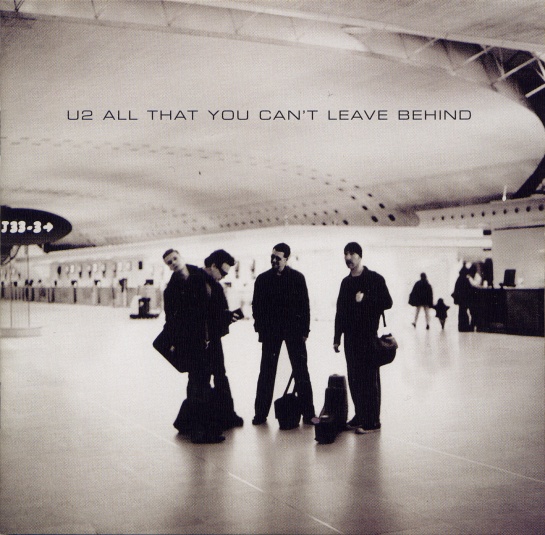
In "Unknown Caller," the protagonist finds himself "lost between the midnight and the dawning, in a place of no consequence or company." Then, at "3:33, the numbers fell off the clock face." This may be a veiled reference to the cover of the band's 2000 album All That You Can't Leave Behind, on which they had the display in the upper left altered to reference Jeremiah 33:3, which Bono calls calls "God's phone number."

Referring to the fact that we tend to kill those whom we admire ("Every artist is a cannibal, every poet is a thief. All kill their inspiration, then sing about the grief"), Bono sings in "Hold Me, Thrill me, Kiss Me, Kill Me":

They want you to be Jesus,
They're going down on one knee;
But they'll want their money back,
If you're alive at thirty-three.
And then, of course, it was "three o'clock in the morning," when "it was quiet with no one around," that the character portrayed in "Stay (Faraway, So Close)" heard "a bang and a clatter, as an angel hits the ground."
.
If you've got an interpretation, then by all means weigh in, because I haven't a clue....

Thursday, March 12, 2009

Let Them Eat Cake!

I like cake. But the thing is, I like to eat it, too.

Because of this tendency, I often shy away from arguments against Catholicism that take as their launching point the various abuses and aberrations of the church throughout the centuries, as if the Protestant's only problem with Rome is the occasionally opulent pope or abused altar boy. In other words, a robust Reformed argument against Rome would focus not only on what it became, but also on how it began.

If all we focus on are the incidentals, then is not this a tacit admission not only that the solution to Rome is not Protestantism but reformed Catholicism, but also that our entire ecclesiology is a convention arising post hoc, a reaction to biblical Christianity gone awry instead of a return biblical Christianity itself? Don't miss the import of what I'm saying: if we focus solely upon Rome's abuses, we are surrendering not only all exegesis, but also conceding that Jesus did in fact intend to found a visible church characterized by apostolic succession and Petrine primacy, but once that church messed things up, we came along with a bunch of new ideas about invisible churches and Sola Scriptura.

To put it bluntly, Protestants need to argue for Protestantism, not just against Catholicism, and we need to do it from Scripture, as if (gasp!) Jesus actually intended something akin to Reformed ecclesiology all along. Why would we be comfortable with anything less? I mean, what are we, Protestants or simply non-Catholics?

So let's not shoot ourselves in the foot by just settling for cake. Let's go the next step and demand to eat it, too.

Monday, March 09, 2009

Rationalists, Mormons, and the Validity of Folk History

After attending an excellent seminar on Saturday by Dr. Tracy McKenzie (Professor of U.S. History at the University of Washington, erstwhile opponent of Doug Wilson and his romanticized view of slavery, and member of the church I pastor) on the topic of "Thinking Christianly About History," I got to thinking....

Is there, or ought there to be, such a thing as folk history?

I guess what I'm asking is, What is the relationship between the actual events of the past and the lens of tradition through which we evaluate them? Take for an example the issue of the resurrection of Christ. No matter how many articles appear in Time or Newsweek quoting some scholar who claims to have discredited the doctrine, or some archaeologist who thinks he found the bones of Jesus, most Christians will not believe it. Our faith makes such claims highly suspicious.

The resurrection may not be the best example, though, since the event is recorded in Scripture. But what about the Johannine authorship of the fourth Gospel? Despite the fact that it is nowhere attested to in the New Testament itself, it is unlikely that any sincere Christian will come to reject it after reading some liberal scholar's arguments, no matter how well-reasoned.

Or, take the debate between Catholics and Protestants over the issue of the papacy. Because Catholic tradition states that Clement wrote to the Corinthians at the end of the first century exercising the authority belonging to the bishop of Rome, it really doesn't matter what contemporary historians may say to discredit the presence of a monarchical bishop in Rome in the first 150 years of church history. This is because the Catholic's lens of tradition functions more powerfully than does the testimony of some historian out there with an axe to grind (and I'm not faulting the Catholic for this, I'm just pointing it out).

So it seems to me that there are two distinct but related pitfalls to avoid as we seek to relate our faith to the study of the history on which it relies. On the one hand, we can accept the testimony of historians based solely on the merit of their research. On the other, we can cling to our story with such devotion that it becomes unfalsifiable.

If we adopt the former approach, what distinguishes us from rationalists? And if we choose the latter, how are we principally different from Mormons?

Friday, March 06, 2009

Finding Grace Inside a Sound

Following Scripture, Reformed theology has always placed great emphasis on the ear over the eye. The gospel is called by Paul "the word of faith," a message that produces belief "by hearing the Word of Christ." The opposite of faith, of course, is not doubt but sight. A person is most faithless, therefore, not when disbelief is mingled with his belief, but when he demands to see, to experience, to feel the truth before he'll believe it. "We walk by faith," says Paul, "and not by sight."

Go ahead and roll your eyes, but I maintain that Bono understands this. U2's music often elevates faith over sight as, for example, in 1987's "I Still Haven't Found What I'm Looking For," where Bono sings:

I believe in the Kingdom Come,
When all the colors will bleed into one,
But yes I'm still running.
You broke the bonds, you loosed the chains,
Carried the cross, and all my shame, all my shame;
You know I believe it,
But I still aven't found what I'm looking for.
On 2000's All That You Can't Leave Behind, Bono sings of the "grace that travels outside of karma," which, "when she goes to work, you can hear the strings." Get it? Grace is something you hear.

This theme is prevalent on their new release, No Line on the Horizon, as well. In the song "Moment of Surrender" Bono sings:
At the moment of surrender,
I folded to my knees;
I did not notice the passers-by,
And they did not notice me.

At the moment of surrender,
Of vision over visibility,
I did not notice the passers-by,
And they did not notice me.
True surrender, in other words, can only happen with "visibility" is relinquished.
.
In their lead single "Get On Your Boots," Bono repeats the line "Let me in the sound!" over and over (the same line is also sampled in "Fez - Being Born"). Lest we scratch our heads over what this "sound" is, the song "Breathe" tells us:

We are people borne of sound;
The songs are in our eyes,
Gonna wear them like a crown ...
I’ve found grace inside a sound,
I found grace, it’s all that I found;
And I can breathe,
Breathe now.
Remember, Newton told us that God's grace is not only "amazing," but that it's "the sound that saved a wretch like me." This is why ears are better than eyes, and why blindness is to be preferred over deafness.

Wednesday, March 04, 2009

Men at Work: Cool Band, Bad Theology

Continuing our look at Louis Bouyer’s The Spirit and Forms of Protestantism, we now turn specifically to the “negative principles” that, the author argues, constituted the Church’s real problems with the Reformation and precipitated her rejection of it.

Bouyer insists that sola gratia, sola fide (salvation by grace alone through faith alone) is perfectly within the pale of Catholic orthodoxy, and it is only when the Reformers waxed polemical that they got all negative and carried away.

The affirmation of sola fide is not content with excluding works in the Jewish sense or works done before faith is received or works done by the believer apart from the agency of faith in grace or even apart from this as the unique means giving man power to do good works. The Catholic faith could not do otherwise than take all these exclusions as its own and ratify them. [But] Luther, and Protestantism after him… declared that all possible and imaginable works are harmful, that faith itself has not to produce them for salvation, cannot, should not, do so.
Bouyer goes on to wonder at the fact that Protestants “attack the scholastic idea of faith ‘informed’ by charity, contrasted with faith without charity as living faith to dead.”

Setting aside for the moment Bouyer’s characterization of Protestantism as arguing that faith not only need not but indeed should not produce good works for salvation (a statement that is false on its face), I would like to offer a brief exegetical rebuttal to Bouyer’s claim that the Protestant Reformers went overboard on their negative statements about works.

According to Bouyer, there are four senses in which the Catholic may agree that works do not contribute to man’s acceptance by God. First, he admits Catholics agree with Protestants that “works in the Jewish sense” are inadmissible. I assume he means what some theologians call “Jewish boundary markers,” those works of the law such as circumcision and dietary restrictions that divided Jews from Gentiles. Second, Bouyer lists “works done before faith is received,” by which he most likely means the good deeds done by the unregenerate pagan before he is converted. Third are “works done by the believer apart from the agency of faith in grace.” I guess what Bouyer is referring to here are the Christian’s attempts to please God in the arm of the flesh. And the last kind of works that the Catholic would agree are useless for pleasing God is works “apart from this [Option 3] as the unique means giving man power to do good works.” I have no idea what Bouyer is talking about here.

So here’s my question: Which type of works was Peter referring to when he insisted at the Jerusalem council that Gentiles need not be circumcised since such practice would “place upon them a burden that neither we nor our fathers could bear?”

The option that seems most obvious at first is #1 (works in the Jewish sense), since the whole debate in Acts 15 was over Jewish boundary markers. But not so fast. If the Judaizers of Peter’s and Paul’s day were so meticulous about adhering to circumcision and dietary laws—even going above and beyond by fasting twice a week (Luke 18:12)—then how can Peter call these works an unbearable burden? They kept them, didn’t they? So what was the problem?

Paul says something similar in Gal. 3:10ff, arguing that the Galatians should not submit to circumcision for the specific reason that “all who rely on works of the law are under a curse.” Now this curse is obviously not solely due to failing to keep the Jewish ceremonies since, as we have seen, the Jews kept them scrupulously (I mean, how circumcised can a man be?). And the “works” Paul is referring to cannot be works done apart from faith or before receiving grace since he is holding up his own kinsman as his foil, arguing that even faithful, circumcised, ham-shunning Jews are under God’s curse.

The only answer that seems to make any sense of these passages is that circumcision binds a man to the entire law (Gal. 5:3) and that failure on just one point is tantamount to failure on all (Epistle of Straw 2:10). In fact, Paul says as much in the verse under consideration, quoting Lev. 18:5 to the effect that the Israelites were bound to perform “all things written in the Book of the Law.” That's the kind of works that curse: not the Jewish kind, the ceremonial kind, the prideful kind, or the faithless kind. All kinds.

The conclusion of all this, therefore, is that even faithful Christians, if they bring works of any kind into the justification equation (even ceremonial boundary markers), thereby bind themselves to a law whose only function this side of the fall is to curse, accuse and condemn.

Better, in my view, to affirm what Trent anathematizes, namely, that whatever good works we perform are but results of grace received and in no way contribute to God’s acceptance of us.

If I’m wrong, please show me how.

Monday, March 02, 2009

Which of the Seven Dwarfs Best Sums Up Protestantism?

Lutheran-turned-Catholic Louis Bouyer argues in his The Spirit and Forms of Protestantism that the expulsion of the Protestant Reformers from the Catholic Church was in no way a response to the "positive principles" of the Reformation such as Sola Gratia and the emphasis on divine sovereignty (principles which, according to Bouyer, had "the power to rejuvenate and restore traditional Christianity"). Instead, the Reformers were tossed out for "something else," namely, the unnecessary negative principles that were also insisted upon but were, Bouyer maintains, "so far from following from the principles already examined or from being necessarily implied by them or even useful or expedient."

The question that must be pondered, according to Bouyer, is not "If the positive principles of the Reformation are perfectly consistent with Catholic tradition, then why did the Church reject them?" but rather, "What was present in the Reformation that forced the Church to reject it despite its clearly orthodox positive principles?"

Before we look at the specific examples Bouyer cites, I'd like to examine his general claim. Is there a "mysterious fatality" resident within Protestantism that inevitably moves its adherents to attach a "negative significance" to its positive principles?

It's a good question.

Just answering the challenge in general terms, it seems necessary to insist that if A is true, then non-A must be equally false. That being said, however, is it absolutely necessary to say that if, say, the Bible is uniquely authoritative then the Church has no real authority beyond that which I attribute to it? Or is it inevitable that if salvation is a sovereign work of divine grace alone, and that works play no role in disposing God towards the sinner, that therefore all works are eliminated from the salvation equation altogether?

I guess what Bouyer is asking is, "Why do Protestants have to be so grumpy all the time?"